
Most homeowners shopping for solar assume the installer picks the right number of panels and that's that. The reality is more consequential. What is solar system sizing, exactly? It's the process of calculating how much solar capacity your home actually needs to match your energy consumption. Get it wrong, and you end up overpaying for capacity you don't use, or worse, producing far less power than expected and staying dependent on the grid. This guide breaks down every factor, formula, and decision involved in solar panel system sizing so you can evaluate any quote with confidence.
Table of Contents
- Key takeaways
- What solar system sizing actually means
- Core factors that influence solar system sizing
- How to size a solar system: the core calculation
- Grid-tied, off-grid, and hybrid: how system type changes sizing
- Common sizing pitfalls to avoid
- My take on why panel count is the wrong focus
- Get an independent review before you commit
- FAQ
Key takeaways
| Point | Details |
|---|---|
| Sizing is not just panel count | System size includes inverter rating, battery storage, and array capacity working together. |
| Daily kWh drives the math | Divide your daily energy use by peak sun hours to estimate the system size you need in kW. |
| Add a 20–25% loss margin | Real-world losses from shading, heat, and inverter inefficiency require a built-in performance buffer. |
| System type changes the sizing logic | Off-grid systems must be oversized with battery backup; grid-tied systems can be sized closer to actual use. |
| Future loads matter now | Adding an EV or heat pump later can quickly outpace an undersized system. |
What solar system sizing actually means
Solar system sizing explained simply: it's the process of determining the right capacity for your photovoltaic (PV) array so it produces enough energy to cover your household demand. The key word is capacity, and that requires understanding two separate measurements that installers sometimes blur together.
Kilowatts (kW) measure power. That's the size of your array at any given moment. Kilowatt-hours (kWh) measure energy produced over time. A 6 kW system running at full output for five hours produces 30 kWh. Sizing distinguishes system capacity (kW) from actual energy production (kWh) over time, and both numbers matter for different reasons.
The components involved in solar panel system sizing include:
- Solar panels: The array size in kW, determined by panel wattage multiplied by panel count
- Inverter: Converts DC power from panels to usable AC power; must be rated close to array output
- Battery storage: Optional for grid-tied systems, required for off-grid; sized in kWh based on autonomy needs
- Racking and wiring losses: Part of the efficiency margin built into the calculation
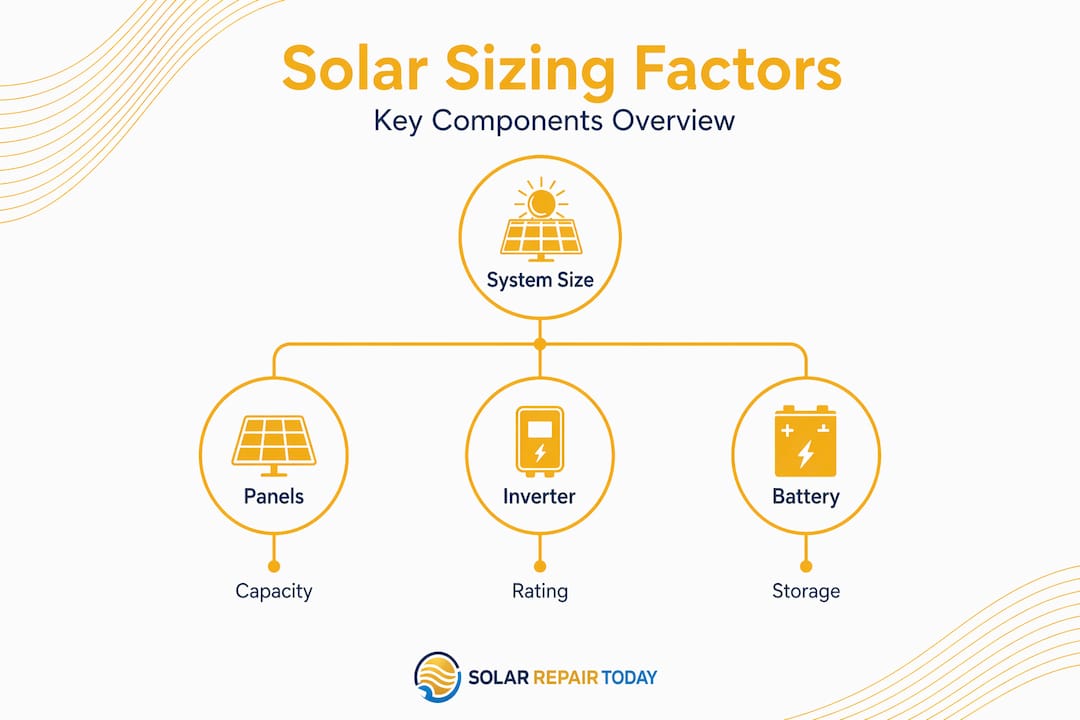
Sizing the whole system includes panel capacity, inverter rating, battery storage, and system balance for delivered power. That last point is where many homeowners and some installers go wrong. They treat system size as a panel count problem when it's actually a system balance problem.
Pro Tip: Ask any installer to show you the kW size of the proposed inverter alongside the kW size of the array. If the inverter is significantly undersized relative to the panels, the system will clip output during peak sun hours.
Core factors that influence solar system sizing
Solar system sizing factors vary by home, location, and goals. No two systems are identical. Here are the inputs that define the right size for your specific situation.
-
Household energy consumption. Pull your last 12 months of utility bills and calculate average monthly kWh. Most U.S. homes use roughly 900 kWh per month, but yours could be significantly higher or lower. Daily consumption is the base number for every sizing formula.
-
Peak sun hours at your location. Peak sun hours represent the equivalent number of hours per day your panels receive full 1,000 W/m² of sunlight. Phoenix averages about 6.5 peak sun hours daily. Seattle is closer to 3.5. Location alone can double or halve the number of panels you need. Location-specific solar yield models like PVGIS 5 use detailed irradiance and environmental data for more precise estimates than generic averages.
-
System losses and efficiency. No system performs at nameplate capacity in the real world. Real-world losses require a performance factor margin of 20 to 25% when calculating system size. Dust, heat, wiring resistance, and inverter conversion losses all add up.
-
Roof orientation, tilt, and shading. South-facing roofs at 30 to 35 degrees tilt in the northern hemisphere capture the most annual energy. Shade from a nearby tree or chimney can cut production from an entire string of panels, not just the shaded panel.
-
Future energy needs. Planned appliances like EVs and heat pumps influence sizing significantly. If you plan to buy an electric vehicle within five years, your electricity demand could increase by 3,000 to 5,000 kWh annually, enough to require several additional panels.
Pro Tip: Check your worst month of electricity use, not just the annual average. Sizing to your peak consumption month, typically January or July depending on your climate, prevents shortfalls when demand is highest.
How to size a solar system: the core calculation
Calculating solar system size breaks down into a repeatable process. Here's how to work through it.
-
Find your average daily energy use. Take your annual kWh from utility bills and divide by 365. If your home uses 12,000 kWh per year, your daily consumption is about 32.9 kWh.
-
Apply the basic sizing formula. Divide daily kWh by your location's average peak sun hours. The formula works as follows: system size (kW) equals daily energy use (kWh) divided by average peak sun hours. For 32.9 kWh divided by 5.5 peak sun hours, that's approximately a 6 kW system.
-
Add a loss margin. Multiply the result by 1.25 to account for the 25% inefficiency buffer recommended by solar engineers. That 6 kW system becomes 7.5 kW after the margin.
-
Convert to panel count. Divide system size in watts by the wattage of your chosen panel. Using 430W panels: 7,500W divided by 430W equals approximately 17 panels. The average U.S. home using 10,791 kWh annually typically needs 16 to 23 panels of 430W depending on location.
-
Check inverter and battery sizing. The inverter should match or slightly exceed your array's DC output. For battery storage, battery sizing requires distinguishing between kWh (storage capacity) and kW (power output), considering depth of discharge limits and how many hours of backup you need.
The table below illustrates how the same household gets a different result depending on location.
| Location | Daily kWh | Peak sun hours | Raw system size | After 25% margin | Approx. panel count (430W) |
|---|---|---|---|---|---|
| Phoenix, AZ | 33 kWh | 6.5 hrs | 5.1 kW | 6.4 kW | 15 panels |
| Denver, CO | 33 kWh | 5.5 hrs | 6.0 kW | 7.5 kW | 17 panels |
| Seattle, WA | 33 kWh | 3.5 hrs | 9.4 kW | 11.8 kW | 27 panels |
Same house. Three very different systems. That's why geographic location is one of the most consequential solar system sizing factors.
Grid-tied, off-grid, and hybrid: how system type changes sizing
System type changes the sizing math in ways most homeowners don't fully realize before signing a contract. Understanding solar system size requirements by system type prevents expensive miscalculations.
| System type | Grid reliance | Oversizing needed? | Battery required? | Sizing approach |
|---|---|---|---|---|
| Grid-tied | High | No | No | Size to offset target % of bill |
| Off-grid | None | Yes | Yes | Size for worst-month full autonomy |
| Hybrid | Partial | Often | Yes | Balance grid backup with storage goals |
Off-grid systems must cover all loads even at low-sun times, requiring larger capacity and substantial battery reserves. Grid-tied systems draw from the utility when panels fall short, so the array can be sized closer to average rather than worst-case demand.
A few factors specific to each type:
- Grid-tied: Net metering policies in your state determine how much value you get for excess production. Some utilities offer full retail credit; others offer significantly less. This directly affects whether sizing above 100% of your usage makes financial sense.
- Off-grid: Seasonality and worst-month sunlight variation heavily affect system sufficiency. Sizing based on summer averages will leave an off-grid home short in December.
- Hybrid: Battery sizing becomes a critical sub-calculation. A hybrid system sized for whole-home backup requires substantially more battery capacity than one designed for critical loads only.
Sizing decisions balance roof and budget constraints with energy goals and local utility policies. That balance looks different for every household.
Common sizing pitfalls to avoid
Even with a clear process, these mistakes appear in proposals regularly.
- Using online calculators as final answers. Online sizing tools are useful for quick estimates but cannot substitute detailed engineering design that accounts for roof layout, shading, and interconnection rules.
- Ignoring future load increases. Estimating future load changes is one of the hardest sizing inputs but critical for system longevity. If you're planning an EV, build that load into your sizing now.
- Accepting a system sized to past usage only. Sizing around 110 to 115% of annual usage is common practice to offset nearly all utility costs and compensate for performance dips.
- Skipping shading analysis. A single shaded panel in a series string can reduce output across the entire string. Proper shading analysis using tools like shade reports or optimizers is non-negotiable.
- Mismatched inverter sizing. An inverter rated too small clips output on sunny days. An inverter rated too large adds cost with no production benefit.
Pro Tip: Ask your installer to provide a shading analysis report and an annual production estimate in kWh, not just the system size in kW. The kWh estimate is what actually gets compared to your utility bill.
My take on why panel count is the wrong focus
I've reviewed hundreds of solar proposals, and the pattern is consistent. Homeowners walk in asking "how many panels do I need?" and installers answer that question. But the panel count is almost a side effect of a correctly designed system, not the goal itself.
The real sizing work is determining daily load, applying realistic peak sun hours, building in the loss margin, and then confirming the inverter and battery stack can actually deliver what the panels generate. I've seen 20-panel systems outperform 26-panel systems because the smaller system had a better-matched inverter and no shading issues.
What I've also found is that cost pressure leads to undersized systems more often than people realize. An installer trying to hit a price point may shave panels or select a smaller inverter. The homeowner saves a few thousand dollars upfront and then wonders why their bill didn't drop as expected. That's buyer's remorse with a five-figure price tag.
The other thing consistently underestimated is seasonality. Annual averages look fine on paper. December and January are where undersized systems expose themselves, especially in northern states. A site-specific design that models monthly production against monthly consumption is worth far more than a generic rule-of-thumb estimate.
If you're looking at a proposal and it doesn't show you monthly production estimates, that's a gap worth asking about before signing.
— David
Get an independent review before you commit
Solarrepairtoday.com built its "Before You Sign" intake program specifically for this stage in the process. You can submit your quote, utility bill, or full proposal for an independent review of system sizing, pricing, equipment, and financing. The service checks whether the proposed kW array and inverter pairing actually matches your consumption data, flags underesized designs, and identifies red flags in contract terms.
If battery backup is part of your quote, the battery proposal review service evaluates whether the storage capacity and power rating are sized for your actual backup needs. For full proposal review covering system size, equipment, and pricing, the solar proposal review service provides a line-by-line assessment. Homeowners who want to compare multiple quotes side by side can use the quote comparison service to evaluate sizing differences across bids.
FAQ
What does solar system sizing mean?
Solar system sizing is the process of calculating the right photovoltaic array capacity, measured in kilowatts, to meet a household's energy demand. It accounts for daily energy use, location-based peak sun hours, system losses, and component matching including the inverter and battery storage.
How many solar panels do I need for my home?
Panel count depends on your energy use, location, and panel wattage. The average U.S. home using approximately 10,791 kWh per year typically requires 16 to 23 panels rated at 430W, depending on geographic location and available roof space.
What is the basic formula for calculating solar system size?
Divide your average daily kWh consumption by your location's average peak sun hours to get the raw system size in kW. Then multiply by 1.25 to account for real-world losses. For example, 30 kWh per day divided by 5.5 peak sun hours equals 5.45 kW, or about 6.8 kW after the loss margin.
Does the type of solar system affect sizing?
Yes. Off-grid systems require oversizing and full battery backup to cover all loads without grid support, including during low-sun periods. Grid-tied systems can be sized closer to average demand since the utility provides backup power when panels fall short.
Why shouldn't I rely only on an online solar calculator?
Online calculators provide useful estimates but cannot account for roof-specific shading, panel layout constraints, local interconnection requirements, or inverter and battery compatibility. A detailed engineering assessment is needed before committing to a final system design.