

Most homeowners assume their solar panels will keep the lights on during a blackout. They won't. The role of battery backup in solar is precisely to solve this problem, and understanding it before you sign a contract could save you thousands in poorly sized equipment or missed savings. This guide covers why grid-tied panels shut down during outages, how battery backup restores that power, what it costs and saves, and how to size a system that actually fits your home.
Table of Contents
- Why solar panels don't work during power outages
- How battery backup works in a solar energy system
- Financial and practical benefits of adding battery backup
- Sizing and configuring your battery backup system effectively
- Using battery backup for outage management best practices
- Why battery backup is becoming the control center of modern solar homes
- Explore solar battery backup options tailored for your home
- Frequently asked questions
Key Takeaways
| Point | Details |
|---|---|
| Solar panels shut off during outages | Standard grid-tied solar systems turn off immediately when the power goes out for safety reasons. |
| Battery backup enables power during blackouts | Battery systems with hybrid inverters create a microgrid that lets your solar panels provide backup power. |
| Backup sizing differs from daily savings sizing | Sizing batteries for outage backup focuses on duration and essential loads, while daily savings focus on stored energy capacity. |
| Load management extends battery runtime | Conserving energy and avoiding heavy loads during outages can greatly prolong battery backup duration. |
| Financial benefits include bill savings and incentives | Battery storage reduces utility bills via time-of-use load shifting and may generate income through grid services. |
Why solar panels don't work during power outages
This is the most common source of confusion in solar sales. Your panels are generating electricity. The sun is shining. But your home is dark. Here is why.
Grid-tied solar systems shut down within 100 to 500 milliseconds of a grid outage. This is not a malfunction. It is a required safety feature under IEEE 1547, the standard that governs grid-connected solar. The reason: utility line workers responding to an outage could be electrocuted if your panels are still feeding power into downed lines.
Standard grid-tied inverters cannot operate independently. They need the grid's stable voltage and frequency (120V/60 Hz in the U.S.) as a reference signal to produce usable AC power. No grid signal, no power output.
To restore backup capability, you need two things:
- A hybrid inverter that can operate in both grid-tied and off-grid (island) mode
- A battery system that provides the stable voltage and frequency reference when the grid is gone
Together, they form a small local grid, often called a microgrid, that keeps your home powered without connecting to utility lines. You can learn more about battery backup basics to understand what a full system includes before you start evaluating proposals.
How battery backup works in a solar energy system
Once you add a hybrid inverter and battery, the system gains what is called islanding capability: the ability to disconnect from the grid and operate independently. Here is the sequence of events during an outage:
- Grid loss detected. The hybrid inverter detects the absence of the grid signal within milliseconds.
- Automatic transfer switch activates. The switch isolates your home from utility lines, preventing any backfeed to the grid.
- Battery takes over. The battery supplies power and creates a stable AC waveform that the inverter uses as a reference.
- Panels resume production. With the battery providing a stable frequency and voltage, solar panels continue charging the battery as long as sunlight is available.
- Critical load panel limits consumption. Power is routed only to pre-selected essential circuits, such as refrigerator, lighting, medical devices, and internet router.
- Load management prevents overload. The inverter monitors total draw and may shed non-essential loads to protect its output capacity.
The hybrid inverter function is central to this entire process. Not all inverters support islanding. String inverters without backup capability will not do this, regardless of whether a battery is present.
Pro Tip: When reviewing a solar proposal that includes battery backup, confirm the inverter model explicitly supports island mode. Some proposals include batteries paired with inverters that do not support backup operation at all, a configuration mismatch that renders the battery useless during outages.
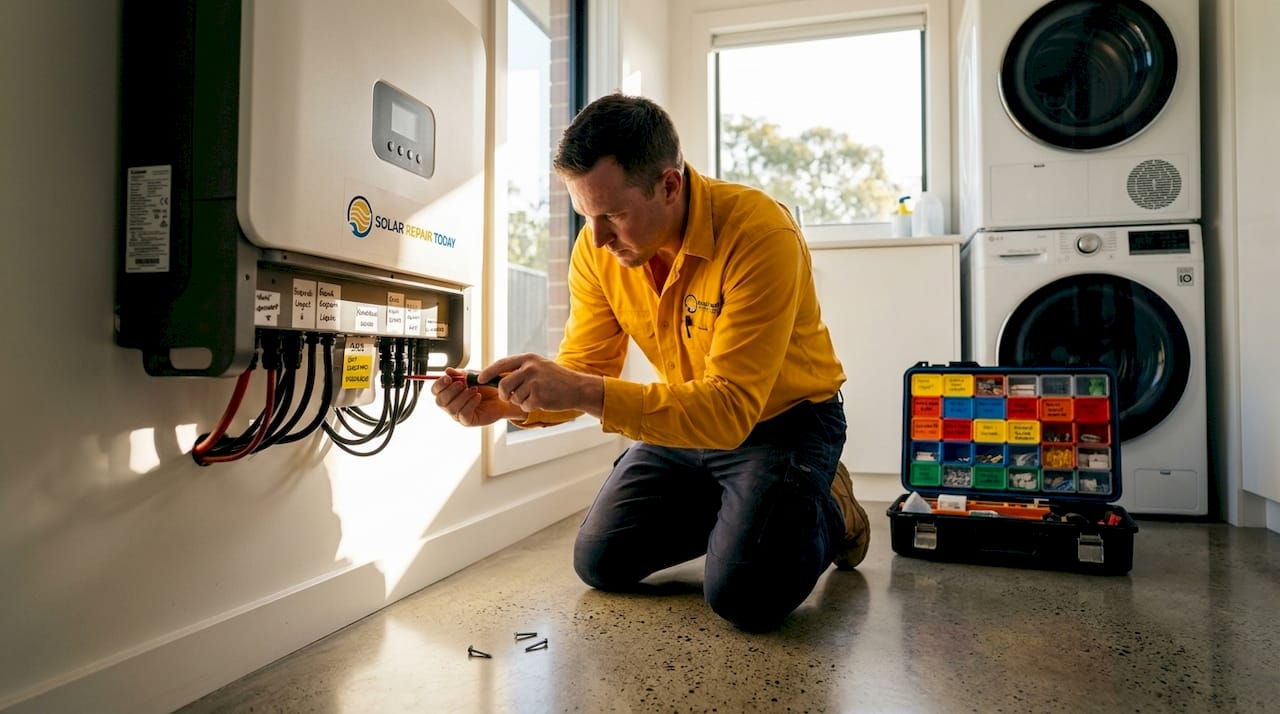
Reviewing your solar battery proposal details with a qualified second opinion can catch this type of error before installation.
Financial and practical benefits of adding battery backup
The importance of solar battery storage goes beyond keeping the lights on during outages. There are measurable financial benefits that apply every day, not just when the grid fails.
Key financial and practical benefits:
- Load shifting under time-of-use (TOU) rates. Utilities in states like California, Arizona, and Texas charge significantly more for electricity in the evening. A battery stores midday solar production and discharges it at peak rate hours, directly offsetting your highest-cost consumption. Battery storage with TOU rates can save $400 to $600 annually, plus over $1,000 in incentives through virtual power plant (VPP) programs.
- Increased self-consumption. Without a battery, excess solar production is exported to the grid, often at low net metering credit rates. A battery captures that energy for your own use, increasing the financial return on your panels.
- Virtual power plant participation. Programs offered by utilities and aggregators allow homeowners to earn revenue by letting the grid draw on their battery during peak demand events. This is real income, not just bill reduction.
- Federal tax credit applicability. Batteries installed with solar qualify for the 30% federal Investment Tax Credit (ITC). Understanding solar tax credit rules is critical before assuming this applies to your situation.
- Reduced outage disruption. For homeowners with medical equipment, home offices, or freezers full of food, even a 12-hour outage carries real financial and safety consequences that a battery directly prevents.
Battery prices have dropped significantly over the past five years. A system that cost $15,000 in 2020 can now often be installed for $10,000 to $12,000 before incentives. Pairing that with energy saving strategies reduces overall consumption and improves return on investment further. If your utility bill is already high, reducing it with storage is one of the most direct applications for a battery system.
Sizing and configuring your battery backup system effectively
This is where most homeowners get misled, often through no fault of their installer. The problem is that backup sizing and self-consumption sizing are two entirely different calculations with different goals. Mixing them produces a system that does neither job well.
Comparison: Backup sizing vs. self-consumption sizing
| Factor | Backup sizing | Self-consumption sizing |
|---|---|---|
| Primary goal | Cover essential loads during outages | Shift solar energy to reduce peak-rate bills |
| Key input | Critical load wattage x hours of coverage | Daily solar surplus vs. daily evening load |
| Battery reserve setting | High (80-100% reserve for emergencies) | Low (5-20% reserve to maximize daily cycling) |
| Typical capacity needed | 10-30+ kWh depending on loads | 5-15 kWh for most residential systems |
| Inverter sizing priority | Must handle surge loads (motors, HVAC) | Optimized for continuous daily discharge rate |
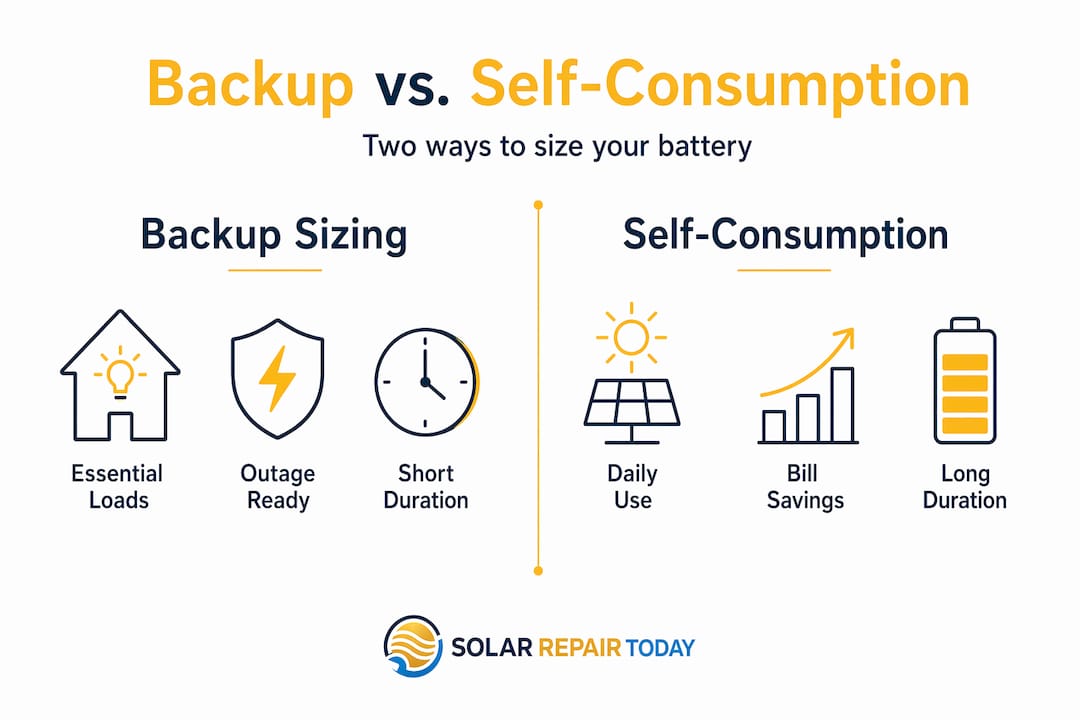
The two approaches require different reserve settings. Set backup reserve too high and your battery sits idle all day, missing daily savings. Set it too low and a sudden outage finds the battery mostly depleted.
Steps to size your system correctly:
- Perform a critical load audit. List every device you need during an outage and its wattage. Prioritize 120V devices; 240V loads like HVAC, electric water heaters, and EV chargers consume battery capacity very fast.
- Calculate daily critical load hours. Multiply critical wattage by desired backup hours. That gives you your minimum kWh target.
- Determine daily solar surplus. Compare your expected solar production to your daytime consumption. The surplus is what the battery captures for evening use.
- Choose a system sized for the larger requirement. In most cases, homeowners in outage-prone areas should size for backup first, then verify savings performance.
- Verify inverter surge capacity. Refrigerators and sump pumps draw 3 to 5 times their running wattage at startup. The inverter must handle that surge without tripping.
Pro Tip: CT clamp placement errors are one of the most common installation mistakes in battery systems. A misplaced current transformer causes the battery to charge and discharge based on incorrect load readings, resulting in poor performance and sometimes daily grid import charges the homeowner did not expect. Confirm your installer's plan in a battery sizing review before work begins.
Reviewing the solar proposal in detail with an independent expert is the most direct way to catch sizing mismatches before they become expensive corrections.
Using battery backup for outage management best practices
How you manage loads during an outage has as much impact on backup duration as battery capacity does. Conserving energy during an outage can quadruple your runtime. Turning off heavy 240V loads alone, such as central HVAC, electric dryers, and EV chargers, is the single highest-impact action you can take.
Practical steps to extend backup power:
- Power only critical 120V circuits: lighting, refrigerator, phone chargers, router, and medical devices
- Turn off or unplug all 240V appliances immediately when an outage begins
- Switch to LED lighting if you have not already; it uses 75% less power than incandescent
- Use your battery monitoring app to track state of charge and solar production in real time
- Shift any flexible loads, such as running the dishwasher or doing laundry, to hours when the sun is charging the battery
- Keep a dedicated circuit for communication devices; losing internet and phone during an extended outage compounds disruption
Pro Tip: Most battery apps allow you to set a storm mode or backup reserve increase before a predicted outage event. If severe weather is forecast, manually raise your reserve setting 24 hours in advance to ensure the battery enters the outage fully charged.
Good practical backup management is as much about behavioral habits as system design. A well-sized battery managed poorly will underperform a smaller battery managed well.
Why battery backup is becoming the control center of modern solar homes
The traditional framing of battery storage is emergency power. That framing is outdated. Batteries now act as the control center of solar homes, balancing generation with dynamic demand and providing grid services. Their value depends heavily on local utility policy and export credit gaps. That last point is the one most homeowners miss.
In states with reduced net metering rates, the financial case for batteries has strengthened substantially. The shift from full retail net metering to avoided-cost rates in California under NEM 3.0, for example, made battery storage nearly mandatory for a positive return on solar investment. That policy reality does not exist everywhere, but the trend is moving in that direction nationwide.
What this means practically: the solar battery system role in your home is not static. A battery purchased today for emergency backup may generate daily savings tomorrow as utility rate structures evolve. Homeowners who evaluate batteries only as backup devices tend to undersize them and miss the grid-service revenue potential.
There is also a configuration reality that sales proposals rarely address clearly: combining a battery with a generator produces better resilience than either alone, and often at lower total cost than a larger battery array. The generator handles extended multi-day outages; the battery handles the transition, daily savings, and short outages. This hybrid approach is frequently overlooked.
The expectation of whole-home backup from a single 13.5 kWh battery is one of the most persistent mismatches between what homeowners expect and what the system delivers. A single battery cannot run central HVAC, an electric range, and an electric water heater simultaneously. Proper education on load limits before signing prevents costly surprises after installation.
Explore solar battery backup options tailored for your home
Before committing to a battery system, an independent review of your proposal is one of the most cost-effective steps you can take.

SolarRepairToday.com offers a structured intake review through the Before You Sign program. Submit your solar or solar battery proposal and receive an independent assessment covering equipment selection, system sizing, inverter compatibility, backup configuration, and pricing fairness. The review also covers financing terms, including loan rates, escalators, and total cost of ownership. For homeowners evaluating battery backup configurations, this service identifies mismatches and red flags before they become post-installation problems.
Frequently asked questions
Can solar panels power my home during a blackout without a battery?
No. Grid-tied solar shuts down within 100 to 500 milliseconds during outages for line worker safety, so a battery system with islanding capability is required to maintain power.
How long does a typical home battery backup last during an outage?
Duration depends on battery size and load management. A 13.5 kWh battery can power critical loads for approximately 32 hours or a whole home for roughly 10 to 12 hours with active load management.
What are the financial benefits of installing a battery with my solar system?
Batteries enable load shifting under time-of-use rates, with annual savings of $400 to $600 on energy bills plus potential earnings over $1,000 annually through virtual power plant program participation.
How does load management affect my battery backup performance?
Turning off heavy 240V appliances during an outage is the most impactful step a homeowner can take. Proper load conservation can quadruple battery runtime compared to running loads without restriction.
What should I consider when sizing my battery backup system?
Treat backup sizing and self-consumption sizing as separate calculations. Conduct a critical load audit for outage coverage, then evaluate daily solar surplus for bill savings. Backup sizing requirements are based on outage duration and essential device load, which is a distinct method from sizing for daily energy optimization.