

Solar quotes can run 15 to 30 pages, yet most homeowners still walk away unsure what they're actually paying for. Installers bundle charges differently, use varying terminology, and sometimes leave out critical line items entirely. The result: surprise costs after you've already signed. This article breaks down every component that typically appears in a residential solar installation cost, explains what each one covers, and shows you exactly what to ask before you commit to any contract.
Table of Contents
- Breaking down the major cost components
- Equipment: Panels, inverters, and more
- Labor, permitting, and soft costs explained
- How to compare and verify what's included in your quote
- Why most homeowners underestimate solar installation costs
- Get expert help reviewing your solar installation costs
- Frequently asked questions
Key Takeaways
| Point | Details |
|---|---|
| Request itemization | Ask for every cost item—equipment, labor, soft costs—to be listed in your quote. |
| Soft costs matter | Permitting, inspections, and utility fees are real and can add significantly to total price. |
| Compare apples to apples | Line up competing quotes category-by-category to truly understand and negotiate. |
| Don’t skip the fine print | Bundled quotes can hide costs; if you don’t see it on the line-item list, ask about it. |
Breaking down the major cost components
With confusion rampant, let's break down where your money actually goes.
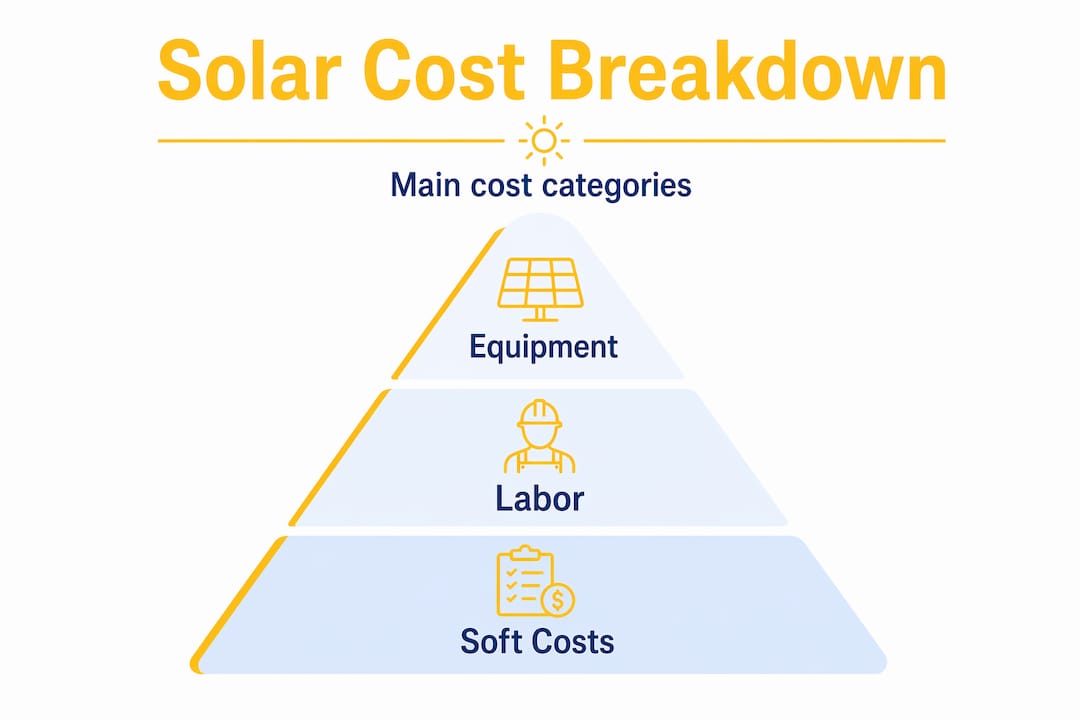
Solar installation costs fall into three main buckets: equipment, installation labor, and soft costs. Understanding these categories is the foundation for reading any quote accurately. When you know the buckets, you can immediately spot what's missing.
Here's what each category covers at a high level:
- Equipment: Solar panels, inverters, racking hardware, wiring, and optional battery storage systems.
- Installation labor: The direct cost of the crew that physically installs your system on your roof and connects it to your electrical panel.
- Soft costs: Everything else required to legally and operationally complete your project, including system design, permits, inspections, and utility interconnection approval.
Reviewing your solar proposal with this framework in mind makes it much easier to identify gaps. A quote that lists only a total project price gives you no way to verify whether any of these categories are actually covered.
According to Palmetto's guidance on what to expect in a solar quote, you should require itemization that shows equipment (panels, inverters, racking, and wiring), installation labor, and soft costs (design, permits, inspections, and utility interconnection). That level of detail is not optional. It's the baseline standard for any credible quote.
"A lump-sum quote is not a quote. It's a number. Demand line items before you sign anything."
Pro Tip: If an installer refuses to provide an itemized breakdown, treat that as a red flag. Legitimate companies can always show you where your money goes.
One reason understanding solar cost line items matters so much is that bundling practices vary widely. One installer may include permit fees in their base price. Another may list them separately or not mention them at all. Without itemization, you can't make a fair comparison between quotes, and you can't catch what's been left out.
Equipment: Panels, inverters, and more
Once you know the big buckets, let's dive deeper into the most visible part: the equipment.
Equipment is typically the largest single cost in a solar installation. It's also the area where homeowners have the most visibility, since brand names and panel specifications are easy to research. But the full equipment picture goes well beyond just the panels themselves.
The core hardware components in a standard residential solar installation include:
- Solar panels: The photovoltaic (PV) modules that convert sunlight into direct current (DC) electricity. Panel brand, efficiency rating, and wattage all affect price.
- Inverters: Devices that convert DC electricity from your panels into alternating current (AC) electricity your home can use. String inverters are the most common and least expensive. Microinverters and power optimizers cost more but improve performance in shaded conditions.
- Racking and mounting hardware: The structural framework that attaches your panels to your roof. Material quality and roof compatibility affect both price and durability.
- Wiring and electrical balance of system (BOS): All the conduit, wiring, junction boxes, disconnect switches, and monitoring equipment required to connect your panels to your home's electrical system.
- Battery storage (optional): Systems like home battery backup add significant cost but provide energy independence during outages.
As confirmed in what to expect in a solar quote, equipment includes solar panels, inverters, racking, and wiring/electrical balance of system. Each of these line items should appear separately in your quote with associated costs.
| Equipment component | Typical cost range (residential) | Notes |
|---|---|---|
| Solar panels | $0.40 to $0.80 per watt | Varies by brand and efficiency tier |
| String inverter | $1,000 to $2,500 | Lower cost, standard performance |
| Microinverters | $1,000 to $3,000+ | Higher cost, better shading tolerance |
| Racking and mounting | $500 to $1,500 | Roof type affects complexity |
| Wiring and BOS | $500 to $2,000 | Includes conduit, disconnects, monitoring |
| Battery storage | $8,000 to $15,000+ | Optional; significant add-on cost |
When analyzing solar battery quotes, pay close attention to whether battery costs are bundled into the system price or listed separately. Bundled battery pricing often obscures the true cost of each component and makes it harder to evaluate whether the battery is appropriately sized for your home's needs.
Also ask about solar hardware coverage for each component. Panel warranties, inverter warranties, and workmanship warranties are separate documents with different terms. A quote that doesn't address warranty coverage for each piece of equipment is incomplete.
Labor, permitting, and soft costs explained
Hardware is only half the picture. Let's explore the essential labor and compliance costs that come with going solar.

Soft costs are the most misunderstood part of any solar installation quote. They're also the category most likely to be bundled, minimized, or omitted entirely in a first-pass quote. In reality, soft costs now represent a significant portion of total residential solar project expenses in the United States, often accounting for 25 to 35 percent of the total installed cost.
Here's a breakdown of the major soft cost categories:
- System design: An engineer or certified designer sizes your system based on your energy usage, roof orientation, shading analysis, and local utility requirements. This work has real cost and should appear in your quote.
- Permits: Most local jurisdictions require a building permit before any solar installation begins. Permit fees vary widely by location, from under $100 in some areas to over $500 in others.
- Inspections: After installation, a local inspector typically must verify the work before your system can be turned on. Inspection scheduling can also affect your project timeline.
- Utility interconnection: Before your system can feed electricity back to the grid or operate under net metering, your utility company must approve the connection. This process involves paperwork, fees, and waiting periods that vary by utility and state.
- Sales and project management overhead: Some installers include sales commissions, customer service costs, and project coordination fees in their soft costs. These are legitimate business expenses, but you should know they're there.
Per Palmetto's breakdown, soft costs include design, permits and inspections, and utility interconnection. All three should be explicitly listed in your quote.
"Utility interconnection is not a formality. It's a process that takes time and sometimes costs money. Know what your installer is doing to manage it."
Pro Tip: Ask your installer for a timeline estimate for each soft cost phase. Permit delays and utility interconnection backlogs are common causes of project overruns. If your installer can't give you a realistic timeline, that's worth noting before you sign.
Understanding the utility approval process is especially important if you're counting on a specific activation date. Some utilities take weeks or even months to process interconnection applications, and that delay affects when you start saving money on your electric bill.
Labor costs cover the physical installation crew. This includes the time required to mount racking, install panels, run wiring, connect the inverter, and complete the electrical work at your main panel. Labor rates vary by region and company size. In high cost-of-living markets, labor can run significantly higher than the national average. A detailed quote should list labor as a separate line item, not buried inside a bundled project total.
How to compare and verify what's included in your quote
With a clear understanding of cost components, here's how to make sure your quote covers everything that matters.
Getting multiple solar quotes is standard advice. But comparing quotes accurately requires a structured approach. Two quotes for the same home can look very different on paper even when they cover the same scope of work, simply because installers present costs differently.
Follow these steps to verify and compare quotes effectively:
- Request itemized quotes from every installer. Never accept a single-line project total. Ask specifically for equipment costs broken out by component, labor listed separately, and all soft costs itemized.
- Map each quote to the three main categories. Create a simple grid: equipment, labor, and soft costs. Place each line item from each quote into the appropriate column. This immediately reveals what's missing from any given quote.
- Check for omissions. If one quote doesn't list permit fees and another does, that's not a pricing difference. It's a scope difference. You need to know whether the cheaper quote actually includes the same work.
- Verify equipment specifications. Panel model numbers, inverter brands, and battery specs should be listed explicitly. A quote that says "high-efficiency panels" without a model number is not giving you enough information to compare.
- Confirm warranty terms for each component. Equipment warranties and workmanship warranties should be documented in the quote or accompanying materials.
As EcoFlow's guide on comparing solar quotes confirms, the consistent way to verify is to compare the line items that map to equipment, labor and fieldwork, and permitting and interconnection. That three-column framework is the most reliable tool for apples-to-apples comparison.
| Quote element | Installer A | Installer B | Installer C |
|---|---|---|---|
| Panel brand and model | Listed | Listed | "Premium panels" only |
| Inverter type and brand | Listed | Listed | Not listed |
| Racking hardware | Listed | Bundled | Not listed |
| Labor (separate line) | Yes | No | No |
| Permit fees | Included | Not listed | Included |
| Utility interconnection | Included | Not listed | Not listed |
| Battery storage | Not included | Included | Not listed |
This type of side-by-side comparison makes it immediately clear that Installer C's quote is incomplete. Comparing solar quotes this way also gives you leverage in negotiations. If Installer A includes everything and Installer B doesn't, you can ask Installer B to match the scope before you evaluate price.
Before signing anything, consider getting a second opinion on solar from an independent reviewer. A professional review can catch gaps, flag overpriced components, and confirm that the system is appropriately sized for your home.
Why most homeowners underestimate solar installation costs
Now that you know what should be included, let's talk about why so many homeowners get caught off guard.
The most common pattern: a homeowner receives a quote, focuses on the total price and the monthly payment, and signs without fully understanding what's included. Weeks later, they discover that permit fees weren't included, or that the inverter brand is lower quality than they assumed, or that the battery they thought was part of the deal is actually an optional add-on at a separate cost.
This happens for several reasons.
First, installers sometimes use bundled pricing intentionally. When costs are grouped together, it's harder for you to evaluate whether each component is fairly priced. As EcoFlow's analysis notes, cost components can be bundled differently across installers and quote types, so what the installation cost includes may vary significantly from one company to the next.
Second, homeowners naturally focus on the most visible elements. Panels are tangible. Labor, permits, and utility interconnection are abstract. So the abstract costs get less scrutiny, even though they can add thousands of dollars to the total.
Third, sales pressure is real. Many solar sales processes are designed to move quickly. Limited-time pricing, same-day signing bonuses, and urgency tactics all reduce the time you have to ask detailed questions. When you're being pushed to decide fast, it's harder to slow down and demand full transparency.
The practical takeaway: slow down. A reputable installer will give you time to review your quote in detail. If you're being pressured to sign before you've had a chance to verify every line item, that pressure itself is a reason to pause.
Explore the full range of solar services available to homeowners who want independent support before committing to a contract. Getting clarity now is far less costly than resolving disputes after installation.
Get expert help reviewing your solar installation costs
Understanding cost components is one thing. Verifying that your specific quote is accurate, complete, and fairly priced is another.
SolarRepairToday.com offers independent solar proposal review services built specifically for homeowners at this stage of the process. Through the Before You Sign intake program, you can submit your quote, utility bill, or project details for a professional review covering pricing, equipment, financing terms, system sizing, battery options, and potential red flags. If you've received multiple quotes and aren't sure how to compare solar quotes accurately, the review process walks through each line item with you. No guesswork. No pressure. Just a clear, independent assessment before you commit.
Frequently asked questions
Do solar quotes usually include all permits and inspections?
Most reputable solar quotes include permitting and inspection fees, but this is not universal. Always confirm that permits and inspections are listed as explicit line items in your quote before signing.
Are utility interconnection fees part of the standard installation price?
Not always. Utility interconnection is a soft cost that must be clarified directly with your installer. Ask whether it's included in the quoted price or billed separately after project completion.
Why do installation costs vary so much between companies?
Solar costs vary because equipment choices, labor rates, regional permitting requirements, and quote bundling practices all differ by company and location. As EcoFlow confirms, cost components can be bundled differently across installers, making direct price comparisons unreliable without itemized quotes.
Can I negotiate or remove any costs from my solar quote?
Yes. Non-essential upgrades, bundled monitoring services, and certain add-ons are often negotiable. Ask your installer to provide a quote with and without specific line items so you can evaluate each cost independently.
Does the installation cost cover maintenance or support after install?
Standard installation costs do not typically include ongoing maintenance. Ask your installer specifically about post-installation support, service call policies, and what each warranty covers before you sign the contract.