

Most homeowners sign a solar contract without fully understanding what they are agreeing to. The document looks straightforward, but what does a solar contract include beyond the system specs and price? The reality is that a typical solar agreement spans 20 to 25 years, covers warranties, financial obligations, legal provisions, and maintenance responsibilities. Each clause carries real consequences. Missing even one can cost thousands of dollars or complicate a future home sale. This guide breaks down the core components, important contract clauses, contract types, and the red flags you need to catch before you sign.
Table of Contents
- Key takeaways
- What a solar contract includes: core components
- Important solar contract clauses you must know
- Comparing solar contract types
- Red flags to catch before signing
- My perspective on solar contract review
- Get a professional review before you sign
- FAQ
Key takeaways
| Point | Details |
|---|---|
| Contracts run 20 to 25 years | Solar agreements are long-term commitments that can exceed $35,000 in total cost for a typical home. |
| Escalator clauses increase cost | Annual price escalators between 1% and 5% compound over the contract life and significantly impact total payments. |
| Disputes come from contract language | Homeowner disputes arise from unclear clauses, not equipment failure, making careful reading critical. |
| Contract type determines ownership | Purchase, lease, and PPA agreements carry different ownership rights, maintenance obligations, and resale implications. |
| Integration clause voids verbal promises | Any commitment not written into the signed contract has no legal standing under the integration clause. |
What a solar contract includes: core components
Every solar contract, regardless of whether you are buying, leasing, or entering a power purchase agreement, contains a set of foundational elements. Knowing what to look for before you sit down with an installer separates informed homeowners from those who sign without full clarity.
System specifications are the technical core of the agreement. The contract must list the number of solar panels, their wattage and model, the inverter type, and whether a battery storage system is included. Vague language like "panels equivalent to 300W" is not enough. Exact model numbers and equipment brands belong in writing. If your installer is recommending battery backup, confirm those details are in the contract and not just on a verbal quote.
Installation details cover timeline, permits, and utility interconnection. The physical installation of a residential solar system typically takes 1 to 3 days, but permits and utility approvals can take weeks or months. Your contract should define who handles permit applications, what happens if there are delays, and when the system is considered officially commissioned.
Financial terms include the total system price, payment schedule, applicable incentives, and any financing fees. A clear breakdown of installation costs prevents disputes at project completion. Watch whether tax credit eligibility is factored into the quoted price or listed separately. The federal solar tax credit is commonly misrepresented in proposals.
Key financial elements to confirm in the contract:
- Total cash price or financed amount
- Payment schedule with defined milestones
- Applicable incentives or rebates and who receives them
- Annual rate escalator percentage, if applicable
- Any dealer fees or origination fees added to financing
Energy production estimates should appear as projected annual kilowatt-hour output, not just a dollar savings figure. Estimates based on your utility bill, roof orientation, and local solar irradiance data are reasonable. Guarantees are a different matter and are covered in the next section.
Warranty coverage includes both equipment warranties and workmanship guarantees. Reputable installers provide workmanship warranties covering 25 years. Panel manufacturers typically warrant output at 80% or better over 25 years. Your contract should specify which warranties are backed by the installer versus the manufacturer, and what the claims process looks like. For detailed warranty expectations, Solarrepairtoday covers solar warranty specifics worth reviewing.

Pro Tip: Ask your installer to attach all warranty documents as exhibits to the signed contract. Verbal references to warranty coverage carry no legal weight once the integration clause applies.
Important solar contract clauses you must know
Understanding the specific clauses in your agreement is how you avoid disputes years down the road. Disputes rarely stem from equipment failure. They come from contract language that was unclear or unread at signing.
Contract length and start date. Most residential solar contracts run 20 to 25 years. The start date matters because it determines when escalator rates begin, when warranties are measured from, and when buyout options become available.
Annual price escalator. In lease and PPA agreements, SPPA terms range from 6 to 25 years and typically include an annual escalator between 1% and 5%. Over 20 years, a 3% annual escalator adds up significantly. Run the numbers before assuming the agreement saves money long-term.
Roof maintenance and damage responsibilities. Your contract should clarify who pays for roof repairs if panels need to be removed and reinstalled. If the installer installs the system and later a shingle issue requires panel removal, that labor can cost thousands of dollars. Confirm responsibility is written into the agreement.
Production guarantees versus estimates. A production guarantee means the company owes you compensation if output falls below the stated threshold. An estimate carries no such obligation. Many contracts use estimate language while salespeople describe it as a guarantee. Know the difference.
Transfer provisions. If you sell your home, what happens to the solar agreement? Lease and PPA contracts typically require either a transfer to the new buyer or a buyout. Some buyers are deterred by inherited solar agreements. Confirm transfer terms in writing before signing.
"Integration clauses are one of the most legally significant and least-discussed parts of a solar agreement. Anything a salesperson promises verbally that is not written into the signed contract is legally void." This is not a technicality. It is the rule that governs disputes.
Buyout and cancellation options. Many contracts include a fixed-price buyout option at specified intervals. Cancellation before that window often triggers penalties. Read the early termination section carefully and calculate the cost before assuming flexibility exists.
Mandatory arbitration clauses. Arbitration clauses prevent class actions and require private dispute resolution, which limits your leverage significantly. If a systemic problem affects many homeowners, arbitration means you cannot join a collective legal action against the company.
Comparing solar contract types
Not all solar contracts are structured the same way. The three primary contract types are outright purchase, solar lease, and power purchase agreement. Each carries different financial and legal implications.
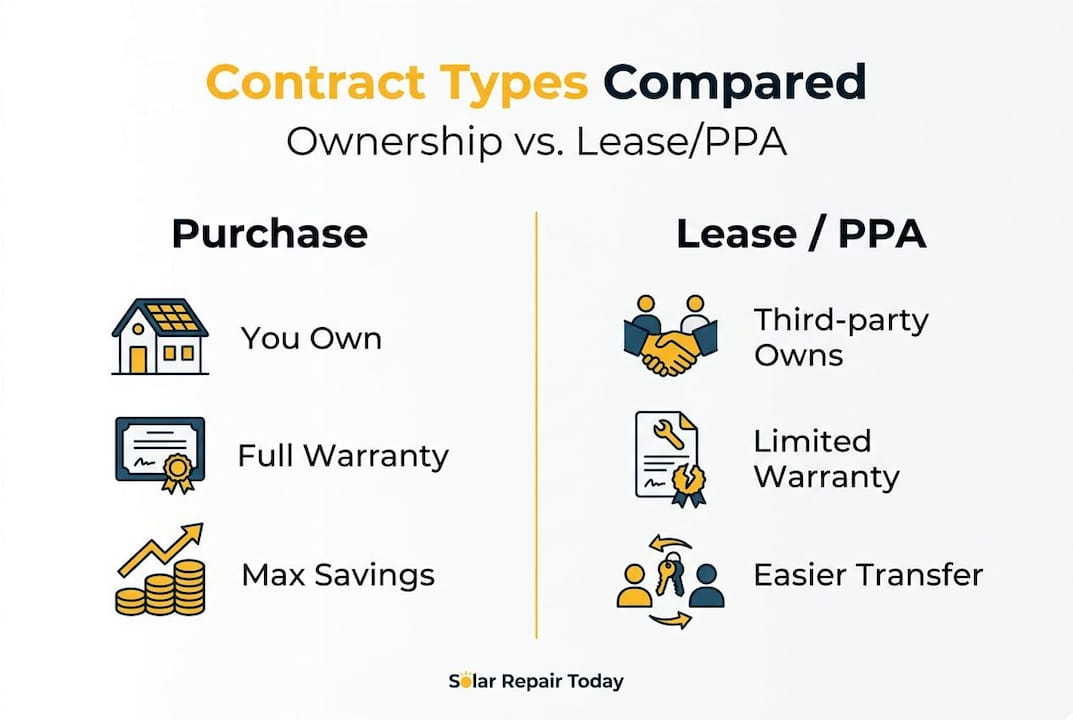
| Contract type | Ownership | Maintenance responsibility | Home resale impact | Long-term savings |
|---|---|---|---|---|
| Purchase (cash or loan) | Homeowner owns system | Homeowner responsible | Increases home value | Highest potential savings |
| Solar lease | Provider owns system | Provider responsible | Requires transfer or buyout | Moderate, fixed monthly cost |
| PPA (power purchase agreement) | Provider owns and maintains system | Provider responsible | Requires transfer or buyout | Variable, depends on escalator |
A purchased system gives you full ownership, access to all tax credits, and the clearest path to long-term savings. A solar lease means paying a fixed monthly amount to use the system, with the provider handling maintenance. A PPA means you buy the electricity output at a set rate, not the system itself.
Knowing the difference between owning and leasing your system avoids unexpected limitations on resale and maintenance. This is not a minor distinction. It determines whether the federal tax credit applies, who files warranty claims, and how your mortgage lender views the installation.
Pro Tip: If you are financing a purchase, get a copy of the loan agreement separately from the installation contract. Dealer fees and origination fees are sometimes embedded in the loan principal without clear disclosure, which may violate Truth in Lending disclosures.
Red flags to catch before signing
Knowing what to expect in a solar contract is valuable. Knowing what should not be there is equally important. These are the most common red flags found in residential solar agreements.
-
Undisclosed dealer or origination fees. These fees increase the total amount financed without appearing as a transparent line item. They can breach federal lending disclosure requirements. Ask for an itemized breakdown of all financing costs before signing.
-
Mandatory arbitration with no opt-out. Arbitration clauses limit your legal options. Some contracts allow you to opt out within a defined window. Look for that option immediately.
-
Vague or missing warranty language. If the contract does not specify who backs the workmanship warranty, the duration, or the claims process, that is a material gap. Push for clear terms or walk away.
-
Escalating rates without a cap. An uncapped 5% annual escalator over 25 years produces a dramatically different financial outcome than a 2% capped rate. Model both scenarios before signing.
-
No written transfer or cancellation terms. If the contract is silent on what happens when you sell your home or want to exit early, you are accepting unknown obligations.
-
Verbal promises not documented in the contract. The integration clause legally voids any verbal commitment not written into the agreement. If a salesperson promises a specific savings amount, system performance level, or service commitment, get it in writing before signing.
Before signing any agreement, send the contract to an independent reviewer. An independent review by essential questions to ask that stage can prevent disputes that play out over years.
The FTC received over 7,000 solar fraud complaints in 2025 alone, most tied to contract term misrepresentation. That is not a fringe problem. It reflects how commonly contracts are misrepresented at the point of sale.
My perspective on solar contract review
I've reviewed hundreds of solar contracts, and the pattern is consistent. Homeowners focus on the monthly payment and the estimated savings figure. They skim past the escalator clause, the arbitration provision, and the integration clause. Then, three years later, they are surprised by a bill increase they technically agreed to.
What I've found is that most installers are not acting in bad faith. But the contracts they use are written by legal teams optimized to protect the company, not the homeowner. That is not unusual in any industry. What is unusual about solar is the 25-year commitment attached to a transaction most homeowners complete only once.
The single most overlooked element, in my experience, is the transfer provision. Homeowners assume they can hand off the contract cleanly when they sell. The reality is that a prospective buyer seeing a 15-year lease remainder on a solar system often walks away from the deal, or negotiates a reduced offer. That risk is almost never discussed at the sales stage.
My take: treat the solar contract review the same way you would treat a mortgage review. You would not close on a home without reading the loan documents. A 25-year solar agreement with a total exposure over $35,000 deserves the same scrutiny. If you are not sure what you are looking at, get an independent check before you sign.
— David
Get a professional review before you sign
Understanding solar contract terms on your own takes time and legal literacy most homeowners do not have readily available. Solarrepairtoday built the "Before You Sign" intake program specifically for this situation. You submit your proposal, quote, utility bill, or full contract, and the team conducts an independent review covering pricing, equipment specifications, financing structure, system sizing, and potential red flags.
The solar contract financing review is especially useful for homeowners being offered loans with built-in dealer fees or financing through an installer-affiliated lender. The review identifies whether the financing terms are competitive and whether any disclosure issues exist. You can also request a solar proposal review for a complete evaluation of the full package before committing.
One review before signing is far less expensive than a dispute after the fact.
FAQ
What does a solar contract typically include?
A solar contract includes system specifications, installation timeline, financial terms, energy production estimates, warranty coverage, and legal provisions such as arbitration and integration clauses. The exact contents vary by contract type: purchase, lease, or PPA.
How long do residential solar contracts last?
Most residential solar contracts run 20 to 25 years. Lease and PPA agreements commonly fall within this range, with some shorter-term options starting around 6 years depending on the provider and financing structure.
What is an integration clause in a solar contract?
An integration clause means the signed contract is the complete agreement between both parties. Any verbal promise not written into the contract has no legal standing, which makes it critical to document all commitments in writing before signing.
What is a solar price escalator clause?
A price escalator clause in a solar lease or PPA agreement increases the rate you pay annually, typically between 1% and 5%. Over a 20 to 25-year contract term, even a modest escalator significantly increases total cost compared to the initial rate.
Can I transfer my solar contract if I sell my home?
Transfer provisions vary by contract. Most lease and PPA agreements allow transfer to the new buyer, but that buyer must qualify and agree to the terms. Some agreements require a buyout instead. Confirm transfer terms before signing to avoid complications at the time of sale.