

Signing a solar contract without independent verification is one of the most common and costly mistakes homeowners make. Understanding how solar third-party review helps is the difference between a well-priced system that performs as promised and a 25-year financial commitment built on assumptions. Most proposals look convincing on the surface. But installer-provided numbers, savings projections, and contract language are not impartial. They are designed to close deals. An independent review changes that equation entirely, giving you a fact-based second opinion before you commit to anything.
Table of Contents
- Key Takeaways
- How solar third-party review helps: definitions and key roles
- Common gaps in solar proposals without review
- How reviews safeguard your solar investment
- Real-world examples of review benefits
- How to apply third-party reviews in your process
- My perspective on third-party solar reviews
- Get an expert review before you commit
- FAQ
Key Takeaways
| Point | Details |
|---|---|
| Proposals contain unverified assumptions | Savings estimates, incentive eligibility, and interconnection costs are often optimistic and need independent validation. |
| Contract language requires scrutiny | Third-party ownership models like leases and PPAs carry financial terms that independent review can clarify before signing. |
| Commissioning catches installation faults | Independent post-installation checks verify system performance and create documentation for future warranty claims. |
| Permit errors delay projects | Checklist mismatches in permit submissions lead to rejections that a pre-submission review can prevent. |
| Reviews save money long term | Upfront review costs are minor compared to the financial exposure from undiscovered contract or installation problems. |
How solar third-party review helps: definitions and key roles
A solar third-party review is an independent assessment of your solar proposal, contract, or installation conducted by a qualified reviewer with no financial stake in your decision. The reviewer is not your installer. They are not your utility. They have one job: to give you an accurate, unbiased read of what you are being offered.
There are three primary types of third-party solar assessments homeowners should understand:
- Proposal review. An independent expert examines your installer's quote for pricing accuracy, equipment specifications, system sizing, financial assumptions, and incentive eligibility. This is the most common entry point for homeowners.
- Contract and financing review. Covers the legal and financial terms in your agreement. This is especially relevant for third-party ownership models like leases and power purchase agreements (PPAs), where the installer or a financing company retains ownership of the system.
- Third-party commissioning. A field inspection conducted after installation to verify that the system was installed correctly, operates per specifications, and meets code requirements.
One important distinction: "third-party review" and "third-party ownership" are not the same thing. Third-party ownership structures are financing arrangements where a company other than you owns the solar system. A third-party review is an independent advisory service. Both involve a third party, but they play completely different roles. Conflating the two is a common source of confusion at the proposal stage.
The independence of the reviewer is what makes the service worth having. An installer has an incentive to present favorable numbers. A third-party reviewer has an incentive to be accurate. That distinction shapes everything about the output you receive.
Common gaps in solar proposals without review
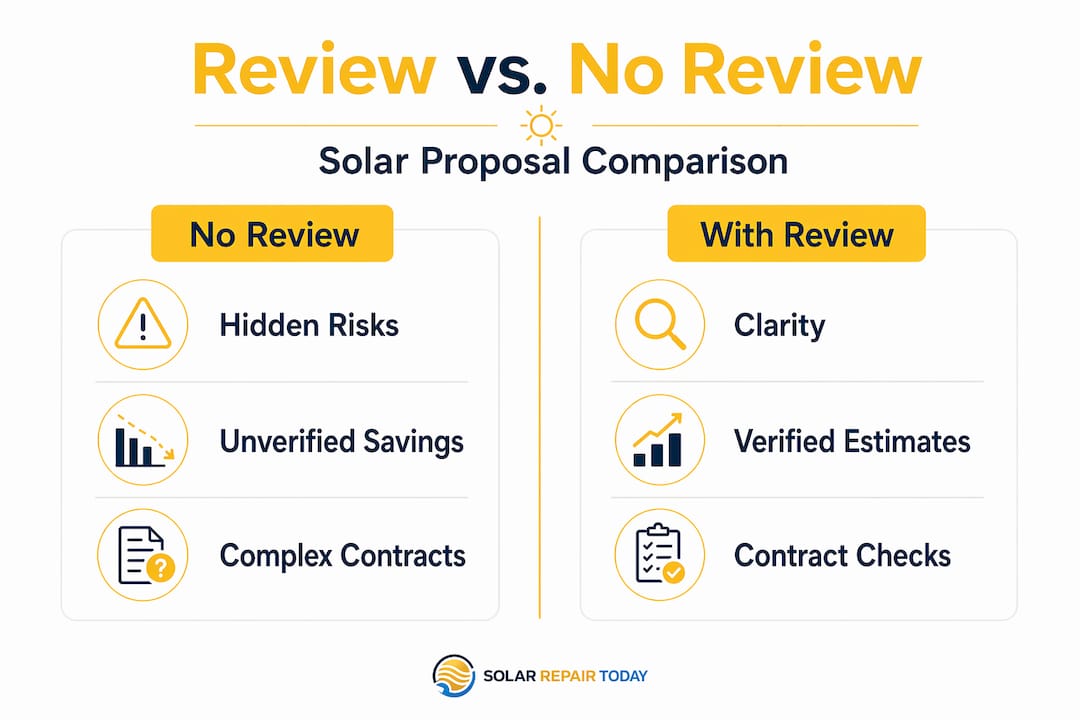
Most homeowners assume the numbers in a solar proposal are conservative estimates. In practice, proposal-stage reviews expose optimistic assumptions on incentives, interconnection, and cost estimates that are not guaranteed. Here are the most common gaps that independent review catches:
- Overstated savings projections. Installers often model production assuming optimal conditions year-round. Shading, panel degradation, and roof orientation can significantly reduce actual output. Without independent modeling, you may not know your real savings until year three.
- Incentive assumptions without confirmed eligibility. Federal tax credits, state rebates, and utility incentives are presented as if certain. But eligibility depends on your tax liability, utility program caps, and application timing. Reviewers separate guaranteed from conditional elements in the financial model.
- Interconnection costs excluded from quotes. Utility upgrades, metering costs, and interconnection fees can add hundreds to thousands of dollars to your project. These are routinely buried or omitted.
- Permit documentation errors. Incomplete or misorganized submissions lead to rejections and delays. Independent review catches checklist mismatches before submission.
- Contract terms tied to ownership models you do not fully understand. PPA and lease agreements have escalator clauses, early termination fees, and system removal conditions that are easy to overlook without a structured contract review.
Pro Tip: Ask your reviewer to specifically flag which savings numbers are guaranteed versus projected. If an installer cannot separate those two categories clearly, that tells you something important.
Skipping independent review does not eliminate these risks. It just means you absorb them without warning. Skipping third-party commissioning may save a few hundred dollars upfront but risks costly long-term losses from undiscovered installation faults. The same logic applies to proposal and contract review.
How reviews safeguard your solar investment
This is where solar review importance becomes concrete. Independent reviewers add value at multiple stages of a solar project.
Financial verification. A quality review rewrites the financial model to separate guaranteed versus conditional elements, translating complex proposals into realistic homeowner economics. This means you know your actual payback period, not the installer's best-case scenario.
Contract language checks. For leases and PPAs, the owner of record drives incentive eligibility and insurance obligations. Reviewers verify that the contract language reflects these ownership mechanics accurately and that you are not inadvertently taking on liabilities that belong to the financing company.
Permit compliance validation. Permit package success depends on meeting checklist items with clearly labeled, organized sheets matching building and electrical codes. A reviewer who checks your permit package before submission can prevent rejection and the rework cost that follows.
Commissioning and post-installation documentation. Third-party commissioning provides unbiased verification and specialized testing that identifies installation or equipment issues early. This documentation is critical evidence if you ever need to file a warranty claim or dispute a performance issue.
Here is a direct comparison of the homeowner experience with and without independent review:
| Review element | Without independent review | With independent review |
|---|---|---|
| Savings projections | Accepted as stated | Validated against actual site conditions |
| Incentive eligibility | Assumed guaranteed | Confirmed based on your tax profile |
| Contract obligations | Signed without full clarity | Mapped to ownership and payment terms |
| Installation quality | Installer self-certified | Independently tested and documented |
| Warranty position | Weak without documentation | Supported by commissioning records |
Real-world examples of review benefits
Consider a homeowner presented with a proposal showing a 12-year payback period and $40,000 in lifetime savings. A proposal review reveals the model assumes full federal tax credit eligibility, a 30% utility rate escalation, and zero shading loss. After adjusting for the homeowner's actual tax liability and a realistic rate escalation, the payback period extends to 17 years. That five-year difference changes whether the project makes financial sense at that price.
In another case, a commissioning review finds that two panels were installed at the wrong tilt angle and one string inverter was undersized relative to the panel array. Neither issue would have been visible to the homeowner. Catching those faults early avoids years of underperformance and potential warranty denial, since the installer could argue the homeowner accepted the system as-is.
"Commissioning documentation is a key risk-transfer tool that prevents costly long-term disputes and supports warranty claims by verifying installation and system performance independently." — Solar Power World
Texas passed legislation allowing qualified third parties for plan reviews and inspections, which has accelerated permit approvals and reduced administrative bottlenecks. This is not an isolated example. It reflects a broader recognition that independent review at the permitting stage produces faster, more accurate outcomes for all parties involved.
Cost-benefit math is straightforward. A proposal review typically costs between $150 and $500. A solar system costs between $15,000 and $40,000. Catching one pricing error, one disqualifying contract clause, or one installation fault more than covers that fee.
How to apply third-party reviews in your process
Getting value from an independent review requires engaging it at the right time and with the right scope. Here is a practical approach:
- Request review before you sign, not after. A solar quote independent check is most useful when you still have leverage to negotiate or walk away. Post-signature reviews can identify problems but cannot always fix them.
- Submit your full proposal package. Include the quote, system design, financing agreement, warranty documents, and any utility bill or shading analysis the installer provided. Reviewers need complete data to give you accurate findings.
- Ask specific questions upfront. What assumptions are in the production model? Which incentives are guaranteed? What happens to the system if I sell my house? These questions frame the reviewer's analysis and produce more targeted output.
- Use review findings to negotiate. A written review report that identifies inflated savings or non-standard contract terms gives you a factual basis to request pricing adjustments or contract revisions. Installers respond differently to documented evidence than to general complaints.
- Schedule commissioning separately from installation sign-off. Do not let the installer's final walkthrough substitute for independent commissioning. These serve different purposes. Read up on what solar contracts include to understand what sign-off language actually obligates you to accept.
Pro Tip: When evaluating reviewers, ask whether they have seen the specific financing structure you are being offered. Reviewers with PPA or lease experience read those contracts differently than reviewers who primarily work with cash or loan purchases.
Trusted solar review sites and services vary in scope. Some focus on proposal pricing only. Others cover the full contract, commissioning, and permit review. Match the service scope to your specific risk. If you are signing a 20-year PPA, you need contract review. If you are purchasing outright, proposal and commissioning review may be sufficient.
My perspective on third-party solar reviews
I have reviewed hundreds of solar proposals and seen the same patterns repeat. Homeowners who skip independent review consistently underestimate the complexity of what they are signing. This is not a criticism. Solar contracts are deliberately dense. They are written by attorneys who represent the installer's interests, not yours.
What I have found is that the homeowners most resistant to third-party review are also the ones most likely to call back six months later with a problem they cannot resolve. They trusted the process, which is reasonable. But trust without verification is not a strategy in a transaction this size.
The misconception I encounter most often is that a third-party review signals distrust of the installer. It does not. Good installers welcome independent review because it reduces disputes and warranty friction on their end too. If an installer actively discourages you from getting a second opinion, that is meaningful data about how they operate.
The upfront cost of a quality review is real. It is also the smallest line item in a solar project by a significant margin. Framing it as an expense misses the point. It is a quality check on a 20-plus year financial commitment. I have never spoken to a homeowner who regretted getting one. I have spoken to many who regretted skipping it.
— David
Get an expert review before you commit
Solarrepairtoday.com specializes in independent solar proposal and contract reviews for homeowners who want clarity before signing. Through the "Before You Sign" intake program, you submit your proposal, quote, utility bill, or contract details for a structured review covering pricing, equipment specs, system sizing, financing terms, battery backup options, and red flags.
The service is built for exactly this situation: a significant financial commitment, a complex document, and a need for an unbiased second opinion. Review the solar proposal review service for full details on what the assessment covers. For financing-specific concerns, the contract financing review covers PPA and lease structures in depth. You can also start with the Before You Sign program if you want a comprehensive second opinion before committing to any installer.
FAQ
What is a solar third-party review?
A solar third-party review is an independent assessment of a solar proposal, contract, or installation conducted by a reviewer with no financial connection to the installer. The review covers pricing accuracy, financial assumptions, contract terms, equipment specs, and installation quality depending on scope.
When should I get a third-party solar review?
Request a review before signing any agreement, while you still have the option to negotiate or walk away. Proposal-stage review is most effective because it preserves your leverage and prevents locking into terms you have not fully validated.
Does a third-party review replace the installer's warranty?
No. A third-party commissioning report supports your warranty position by creating independent documentation of installation quality and system performance. It does not replace the warranty itself but significantly strengthens your ability to file a successful claim.
Are solar leases and PPAs reviewed differently than cash purchases?
Yes. Third-party owned solar contracts require reviewers to examine ownership-driven economics, including incentive eligibility tied to the owner of record, rate escalators, and early termination terms before reviewing equipment specifications.
How much does a solar third-party review cost?
Costs vary by scope and provider, typically ranging from $150 to $500 for a proposal review. Given that solar systems cost $15,000 to $40,000 and involve multi-decade financial commitments, the review fee is a minor expense relative to the risk it mitigates.