

Two quotes for the same home, same system size, same roof. One comes in at $28,000. The other at $34,500. Both look legitimate on paper. Yet neither price tells you whether the system is properly sized, whether the equipment is comparable, or whether the financing terms are actually favorable. Price alone is not a reliable comparison tool in solar, and that gap between quotes can cost you thousands if you sign without a deeper look. This article breaks down why solar quotes differ, what independent review reveals, and when outside verification is not optional.
Table of Contents
- Why quotes differ: System designs, scope, and pricing methods
- How independent checks reveal hidden differences
- Financial impact: Why relying on one quote is risky
- When expert review is essential: Edge cases and common pitfalls
- The uncomfortable truth: Most homeowners miss critical details—here's what actually matters
- Get your solar quote checked before you sign
- Frequently asked questions
Key Takeaways
| Point | Details |
|---|---|
| Solar quotes aren’t apples-to-apples | Prices differ for reasons like design, scope, and hidden fees, so you need independent review before comparing. |
| Standardized metrics reveal hidden gaps | Cost per watt and performance normalization identify mismatches in technical assumptions. |
| Multiple quotes save real money | Market data shows that negotiating and comparing quotes can cut your installation cost by up to 20 percent. |
| Expert review matters most in complex projects | Edge cases—like unusual roof conditions or tricky financing—are where independent checking prevents expensive mistakes. |
| True value is in validating scope | The lowest price only makes sense after confirming the offer covers all needed equipment and services. |
Why quotes differ: System designs, scope, and pricing methods
Solar quotes are built differently by every installer. There is no standard template, no universal format, and no requirement that two companies quote the same scope. That is the core problem.
Two quotes at different price points may reflect completely different systems. One installer might quote a 7 kW DC system using budget panels and a string inverter. Another might quote a 6.4 kW DC system with premium panels and microinverters. On paper, the first looks cheaper. In practice, the second may deliver more production, better warranty coverage, and lower long-term maintenance costs. Without a systematic review, those differences are invisible to most homeowners.
Key variables that commonly differ between quotes:
- Panel brand and efficiency rating: Budget panels degrade faster and produce less per square foot over time.
- Inverter type: String inverters, microinverters, and power optimizers carry different costs, warranties, and performance profiles.
- Installation scope: Some quotes include electrical panel upgrades; others do not. Some include monitoring hardware; others treat it as an add-on.
- Financing structure: Loan APR, dealer fees, and escalator clauses on leases vary widely and affect total cost significantly.
- Production estimates: Some installers use optimistic shading assumptions that inflate projected output.
As noted in a solar quotes comparison review by Earthlight Technologies, homeowners often need an independent review because different solar quotes can be based on different assumptions covering system design, included scope, and financing, so an apples-to-apples comparison is not guaranteed by price alone.
The return on investment calculation changes completely when you factor in these variables. A cheaper quote that excludes monitoring, uses lower-efficiency panels, and carries a high-APR loan may cost more over 25 years than a pricier quote with better equipment and a lower-rate cash purchase. Comparing solar quotes with a structured review process is the only way to see the true difference.
A solar proposal review catches those discrepancies before you commit. It does not assume quotes are equivalent just because they target the same home.
How independent checks reveal hidden differences
Knowing that quotes differ is one thing. Knowing how to catch those differences is another. Independent review applies standardized metrics and systematic verification steps that most homeowners do not have the training or data access to perform on their own.
The most important standardized metric is cost per watt. This normalizes pricing across system sizes and allows direct comparison. A 7 kW system at $28,000 works out to $4.00 per watt. A 6 kW system at $25,200 also works out to $4.20 per watt. Without normalizing, the raw dollar amounts are misleading.
A detailed guide on comparing solar quotes from Solar Permit Solutions identifies that the core methodology for independent checking includes comparing cost and value using standardized metrics like cost per watt, verifying that system size matches the rating basis used (DC vs. AC conventions), and confirming that performance projections are consistent with actual system inputs.
That DC vs. AC distinction matters more than most homeowners realize. Installers who quote system size in DC watts can make a system look larger than it actually performs, because AC output is always lower due to inverter losses. An independent reviewer catches this mismatch immediately.
Pro Tip: Always ask your installer to express both the DC system size and the expected AC output. If a quote only gives you one number, that is a red flag worth investigating before signing.
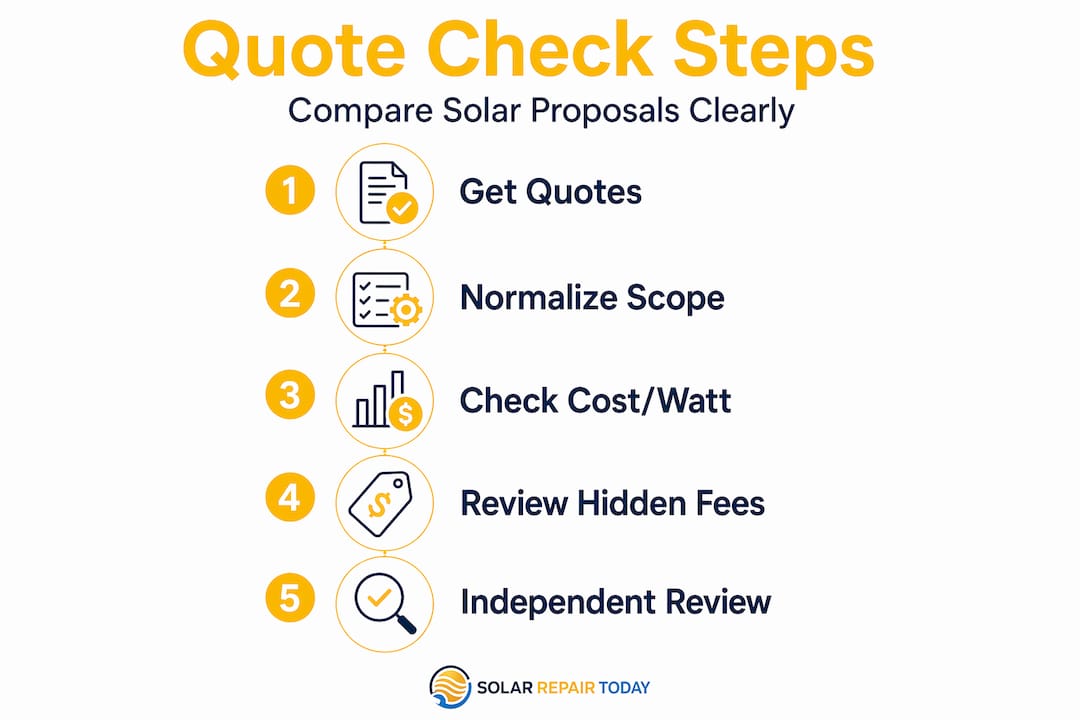
Here is how a structured independent review approaches quote comparison:
- Normalize to cost per watt using the DC system size for consistent comparison.
- Verify panel specifications, including efficiency rating, temperature coefficient, and degradation rate from the manufacturer's data sheet.
- Check inverter type and warranty, confirming whether the warranty is 10, 12, or 25 years and whether it covers labor costs.
- Audit the production estimate, cross-referencing it with publicly available solar radiation data for your location.
- Review the financing terms, including the effective APR, loan term, prepayment penalties, and any dealer fees rolled into the loan principal.
- Confirm included scope, identifying what is and is not covered in the quoted price, such as permit fees, utility interconnection fees, and roof work.
| Review metric | Why it matters |
|---|---|
| Cost per watt | Normalizes pricing for fair comparison |
| DC vs. AC rating | Prevents inflated system size claims |
| Production estimate source | Identifies optimistic or unsupported projections |
| Inverter warranty length | Indicates long-term reliability and cost exposure |
| Financing APR and dealer fee | Reveals true total cost of ownership |
| Scope of work detail | Uncovers missing line items that add cost later |
If you are uncertain about tax credit confusion in the quote, independent review also clarifies how the federal Investment Tax Credit is applied to the final price versus the loan amount.
Financial impact: Why relying on one quote is risky
The financial stakes in solar are not small. A typical residential installation runs between $20,000 and $40,000 before incentives. The decision you make based on a single quote, or even multiple unreviewed quotes, can result in overpaying by thousands of dollars.

Installer pricing data from NREL confirms that market pricing varies significantly by installer and quoting channel, and relying on a single sales quote can miss meaningful opportunities for negotiating or selecting better-value pricing. That is not a minor inefficiency. It is a structural gap in the process.
Key pricing variables that drive this variance:
- Installer size: Large national installers often charge premium prices due to higher overhead and sales commissions.
- Sales channel: Quotes originating through door-to-door sales typically carry higher margins than quotes requested directly by the homeowner online.
- Quote structure: Bundled quotes (system plus financing plus monitoring) obscure individual component costs, making it harder to identify where the margin is hidden.
- Regional market conditions: Installer density, permitting complexity, and local demand all affect what a fair price looks like in your specific market.
Statistically, homeowners who collect multiple quotes and apply systematic comparison can reduce total project cost by up to 20%. That is real money. On a $30,000 system, 20% is $6,000. Even a 10% reduction saves $3,000 that stays in your pocket.
The problem is that collecting multiple quotes does not automatically produce clarity. If those quotes use different scopes, different equipment, and different production assumptions, comparing them directly is still unreliable. That is where a contract financing review adds direct value. It turns a stack of inconsistent proposals into a structured comparison with clear conclusions.
The negotiation angle is real. An independent review that identifies a specific line item as overpriced, or a production estimate as inflated, gives you documented leverage in negotiations. Installers respond differently when a homeowner presents specific, technically grounded objections versus vague hesitation.
When expert review is essential: Edge cases and common pitfalls
Most solar installations are straightforward. But a meaningful percentage involve conditions that create serious risk of costly errors when reviewed only by the installer making the sale.
According to a contractor evaluation guide from Infinity Solar USA, edge cases where independent review is especially important include unusual roof conditions or shading, unclear specification of equipment and scope, and financing or lease structures with hidden terms. These are not rare scenarios. Shading from trees, dormers, or neighboring structures is common in residential settings.
A contrasting perspective from the Modernize solar evaluation guide suggests that using a comparison checklist is sufficient protection. But real protection comes from validating assumptions and scope, not just comparing headline prices. A checklist does not catch a production estimate that ignores a chimney shadow, or a loan with a hidden dealer fee of $4,000 added to the principal.
Situations that demand expert review:
- Shading or unusual roof pitch: Production estimates for shaded roofs require shade analysis tools like Solargraf or Aurora. If an installer does not mention shading corrections, the estimate is likely overstated.
- Lease or PPA structures: Power purchase agreements and leases involve 20 to 25 year contracts with escalator clauses, buyout options, and transfer conditions at home sale. These terms are not always disclosed clearly upfront.
- Unclear equipment specification: A quote that lists "Tier 1 panels" without naming the manufacturer and model number is not a complete specification. Independent review forces specificity.
- Battery backup proposals: Battery proposals introduce a second layer of technical and financial complexity, including usable capacity, backup duration calculations, and incentive stacking.
- Warranty and interconnection gaps: Some quotes omit who handles utility interconnection delays, permit revisions, or warranty service calls. These gaps become disputes after installation.
Pro Tip: Before signing any solar contract, verify that monitoring equipment, utility interconnection fees, permit costs, and workmanship warranty terms are explicitly listed in the scope of work. Anything not written into the contract is not guaranteed.
A battery proposal review specifically addresses the additional complexity of storage systems. And a solar warranty review confirms what is and is not actually covered under the manufacturer and installer warranties before you are locked in.
The uncomfortable truth: Most homeowners miss critical details—here's what actually matters
After reviewing hundreds of solar proposals, the pattern is consistent. Homeowners who compare two or three quotes are still not protected if they are comparing the wrong things. Focusing on the monthly payment, the payback period estimate, or the system size number printed on the first page of a proposal is not enough.
The details that actually determine whether a solar deal is good or bad are buried deeper. They are in the production estimate methodology. They are in the inverter warranty terms. They are in whether the loan includes a dealer fee that inflates the principal by 15 to 30%. They are in whether the monitoring system is manufacturer-provided or a third-party subscription that lapses.
Most homeowners do not know to look for these things. That is not a failure of intelligence. It is a failure of information access. Solar installers are sales organizations, and their proposals are designed to emphasize benefits and minimize friction to signing. That is a rational business practice. But it creates an information asymmetry that costs homeowners real money.
The SolarCheck 99 review process is built specifically to close that asymmetry. It applies the same review framework to every proposal: standardized metrics, scope validation, production estimate audit, financing term analysis, and equipment specification check. The output is not an opinion. It is a structured analysis with specific findings.
The real value of independent review is not catching fraud. Most solar installers are legitimate businesses. The value is catching mismatches, gaps, and assumptions that look fine on the surface but create problems at 5, 10, or 15 years into ownership. That is when the panel underperforms the estimate, the inverter warranty lapses without notice, or the loan payoff does not align with the refinance timeline. Independent review is risk reduction applied before commitment.
Get your solar quote checked before you sign
Solar Repair Today provides independent proposal review for homeowners who want clarity before committing to an installer. The process is direct. You submit your quote, proposal, utility bill, or project details. The review covers pricing, equipment specification, financing terms, system sizing, battery options, and any identified red flags.
The solar proposal review service gives you a structured, independent analysis of what you have been quoted and whether it holds up. If you have multiple quotes, the comparing quotes service normalizes them to the same basis so you can make an actual apples-to-apples decision. And if you are close to signing, the second opinion before signing intake program is the direct entry point. Review pricing starts at a flat fee, with no sales pitch and no installer referral involved. The output is yours to use however you need it.
Frequently asked questions
What hidden costs should I watch for in solar quotes?
Watch for equipment quality differences, unclear scope of work, and fine print on financing or warranty terms. As quote comparison research confirms, these are the primary sources of unplanned expense that surface after signing.
How many quotes should I get before deciding?
Aim for at least three quotes and normalize them using standardized metrics like cost per watt before comparing. Installer pricing data shows that relying on a single sales quote misses real opportunities for better pricing.
Can independent review identify unreliable performance estimates?
Yes. Independent review cross-checks the system design, shading assumptions, and production inputs used in the estimate against verifiable data. Guide-level methodology confirms that performance projections must be validated against actual system inputs to be reliable.
Does independent review help with negotiating a better deal?
Absolutely. Documented findings from an independent review give you specific, technically grounded leverage in negotiations. Market pricing variance data shows that missing this step can cost thousands in avoidable overpayment.