

Signing a solar contract is one of the largest financial commitments most homeowners make outside of buying a home. The U.S. solar market includes thousands of installers, ranging from well-established regional firms to short-lived operations that disappear after installation. Without the right questions, you risk overpaying, getting undersized equipment, or being locked into financing terms that quietly cost you thousands. This guide gives you a direct, field-tested set of questions to ask every solar company before you commit to anything.
Table of Contents
- Check the company's experience and credentials
- Clarify who does the work and what's included
- Understand costs, financing, and hidden fees
- Dig into warranties and long-term service
- Grill them on performance, guarantees, and battery backup
- Our take: Why asking tough questions protects your investment
- How Solar Repair Today helps you get answers (and peace of mind))
- Frequently asked questions
Key Takeaways
| Point | Details |
|---|---|
| Company experience counts | Insist on proven installers with at least three years in business to avoid unreliable firms. |
| Demand full contract transparency | Make sure you know exactly who’s doing the work, what the timeline is, and that all terms are written out. |
| Clarify all costs up front | Get a breakdown of price, financing, and all possible fees before signing anything. |
| Scrutinize warranties | Check that both labor and service trip fees are fully covered in writing to prevent surprises. |
| Check guarantees and backup | Understand how energy output is estimated and what’s required for backup power. |
Check the company's experience and credentials
After understanding the importance of thorough preparation, the next step is to know who you're dealing with and why reliable credentials matter.
Not all solar installers are equal. Some have been operating for a decade with hundreds of completed projects. Others opened recently, with minimal track records and no local references. Installer longevity and certifications matter because the industry can include fly-by-night companies that open and close quickly, leaving homeowners without warranty support or a point of contact when problems arise.
Key credentials and experience questions to ask:
- How many years has your company been operating in this state?
- Are your installers NABCEP (North American Board of Certified Energy Practitioners) certified?
- Does the company hold a valid electrical contractor's license in this jurisdiction?
- Can you provide references from local installs completed in the last 12 months?
- How many residential solar systems has your team installed?
NABCEP certification is the gold standard in the residential solar industry. It requires passing a rigorous exam and demonstrating field experience. Not every installer on a crew needs to be NABCEP certified, but the company should employ at least one certified professional overseeing installations.
"When comparing solar companies, homeowners should ask about installer longevity and basic credentials and certifications because the industry can include fly-by-night installers that open and close quickly." — CNET
Pro Tip: Search the company's name on your state contractor licensing board website and the Better Business Bureau before your first meeting. This takes five minutes and can reveal complaints, license lapses, or disciplinary actions.
Understanding vetting solar installer experience is foundational before you get into pricing or equipment. A company with weak credentials is a risk regardless of how attractive the quote looks. Also review how they handle negotiating solar agreements to understand whether they're flexible and transparent from the start.
Clarify who does the work and what's included
Once you've verified experience, the next concern is who actually does the work and whether responsibilities are clearly spelled out in your agreement.
Many solar companies function as sales organizations. They sign you up, then hand the physical installation off to a subcontractor you've never met and never vetted. This is not always a problem, but it becomes one when something goes wrong and neither party accepts responsibility.
Ask these questions to get clarity on project scope:
- Will your company perform the installation directly, or will you subcontract it?
- If subcontracted, who is the subcontractor and can I review their credentials?
- Who is responsible for pulling permits and scheduling inspections?
- Who handles the utility interconnection application and follow-up?
- What is the projected timeline from contract signing to system activation?
- What happens if the timeline is delayed? Is there a penalty or compensation clause?
Get answers about project scope and process in writing: confirm whether the company will perform the installation itself, its installation timeline, and who is responsible for key steps including permitting and interconnection.
Permitting and interconnection are two steps that frequently cause delays. Permits must be approved by your local building department. Interconnection approval comes from your utility company and allows your system to connect to the grid. Both can take weeks, and a company that glosses over these steps in their timeline is likely underestimating your project.
"A contract that does not specify who handles permitting and interconnection is a contract that invites disputes later. Get every step in writing before you sign."
A solid contract should include a detailed scope of work, a payment schedule tied to project milestones, a clear timeline, and named responsible parties for each phase. Use this contract details checklist to verify nothing is missing before you sign. You can also get a full reviewing solar proposals service to have an expert flag gaps in your contract scope.
Pro Tip: If a company sends you a contract that is vague about subcontractors or permitting responsibilities, ask them to revise it. A reputable company will not hesitate to add specifics.
Understand costs, financing, and hidden fees
With contract scope in hand, it's time to look under the hood at the actual numbers and financial structure that could affect your investment for years to come.

Solar pricing is not always transparent. A quote might show a total system cost without breaking down equipment, labor, permitting fees, or financing charges. Asking for itemized pricing forces the company to show you exactly where your money goes.
Key cost and financing questions:
- What is the total installed cost, broken down by equipment, labor, and fees?
- What is the cost per watt for this system?
- Are there dealer fees or origination fees built into the financing?
- Who is the third-party lender, and what are the full loan terms?
- Does the loan include a dealer fee that inflates the principal?
- What happens to my loan balance if I don't claim the federal tax credit?
Ask the contractor to disclose the full financing picture including fees, the third-party lender, and whether there are hidden fees, and to provide itemized pricing.
Dealer fees are a common hidden cost. A solar lender may charge the installer a fee of 15 to 30 percent of the loan amount, which gets rolled into your loan principal without being labeled clearly. On a $30,000 system, that could mean you're actually financing $36,000 or more. This is legal but rarely explained upfront.
| Item to clarify | What to ask | Why it matters |
|---|---|---|
| Per-watt cost | Total cost divided by system size in watts | Benchmark for fair pricing |
| Dealer/origination fee | Percentage added to loan principal | Inflates total cost significantly |
| Third-party lender terms | APR, loan term, prepayment penalty | Affects total interest paid |
| Federal tax credit handling | What happens if you don't owe enough taxes | Loan balance may increase |
| Annual maintenance costs | Cleaning, inspection, monitoring fees | Ongoing maintenance costs add up |
| Escalator clause (PPA/lease) | Annual rate increase percentage | Affects long-term savings |
Review solar contract financing risks before signing any loan or lease agreement. Also confirm your eligibility for incentives through solar tax credit details so you understand exactly what you can claim.
Pro Tip: Ask for the APR (annual percentage rate) and the total amount you will repay over the full loan term, not just the monthly payment. A low monthly payment on a 25-year loan can mean paying nearly double the original system cost.
Dig into warranties and long-term service
Once costs are clarified, the next big risk is what happens when something goes wrong. Warranty strength determines your long-term peace of mind.
Solar systems are expected to operate for 25 to 30 years. A lot can go wrong in that time: inverter failures, panel degradation, roof penetration leaks, monitoring system failures. The warranty structure determines whether you pay out of pocket for repairs or the installer covers them.
Questions to ask about warranties:
- What is the workmanship or labor warranty, and how many years does it cover?
- Does the labor warranty cover the cost of a technician visit, or just parts?
- Are there trip charges or truck-roll fees for warranty service calls?
- What are the equipment warranties on panels, inverters, and racking?
- Who honors the warranty if your installer goes out of business?
Demand "apples to apples" comparisons and deep warranty details including potentially costly items like trip and truck-roll charges and ensuring labor coverage is explicitly written.
"A warranty that covers parts but not labor is nearly worthless. An inverter replacement might cost $300 in parts but $500 in labor and travel. Always confirm what 'covered' actually means."
| Warranty feature | Minimum to require | Red flag |
|---|---|---|
| Workmanship warranty | 10 years minimum | Less than 5 years |
| Labor coverage | Included in workmanship | Labor billed separately |
| Trip/truck-roll charges | Waived during warranty period | Charged per visit |
| Panel product warranty | 12 to 25 years | Under 10 years |
| Panel performance warranty | 25 years at 80% output | No performance guarantee |
| Inverter warranty | 10 to 12 years | Less than 5 years |
Review the full solar warranty breakdown to understand what each component should cover and how to compare solar company warranties side by side.
Grill them on performance, guarantees, and battery backup
Understanding warranties is essential. Now ask tough questions around promised performance, real-world results, and how to stay powered up in an outage.
Every solar company will show you a production estimate. This estimate projects how many kilowatt-hours your system will generate annually and how much that reduces your utility bill. But these estimates are only as reliable as the assumptions behind them.
Critical performance and battery questions:
- What software or tool was used to model system production?
- Does the estimate account for shading, roof pitch, and local weather data?
- Is there a written performance guarantee, and what does it promise?
- What happens if the system underperforms? Is there a financial remedy?
- Does this system keep my home powered during a grid outage?
- If not, what battery options are available and what do they cost?
Ask for the performance estimate basis and whether the estimate is guaranteed, because savings often depend on modeling assumptions and the contract's performance guarantee terms.
Performance guarantees vary widely. Some companies offer a production guarantee with a financial remedy if the system falls short. Others provide an estimate with no guarantee at all. Knowing the difference before you sign is critical.
On battery backup, the answer surprises many homeowners. Standard grid-tied solar does not keep lights on during outages. Without battery storage, your system shuts down automatically when the grid goes down, even if the sun is shining. This is a safety requirement to protect utility workers. Battery storage is the only way to maintain power during an outage.
Pro Tip: If outage protection matters to you, ask the company to provide a separate battery proposal with full pricing, warranty terms, and backup capacity details. Don't let them bundle it into the main quote without a clear breakdown.
Use the solar battery backup resource to understand your options, get a review battery proposal from an independent expert, and confirm your system's promises with a performance guarantee check before committing.
Our take: Why asking tough questions protects your investment
Too many homeowners sign solar contracts and later say the same thing: "I wish I had pushed harder for answers." The instinct to trust a friendly sales rep or assume everything is standard is understandable. But solar contracts are 20 to 25 year financial commitments. Standard is not good enough.
The most effective approach is to treat every proposal as a negotiation, not a take-it-or-leave-it offer. When you have multiple quotes, use them as leverage. Insist on matching system sizes, identical warranty terms, and the same production estimate methodology before comparing prices. Apples-to-apples comparisons are the only fair way to evaluate competing offers.
A company that hesitates to answer direct questions, delays sharing documents, or pressures you to sign before you've reviewed everything is showing you exactly how they operate. That behavior does not improve after the contract is signed.
Third-party review is not a luxury. For a fraction of what a poorly structured deal costs over 25 years, an independent expert can flag pricing errors, financing traps, undersized systems, and warranty gaps before you commit. Get a second opinion from someone who has no financial stake in your decision.
The homeowners who get the best solar deals are the ones who ask the most questions, demand written answers, and verify claims independently. This is not adversarial. It is standard practice for any major financial decision.
How Solar Repair Today helps you get answers (and peace of mind)
Empowered with better questions, see how you can make this process nearly risk-free with professional help.
Solar Repair Today's "Before You Sign" intake program gives homeowners an independent review of their solar proposal before any contract is signed. Submit your quote, utility bill, or project details and receive a diagnostic review covering pricing, equipment, system sizing, financing terms, battery backup options, and potential red flags.
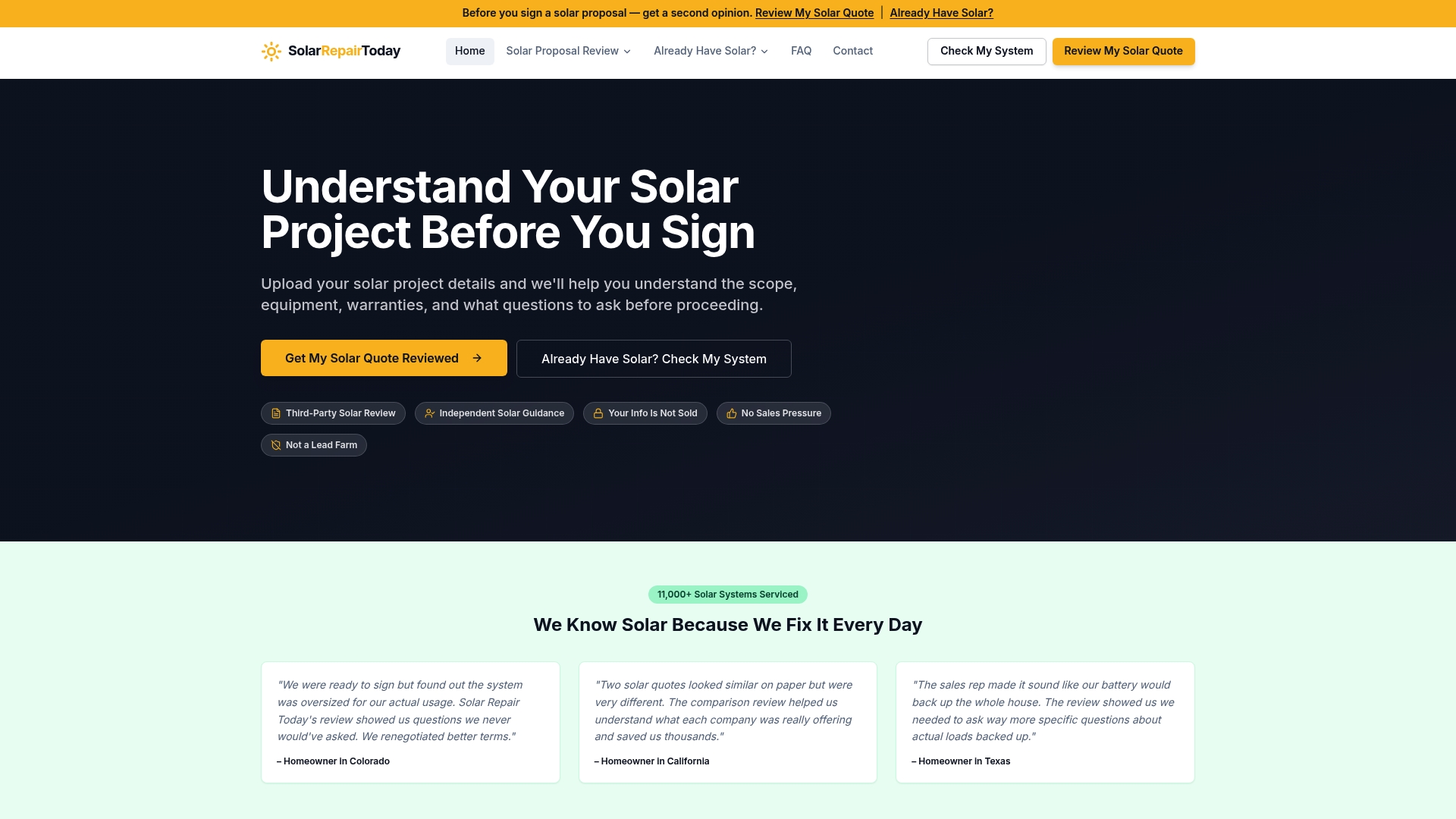
The solar proposal review service checks whether your system is sized correctly and your per-watt cost is competitive. The financing review service identifies dealer fees, unfavorable loan terms, and escalator clauses that could cost you thousands. Both services give you negotiating leverage and documented clarity before you commit. Ready to protect your investment? Get a second opinion today.
Frequently asked questions
What is the most important question to ask a solar company?
Ask how long the installer has been in business and verify their licensing and certifications. Installer longevity and credentials are the first filter because unproven companies carry the highest risk of post-installation problems.
How can I avoid hidden costs when going solar?
Request itemized pricing and details of all financing fees before signing any contract. Disclosing the full financing picture including third-party lender fees and hidden charges is something any reputable installer should do without hesitation.
Do I need a battery for solar to work during a power outage?
Yes, grid-tied solar won't power your home during outages. Battery storage is essential for outage resilience because standard grid-tied systems shut down automatically when the grid goes down.
What are trip charges in solar warranties?
Trip charges are fees for technician visits that may not be covered by your warranty. Always confirm in writing whether labor coverage and truck-roll fees are included or billed separately during the warranty period.
How can I compare multiple solar proposals fairly?
Insist on apples-to-apples comparisons with matching system sizes, warranties, and production estimates. Comparing proposals equally is the only way to identify which offer genuinely delivers the best value rather than just the lowest headline price.