

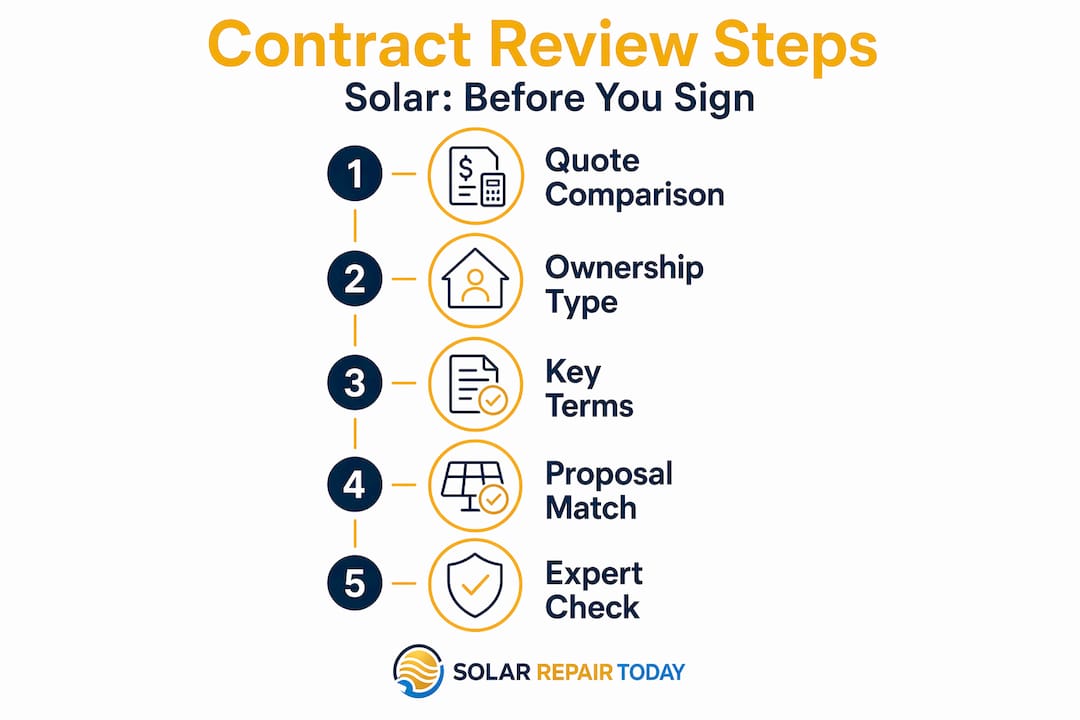
Not all solar contracts are the same. Two proposals from competing installers for the same roof can carry vastly different obligations, escalation rates, warranty terms, and exit rights — while looking nearly identical on the surface. A solar before you sign review is a structured, checklist-style process that evaluates contract terms, incentive disclosures, payment and escalation structure, ownership model, warranties, maintenance responsibilities, and the accuracy of projected energy savings before you commit.
Table of Contents
- What is a solar before you sign review?
- Ownership and financing models: Why they shape your contract
- Key contract terms to review before you sign
- Comparing multiple solar quotes: Spotting red flags and gaps
- Official consumer guides and protections: Your pre-signing safety net
- Why most solar contract reviews miss the biggest risk: The mismatch between proposal and contract
- Get expert help before you sign your solar contract
- Frequently asked questions
Key Takeaways
| Point | Details |
|---|---|
| Checklist review is essential | Never sign a solar contract without a step-by-step pre-signing review of all major terms and details. |
| Ownership type changes everything | Cash, loan, lease, or PPA contracts each have different rights and responsibilities for you as the homeowner. |
| Compare proposals line-by-line | Only side-by-side comparison of quotes and contracts helps spot missing information or potential deal-breakers. |
| State guides protect you | Official consumer documents like the California Solar Consumer Protection Guide exist to safeguard your interests before you commit. |
| Contract must match proposal | The final contract should reflect every promise and feature you were sold; never agree to a mismatch. |
What is a solar before you sign review?
A "before you sign" review is not just a quick read-through of a contract. It is a structured process of comparing every element in the sales proposal against what appears in the binding contract. The core purpose is to confirm that what you were sold is actually what you are agreeing to in writing.
A solar contract review checklist typically covers six core categories:
- Contract terms: Contract length, cancellation windows, and renewal conditions
- Savings estimates: How savings were calculated and what assumptions were used
- Payment details: Total cost, monthly payment amounts, any annual increases
- Warranties: Panel, inverter, and workmanship warranty coverage periods and transferability
- Permits and scope: Who handles permits, interconnection, and electrical upgrades
- Remedies for underperformance: What happens if the system produces less energy than projected
"A robust pre-signing review works like a reconciliation: compare the proposal to the contract and ensure the contract includes the same system specs, warranty language, scope (permits/interconnection/electrical upgrades), and remedies for underperformance." — Palmetto Solar Contract Guide
Consumer protection guides add another layer of safeguards. Key practices include comparing quotes line-by-line, confirming warranties and service processes, and rejecting any proposal accompanied by "sign tonight" pressure or vague terms that cannot be explained clearly. These practices exist because a signature on a solar contract can lock a homeowner into a 20 to 25 year obligation. That is not a document to skim.
A well-structured intake review also flags items that appear only in a verbal sales presentation, such as a promised energy offset percentage or a guaranteed bill reduction amount, that never make it into the written contract. If it is not in the contract, it is not a binding promise.
Ownership and financing models: Why they shape your contract
The ownership and financing structure of a solar deal determines nearly everything else in the contract. The ownership and financing model, whether cash purchase, loan, lease, prepaid lease, or power purchase agreement (PPA), changes who owns the system, who bears maintenance obligations, how incentives are allocated, and what your options are when selling your home.
| Model | Who owns the system | Who gets tax credits | Maintenance responsibility | Home sale impact |
|---|---|---|---|---|
| Cash purchase | Homeowner | Homeowner | Homeowner | System transfers with deed |
| Solar loan | Homeowner | Homeowner | Homeowner | Loan may need payoff at sale |
| Solar lease | Installer/lessor | Installer | Installer | Lease transfer or buyout required |
| Prepaid lease | Installer/lessor | Installer | Installer | Transfer terms in contract |
| PPA | Installer | Installer | Installer | Buyer must qualify to assume |
For lease and PPA contracts, the ownership and payment structure differs significantly by model, and ownership timing matters for control, maintenance, and sale implications. A homeowner who signs a 25-year PPA and then tries to sell their home three years later may find that the buyer cannot qualify to assume the agreement. That can stall or kill a real estate transaction.
Cash and loan buyers take on all maintenance responsibility, but they also capture the full value of the federal Investment Tax Credit (ITC), state rebates, and any net metering credits. Lease and PPA customers typically receive none of those financial benefits because the installer owns the system and claims them instead.

Pro Tip: If you are considering a loan, check whether it is a secured home equity product or an unsecured solar-specific loan. Secured loans place a lien on your home, which affects your ability to refinance. Unsecured loans do not, but often carry higher interest rates.
If you are evaluating a PPA, review negotiating a solar PPA in detail before accepting standard terms. Many PPA terms are negotiable, including the escalator rate and early buyout pricing. Also confirm that solar warranty details are clearly written into the contract, not just referenced verbally by the sales representative.
Key contract terms to review before you sign
With the ownership model understood, the next step is reviewing specific contract language. These are the terms most likely to create problems later if they are vague, missing, or unfavorable.
Top contract terms to examine closely
- Escalation clause (escalator rate): Many leases and PPAs include an annual payment increase, often between 1% and 3% per year. Over 20 years, a 2.9% escalator on a $150 monthly payment grows to over $270 per month.
- Production guarantee: Does the contract guarantee a minimum annual energy output? If yes, what is the remedy — a credit, a check, or nothing?
- Buyout terms: At what price can you buy the system outright? Is the buyout price clearly stated or calculated by a formula?
- Early termination penalties: What is the cost to exit the contract early? Some contracts charge tens of thousands of dollars.
- Transfer and assumption rights: Can a home buyer assume the contract? Is installer approval required? What fees apply?
- Workmanship warranty: How long does the installer warrant their labor? This is separate from manufacturer panel and inverter warranties.
For lease and PPA arrangements, key contract review points include term length, the annual escalator rate, production guarantees, buyout terms, early termination penalties, and what happens at the point of home sale.
| Contract term | What to watch for | Why it matters |
|---|---|---|
| Escalator rate | Anything above 2.9% per year | Can exceed utility rate growth, eliminating savings |
| Production guarantee | Absent or capped at low thresholds | No recourse if system underperforms |
| Early buyout price | Formula-based with unclear inputs | May be unaffordably high at time of sale |
| Termination penalty | Flat fee or remaining payment total | Can cost $10,000 to $30,000 to exit early |
| Transfer fee | Required installer approval or high fee | Delays or complicates home sale process |
Pro Tip: Before signing, ask the sales representative to show you every term that is different from the version you reviewed the day before. Any contract revision made the night before a scheduled signing deserves a full re-review.
Review the solar installation cost breakdown to verify that all scope items, permits, and electrical upgrades included in the proposal are explicitly listed in the contract pricing.
Comparing multiple solar quotes: Spotting red flags and gaps
A single quote provides no reference point. Comparing at least two proposals side by side is the most reliable way to identify overpricing, missing scope, and red flags that one review alone cannot surface. The goal is to normalize every quote to the same scope before any comparison is meaningful.
A line-by-line quote comparison checklist recommends normalizing and comparing offers, including warranties and scope, and highlights red flags such as pressure tactics and missing details like product model numbers.
Key red flags to watch for during quote comparison:
- Missing model numbers: Proposals that list "tier-1 panels" or "high-efficiency inverter" without specific manufacturer and model names are not comparable and not verifiable.
- No workmanship warranty duration: If the labor warranty is not stated in years with specific exclusions, it is unenforceable.
- Vague permit and interconnection language: "We handle all permits" without a defined scope can shift unexpected costs to the homeowner after signing.
- No underperformance remedy: A proposal that projects 9,500 kWh annually with no consequence for falling short by 15% is a one-sided estimate.
- Pressure to sign quickly: Any offer framed as expiring within 24 to 48 hours should be treated as a negotiation tactic, not a real deadline. Incentive programs rarely disappear overnight.
- Savings projections based on inflated utility rate assumptions: Some proposals model utility rates rising 5% to 7% annually, making solar savings look larger than reasonable projections support.
A solar proposal review service can evaluate these details quickly, especially when a homeowner is comparing multiple installers with different financing structures and equipment packages. Using a service to compare solar quotes ensures the evaluation is consistent and based on actual contract language rather than sales pitch summaries.
Official consumer guides and protections: Your pre-signing safety net
State regulators and consumer protection agencies have recognized that solar contracts are complex enough to require formal safeguards. Several states have built official pre-signing requirements into their solar rules.
California is the clearest example. The California Public Utilities Commission (CPUC) publishes a state solar consumer protection guide intended to be reviewed and signed before any solar or battery storage contract becomes binding. The document functions as a mandatory consumer awareness tool. Installers are required to provide it, and homeowners must acknowledge they have read it.
Official consumer guides typically cover:
- How to compare quotes from multiple installers
- What financing terms to evaluate and what they mean
- Disclosure of incentives the installer may be capturing rather than passing to you
- Your right to a cancellation period after signing
- How net metering works and how changes to it may affect your savings
- Battery storage specific risks and what to verify before adding storage
"State-level consumer protection guides position themselves as pre-signing consumer safeguards, requiring acknowledgment before a solar or battery contract becomes valid."
Even in states without formal requirements, reviewing documents like the CPUC guide is a useful practice. The risks covered in that guide, including misleading savings projections, vague warranties, and escalating payment terms, apply in every state.
Review the solar tax credit confusion resource before signing any contract where the sales proposal references the 30% federal Investment Tax Credit as part of the financial justification. Confirming you actually qualify and that the credit structure is correctly applied in the financing model is a critical step many homeowners skip.
If you want an independent professional to guide you through this process, a second opinion before you sign is one of the most cost-effective safeguards available.
Why most solar contract reviews miss the biggest risk: The mismatch between proposal and contract
Here is what most pre-signing checklists fail to emphasize clearly: the single biggest risk in a solar deal is not a hidden fee or an unreasonable escalator. It is the gap between what the sales proposal promised and what the contract actually says.
Sales proposals are marketing documents. Contracts are legal documents. They are written by different people with different objectives. The proposal is designed to win your business. The contract is designed to protect the installer's interests.
A robust pre-signing review works as a reconciliation: compare the proposal to the contract and confirm that system specs, warranty language, scope items, and underperformance remedies all match. If key pieces are missing or unclear, delay signing until they are resolved in writing.
Most homeowners never do this comparison. Many sales representatives have never done it either. The proposal promises a 95% energy offset. The contract guarantees nothing about offset. The proposal includes a monitoring system and app. The contract makes no mention of monitoring. The proposal shows a 25-year panel warranty. The contract limits the workmanship warranty to two years with multiple exclusions.
These are not hypothetical examples. They reflect patterns that appear regularly in solar contract reviews. The fix is straightforward: place the proposal and the contract side by side and go through each major claim one at a time. Any claim in the proposal that is not mirrored in the contract should be added in writing or removed from the sales pitch before you sign.
A solar proposal review service is specifically built to do this comparison for you, with the technical knowledge to identify what is missing and the clarity to explain what each gap means for your actual financial outcome.
Get expert help before you sign your solar contract
Understanding the risks is the first step. Acting on that knowledge before you sign is what protects your investment.
SolarRepairToday.com offers independent expert reviews specifically designed for homeowners in this position. Through the solar contract financing review service, you can submit your proposal and contract for a professional assessment of pricing accuracy, equipment specifications, financing terms, and potential red flags. The solar proposal review service evaluates whether your quote reflects fair market pricing and complete scope. For homeowners who want full confidence before making a final decision, the second opinion before you sign intake program accepts proposals, quotes, utility bills, and project details for a thorough independent review. No sales pressure. No installer affiliation. Just a clear, expert assessment before you commit.
Frequently asked questions
What should I look for in a solar contract before signing?
Focus on payment terms, escalator rates, who owns and maintains the system, warranty coverage, performance guarantees, and what happens if you sell your home. For leases and PPAs, key review points include term length, annual escalator rate, production guarantees, buyout terms, and early termination penalties.
Why do I need to read the California Solar Consumer Protection Guide before signing?
California requires you to review and sign the official guide to confirm you understand your rights and risks before any solar contract becomes binding. The CPUC solar guide is a state-mandated consumer awareness document, not an optional resource.
Is it normal to compare several solar quotes before choosing?
Yes, and it is recommended. Comparing quotes line-by-line helps identify red flags, missing scope details, and the best overall offer for your specific energy needs and home situation.
Can I negotiate solar contract terms?
Yes, particularly on escalators, warranty terms, production guarantees, and transfer options. A solar lease explainer confirms that some terms are negotiable and that all negotiated changes must be confirmed in writing before signing.
What if my contract doesn't match the sales proposal?
Do not sign until all key promises and figures match exactly between the two documents. A pre-signing reconciliation requires that system specs, warranty language, scope, and underperformance remedies in the contract align precisely with what the proposal states.