
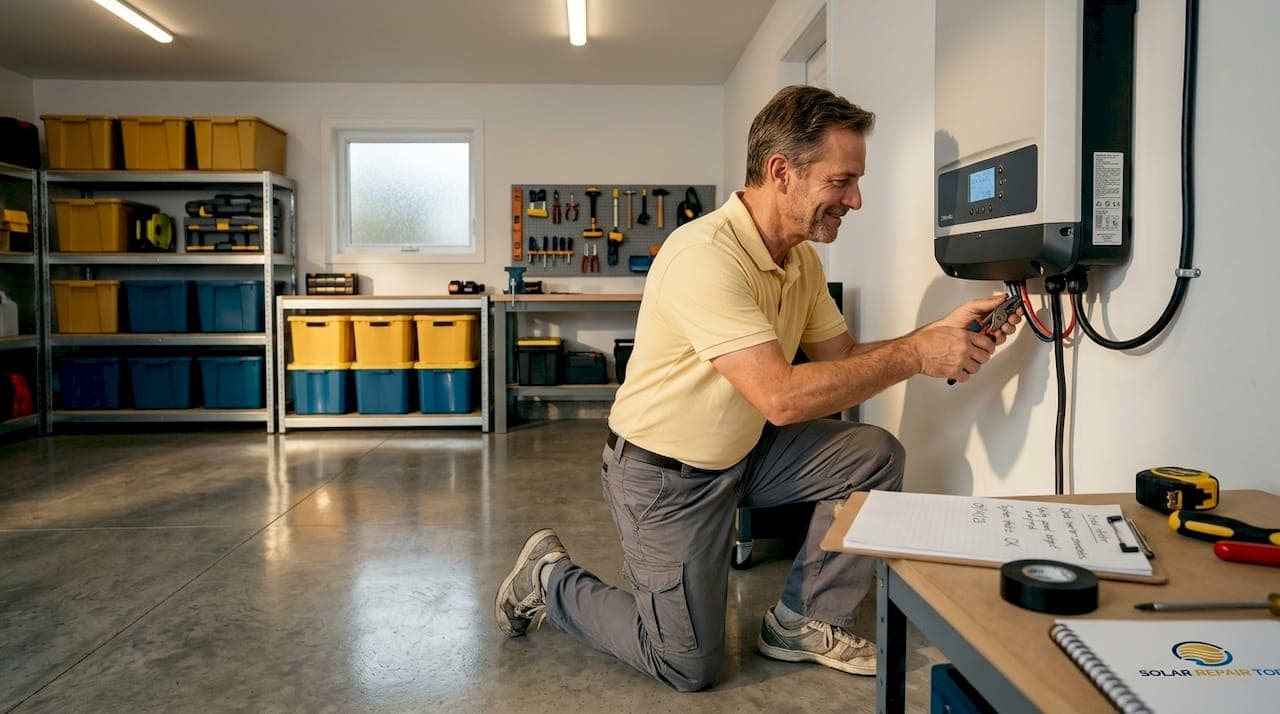
Most homeowners can point to their solar panels and say "that's where the electricity comes from." What they can't explain is how that electricity actually powers the refrigerator. The role of solar inverter explained simply: it converts the raw output from your panels into the kind of electricity your home can use. Without it, your panels are just expensive rooftop decorations. This article covers what inverters do, how the different types compare, what safety features matter, and why inverter choice affects your system's long-term performance more than most homeowners realize.
Table of Contents
- Key takeaways
- Role of solar inverter explained: what it actually does
- Advanced features that maximize performance
- Types of solar inverters and system value
- Critical inverter safety features
- Practical considerations for homeowners
- My take on what homeowners consistently get wrong
- Get an independent inverter and proposal review
- FAQ
Key takeaways
| Point | Details |
|---|---|
| Inverters convert DC to AC | Solar panels produce DC electricity; inverters convert it to AC so your appliances can use it. |
| MPPT maximizes your output | Maximum Power Point Tracking adjusts inverter operation continuously to extract peak panel power. |
| Inverter type affects system value | Microinverters and string inverters have different shading tolerance, monitoring depth, and cost profiles. |
| Safety features are non-negotiable | Anti-islanding and fault protection are required by code and protect your home and utility workers. |
| Match inverter to your specific roof | Poor inverter-to-array matching causes real energy losses even when panels are working perfectly. |
Role of solar inverter explained: what it actually does
Solar panels produce DC power when sunlight hits the photovoltaic cells. DC stands for direct current, a one-directional electrical flow. Your home's outlets, appliances, and the utility grid all operate on AC, alternating current, which reverses direction many times per second. These two types of electricity are not interchangeable. The inverter sits between your panels and your home and handles that translation.
The conversion process involves more than flipping a switch. The inverter must:
- Accept the variable DC voltage coming from your panels
- Convert it to a stable AC voltage at the correct frequency (60 Hz in the U.S.)
- Synchronize that output with the grid's waveform for safe grid connection
- Regulate voltage to stay within safe operating ranges for your appliances
This is why the inverter acts as the central power translator between your panels, your home, and the grid. A grid-tied solar system cannot export power or power your home safely without this conversion step. Skipping or under-specifying the inverter isn't an option. It's the piece that makes everything else functional.
Advanced features that maximize performance
Modern inverters do significantly more than basic DC-to-AC conversion. Understanding these features helps you evaluate what your installer is actually offering.
Maximum Power Point Tracking (MPPT) is the most impactful performance feature. MPPT continuously adjusts inverter operation to pull the maximum available power from your panels as sunlight intensity and temperature shift throughout the day. Without MPPT, panels operate at a fixed point that rarely matches their actual peak output. With it, your system extracts every available watt under real conditions.
Modern inverters also coordinate energy flow between panels, batteries, home loads, and the grid. This means the inverter decides, in real time, whether to send power to your appliances, charge your battery, or export surplus to the grid. That decision-making happens automatically, hundreds of times per minute.

Monitoring is another critical function. Most current inverters connect to apps or web dashboards that show your production, consumption, and any fault conditions. Early issue detection through monitoring helps homeowners catch underperformance before it compounds into significant energy loss. A system producing 15% less than projected for six months without detection is a real financial hit.
Pro Tip: Before signing a solar contract, ask the installer to show you a live demo of the inverter's monitoring app. If they can't demonstrate it clearly, that's a red flag worth investigating before you commit.
Types of solar inverters and system value
The types of solar inverters explained simply come down to where conversion happens. That single architectural difference has significant downstream effects on performance, cost, and maintenance.
String inverters
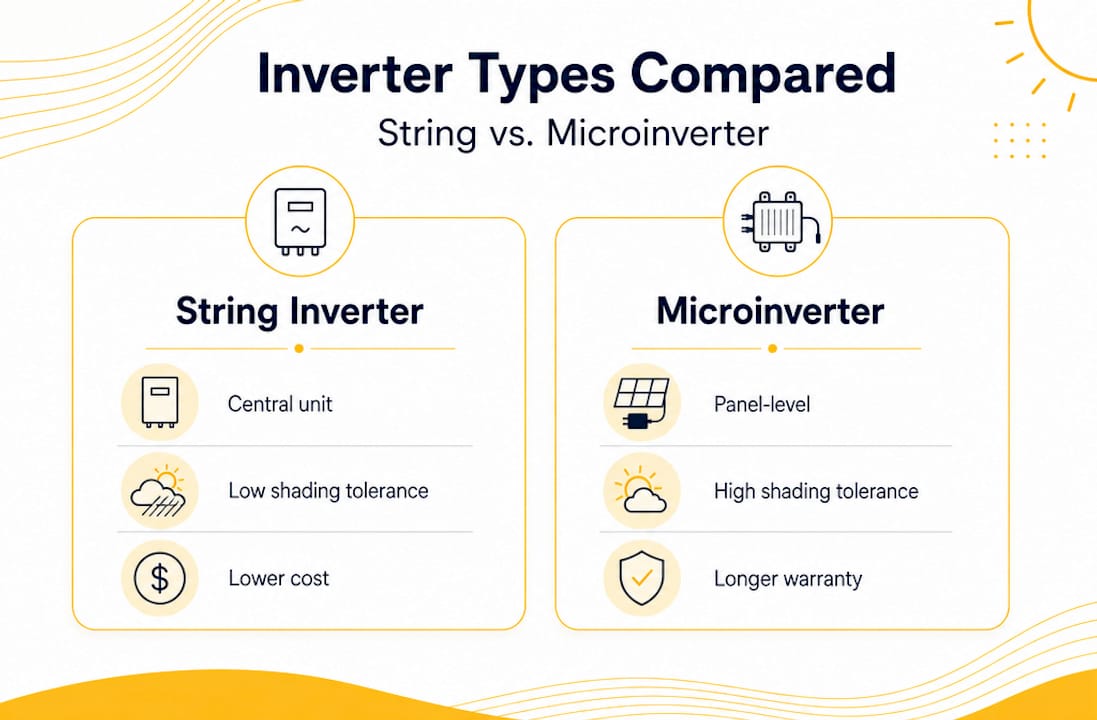
A string inverter connects multiple panels in a series and converts all their DC output at a single central unit. It's cost-effective and straightforward to install. The limitation is shading or failure in one panel reduces the entire string's output. This is often called the Christmas light effect. One bad bulb dims the whole string. For a roof with full, unobstructed sun exposure year-round, a string inverter is a reasonable choice. For roofs with trees, chimneys, or multiple orientations, it's a performance liability.
Microinverters
Microinverters attach directly to each panel and convert DC to AC right there on the roof. One panel's shading or degradation has no effect on the others. This panel-level independence significantly reduces production losses caused by shading or mismatch. Microinverters also carry AC power down from the roof instead of high-voltage DC, which affects safety, permitting, and installation practices. They cost more upfront but typically carry longer warranties and provide deeper panel-level monitoring data.
| Feature | String inverter | Microinverter |
|---|---|---|
| Shading tolerance | Low | High |
| Panel-level monitoring | No | Yes |
| Upfront cost | Lower | Higher |
| Typical warranty | 10-12 years | 25 years |
| Best for | Unshaded, simple roofs | Complex or shaded roofs |
| Safety architecture | High-voltage DC on roof | AC on roof |
Pro Tip: The role of inverter type in solar value is most visible when shading is involved. If your roof has any partial shading during peak hours, get a production comparison estimate for both string and microinverter configurations before making a decision.
Critical inverter safety features
The inverter is also your solar system's primary safety manager. These are not optional features. They're code requirements and performance baselines.
-
Anti-islanding protection. When the grid goes down, your inverter must stop exporting power within approximately 2 seconds. This IEEE 1547 compliance requirement exists to protect utility workers repairing lines who could be electrocuted by backfeed from residential solar systems. Anti-islanding uses passive, active, and communication-based detection methods to confirm the grid is present before allowing export.
-
Over and under voltage protection. If grid voltage fluctuates outside safe thresholds, the inverter disconnects to protect your appliances and the inverter itself.
-
Overcurrent protection. Prevents excessive current from damaging internal components or wiring.
-
Ground fault detection. Identifies unintended electrical paths to ground, which can cause fires or shock hazards.
-
Thermal shutdown. Inverters generate heat during operation. Thermal protection cuts power if temperatures exceed safe limits, preventing hardware damage.
"Anti-islanding is more than compliance. It ensures real-world safety by immediately halting power export during utility outages." Pacific Power
Anti-islanding also undergoes rigorous functional testing before commissioning, simulating grid disturbances to confirm the protection works under real conditions. An inverter that fails this test cannot legally be connected to the grid. Ask your installer for documentation confirming compliance.
Practical considerations for homeowners
The importance of solar inverters becomes concrete when you look at what poor inverter selection actually costs. Poor design alignment between inverter and array can cause energy losses even when panels are functioning perfectly. This happens when the inverter's voltage window doesn't match the array's wiring configuration, or when shading patterns weren't accounted for during system design.
Here's what to evaluate before committing to an inverter:
- Roof layout and shading. Trees, chimneys, dormers, and roof angles all affect which inverter type makes sense. A site assessment should document shading, not just panel count.
- System size matching. The inverter's capacity must match the array's output range. Oversizing or undersizing the inverter both reduce yield.
- Warranty and lifespan. String inverters typically last 10 to 15 years. Microinverters often carry 25-year warranties. Factor in replacement cost when comparing system quotes.
- Battery compatibility. If you plan to add battery backup later, confirm the inverter supports battery integration. Not all do.
- Monitoring access. Confirm you get direct access to monitoring data, not just the installer. Some installers maintain control of monitoring portals, limiting your visibility.
Pro Tip: Ask for the inverter's datasheet alongside the panel datasheet when reviewing a solar proposal. If the installer can't provide it, or if the inverter brand is unfamiliar, flag it for independent review before signing.
My take on what homeowners consistently get wrong
I've worked with homeowners on solar proposals for years, and the same pattern repeats. Everyone focuses on panel wattage and cost per watt. Almost no one asks about the inverter.
What I've found is that inverter choice quietly determines more of a system's real-world performance than the panel brand. I've seen proposals with premium panels paired with undersized or poorly matched inverters, and the projected output numbers were simply wrong because the energy path had a bottleneck nobody caught.
The monitoring feature is another area I think gets underestimated. Homeowners who actively use their inverter's monitoring app consistently catch issues faster and get more value from their O&M contracts. Those who ignore it often discover a fault months after the fact. By then, the lost production is gone.
My honest advice: treat the inverter as a first-tier decision, not an afterthought. Ask specifically which inverter model is included, why that type was selected for your roof, what the warranty covers, and whether the monitoring app gives you direct access. If the salesperson can't answer those questions clearly, that's a signal to pause and get a second opinion before you sign anything.
— David
Get an independent inverter and proposal review
Before committing to a solar installation, get an expert second opinion on the inverter choice, system sizing, and pricing. Solarrepairtoday's "Before You Sign" program reviews your full solar proposal and flags potential issues with equipment selection, inverter compatibility, and system design.
Submit your solar proposal for review and get a clear assessment of whether the inverter type, capacity, and brand match your roof's conditions and your energy goals. If battery storage is part of your plan, Solarrepairtoday also offers a dedicated battery backup proposal review covering inverter-battery compatibility and energy flow design. For homeowners navigating financing, the solar contract financing review covers total system cost, financing terms, and equipment value. Get clarity before you sign.
FAQ
What does a solar inverter do?
A solar inverter converts DC electricity produced by solar panels into AC electricity that home appliances and the grid use. Without this conversion, solar energy cannot power a standard home.
What are the main types of solar inverters?
The two primary types are string inverters, which convert power centrally from multiple panels, and microinverters, which convert power individually at each panel. Microinverters reduce shading-related losses and provide panel-level monitoring.
Why is anti-islanding protection required?
Anti-islanding protection shuts down power export within approximately 2 seconds of a grid outage, protecting utility workers from electrocution caused by backfeed from solar systems. IEEE 1547 mandates this for all grid-tied inverters.
How does inverter type affect solar system value?
Microinverters generally produce more energy on shaded or complex roofs and carry longer warranties, while string inverters cost less upfront and suit simple, unshaded installations. The right choice depends on your specific roof conditions and long-term energy goals.
How often do solar inverters need to be replaced?
String inverters typically last 10 to 15 years and will likely need at least one replacement over a 25-year system lifespan. Microinverters often carry 25-year warranties, aligning with panel lifespans and reducing long-term replacement costs.