

Your solar panels are installed, the system is running, and then one morning the inverter flashes an error code you've never seen. No power output. No clear explanation. This is one of the most common anxieties solar homeowners report after installation, and it catches many buyers completely off guard. The good news: most inverter faults trace back to a small set of well-understood causes. Understanding those causes before you buy or before a fault occurs puts you in a much stronger position to make confident decisions about equipment, maintenance, and when to call for help.
Table of Contents
- Understanding the role of your solar inverter
- Thermal faults: Heat, dust, and derating explained
- Arc-faults and electrical safety: More than just a reset
- Grid and environment-related inverter trips
- The truth most solar buyers miss about inverter faults
- Get expert help for any solar inverter issue
- Frequently asked questions
Key Takeaways
| Point | Details |
|---|---|
| Overheating is common | Most inverter faults are caused by heat from blocked vents or dust buildup. |
| Arc-faults are safety risks | Professional inspection is a must—never try to reset after an arc-fault alarm. |
| Grid faults may not be your fault | Recurring errors at certain times may be due to grid or environmental conditions, not equipment failure. |
| Prevention is possible | Routine cleaning and understanding your inverter’s signals can stop many issues before they start. |
Understanding the role of your solar inverter
The inverter is the central processing unit of a residential solar system. Solar panels generate direct current (DC) electricity. Your home appliances run on alternating current (AC). The inverter converts DC to AC and manages the flow of power between your panels, your home, the battery (if you have one), and the utility grid.
Solar inverters are essential for converting DC to AC and ensuring safe system operation. That safety function is critical. The inverter constantly monitors voltage, frequency, temperature, and grid conditions. When something falls outside safe parameters, it shuts down. That shutdown is a feature, not a failure. It protects your wiring, your appliances, and the utility workers maintaining the grid.
Why does this matter before you buy? Because the inverter's quality, brand, and placement directly affect how often these protective shutdowns happen and how easy they are to diagnose. Buyers who choose cheaper, less-documented inverter brands sometimes face inverter error causes that are nearly impossible to trace without manufacturer support.
Here are the core functions every residential inverter performs:
- Converts DC power from solar panels to AC power for home use
- Monitors grid voltage and frequency, disconnecting if either goes out of safe range
- Tracks maximum power output from panels (MPPT, or maximum power point tracking)
- Reports performance data to monitoring apps or portals
- Detects arc-faults, ground faults, and insulation issues
- Controls battery charge and discharge cycles in hybrid systems
Understanding these functions helps you recognize when an error code is a routine protective response versus a sign of genuine equipment trouble. It also helps you ask better questions when reviewing solar installation costs and evaluating what inverter model is included in a proposal.
| Inverter type | Best for | Key trade-off |
|---|---|---|
| String inverter | Simple roof layouts, lower cost | Whole-string output drops if one panel underperforms |
| Microinverter | Complex roofs, shading issues | Higher upfront cost, more units to potentially service |
| Hybrid inverter | Battery-ready systems | More complex setup, higher failure points |
| Power optimizer + string | Partial shading, panel-level monitoring | Middle-ground cost, requires compatible inverter |
Knowing which type is in your proposal and why helps you compare solar quotes with more accuracy. Not every installer will explain these trade-offs unless you ask.
Thermal faults: Heat, dust, and derating explained
With a basic understanding of inverters, let's look at the most common and preventable set of faults: those caused by overheating or poor airflow.
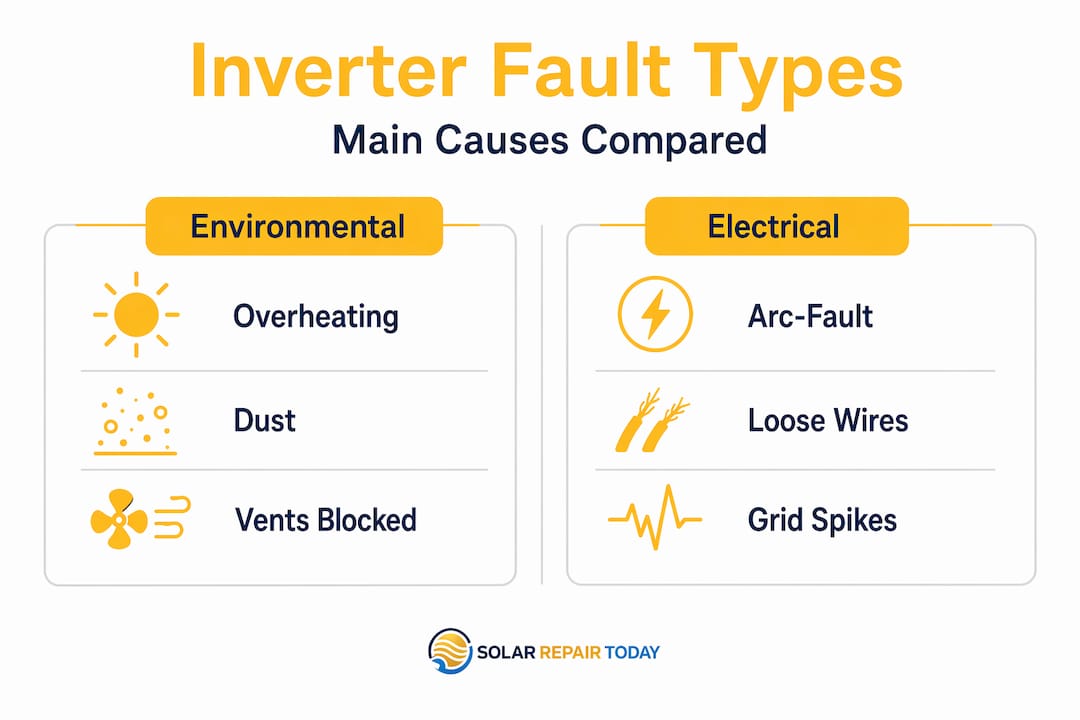
Thermal-related faults and derating occur due to insufficient cooling from blocked vents, dust, or high ambient temperature. Derating is the inverter's automatic response to overheating. It reduces output power to bring internal temperatures down rather than shutting off completely. You may notice your system producing less than expected on a hot afternoon without any visible error. That is often derating in action.

Blocked vents are one of the most overlooked causes. Inverters installed in enclosed garages, tight utility closets, or against walls with insufficient clearance are at higher risk. Dust accumulates on intake vents over months and restricts airflow. In dry or desert climates, this can happen faster than most homeowners expect.
Common warning signs of thermal issues:
- System output drops significantly in the afternoon despite strong sun
- Inverter fan runs loudly or constantly
- Error codes referencing over-temperature or thermal protection
- Inverter surface feels hot to the touch
- Monitoring app shows reduced output without weather explanation
Stat to know: Inverter manufacturers typically specify a maximum ambient operating temperature of 104°F (40°C). In many U.S. climates, garage installations can exceed that range during summer months if ventilation is inadequate.
| Installation location | Thermal risk level | Notes |
|---|---|---|
| Shaded exterior wall | Low | Ideal, good airflow, no direct sun on unit |
| Sunny south-facing wall | Medium | Direct sun raises ambient temp around unit |
| Enclosed garage | Medium-High | Poor airflow, heat buildup in summer |
| Tight utility closet | High | Limited air exchange, fan exhaust has nowhere to go |
Prevention steps are straightforward:
- Keep at least 12 inches of clearance around the inverter on all sides
- Clean vents with compressed air once or twice a year
- Avoid installing in spaces that trap heat
- If installed outdoors, provide shade from direct sun without blocking airflow
Pro Tip: When reviewing an installer's proposal, ask specifically where the inverter will be mounted. If the answer is a garage or utility closet, ask for the inverter's rated maximum ambient temperature and confirm the space can meet it year-round. This one question can prevent years of inverter thermal faults and derating complaints.
Arc-faults and electrical safety: More than just a reset
While many faults stem from environmental factors, others, like arc-faults, demand special attention for safety reasons.
An arc-fault occurs when electrical current jumps across a gap, damaged insulation, or a poor connection. In solar wiring, common triggers include degraded cable insulation exposed to UV or rodent damage, corroded connectors, loose MC4 connections, or failing bypass diodes inside panel junction boxes. The inverter detects the irregular electrical pattern of arcing and trips to prevent fire.
Arc-fault detection trips are triggered by arcing patterns from damaged cable insulation, corroded connectors, or module-level issues. SolarEdge guidance emphasizes professional checks before any reset is performed. This is not a restart-and-move-on situation.
Why is this so serious? DC arcing in solar systems burns at extremely high temperatures. It does not self-extinguish the way AC arcing sometimes does. A persistent arc in a rooftop wiring run can ignite roofing material, insulation, or structural wood within seconds.
Here is the correct sequence when an arc-fault alarm appears:
- Do not attempt to reset the inverter immediately.
- Note the exact error code displayed and photograph it.
- Check for any visible smoke, burning smell, or discoloration near panels or wiring.
- Contact a licensed solar technician for a site inspection.
- Notify your installer and review your arc-fault warranty info to understand what coverage applies.
- Only allow reset after a technician has physically inspected the wiring and connectors.
"Arc-fault detection is a safety system, not an inconvenience. Bypassing it or resetting without inspection removes the protection it provides." This framing from professional solar service teams reflects industry consensus on correct response protocol.
Pro Tip: When buying a solar system, ask whether the inverter model includes integrated arc-fault circuit interrupter (AFCI) protection. In many U.S. jurisdictions, this is now required by code for new residential solar installations. If a proposal omits it, that is worth flagging before you sign.
The most common mistake homeowners make is treating arc-fault trips the same as a generic grid disconnect. They are categorically different. One is a routine safety response to an outside condition. The other signals a potential wiring fault that requires physical inspection.
Grid and environment-related inverter trips
Not all inverter trips come from your own system. Outside forces can play a significant role, and many homeowners never connect the two.
Recurring faults during peak export (such as midday) can reflect environment or grid stress, not random hardware issues. Here's what that means in practice: when many solar systems in a neighborhood export power simultaneously on a sunny day, the local grid voltage can rise above the inverter's acceptable threshold. The inverter trips to protect itself and your home from over-voltage. It looks like a hardware fault. It is actually a grid condition.
This is increasingly common in high-solar-penetration neighborhoods. It is also a known issue in areas with aging grid infrastructure that was not designed for distributed generation at scale.
| Fault type | Most common timing | Likely cause |
|---|---|---|
| Grid over-voltage trip | Late morning to midday | High solar export, grid voltage rise |
| Grid frequency fault | Varies, often during storms | Utility switching or local disturbance |
| Anti-islanding trip | Power outage scenarios | Correct safety response, not a fault |
| Communication error | Any time | Monitoring hardware issue, not inverter fault |
Signs that a trip may be grid-related rather than equipment-related:
- Faults occur consistently at similar times of day, particularly between 10 a.m. and 2 p.m.
- The inverter restarts and runs normally within minutes
- No error codes indicating internal hardware issues
- Your neighbors with solar report similar patterns
- Faults increase in frequency during hot, sunny weather
Pro Tip: Log the time and date of every inverter trip for at least two weeks. If a pattern emerges around recurring inverter fault times, that data is far more useful to a technician or utility representative than a vague complaint. It can also support a claim to your utility if grid voltage management is needed.
When grid-related trips are suspected, two parties need to be involved. Your installer can adjust the inverter's voltage response settings within permitted ranges. Your utility may need to address grid voltage levels in the area. Neither can act effectively without documentation.
For homeowners evaluating a new solar proposal, this is worth discussing upfront. Ask whether the installer has experience with grid-related trips in your utility territory and whether the inverter model supports volt-watt or volt-VAR response, which allows more flexible response to grid conditions. A second opinion on grid faults before you sign a contract can surface these issues before they become post-installation headaches. Reviewing your proposal grid stress factors with an independent reviewer adds a layer of protection most buyers skip.
The truth most solar buyers miss about inverter faults
Here is a perspective that could save you time and money.
Most solar homeowners, when they see an inverter fault code, assume the worst: failed hardware, expensive repair, or a system that was poorly installed. That assumption leads to unnecessary panic, unnecessary service calls, and sometimes unnecessary equipment replacements.
The reality is that the majority of inverter alarms are signals. They are the system communicating what it observed, not necessarily declaring that something is broken. A thermal protection event that clears in 20 minutes and never recurs is completely different from a recurring arc-fault that keeps tripping at the same panel string. The error code might look identical. The implications are not.
Context is the diagnostic tool most homeowners never use. Three pieces of information define whether an inverter fault is meaningful:
Timing. Does it happen at a specific time of day? That points toward grid or thermal causes.
Frequency. Is it a one-time event or a recurring pattern? Single events are often environmental. Recurrence points to a physical or configuration issue.
Conditions. What was the weather? Was it unusually hot? Was there a storm? Did your utility have an outage? These conditions explain a high percentage of fault events.
An error code read without context is nearly useless. The same code, with timing and recurrence data attached, tells a complete story. This is why the advice to "just reset it and see if it comes back" is not as bad as it sounds for most non-arc-fault errors. But it only works if you are actually tracking what happens next.
The bigger issue is that many buyers enter solar ownership without any baseline understanding of how these systems communicate. When the first fault appears, they have no framework to evaluate it. Understanding real inverter error causes gives you that framework before you need it.
One more overlooked truth: inverter faults caught and addressed early almost never become catastrophic failures. The inverter's shutdown behavior is protective. A system that trips on over-temperature and is then relocated or vented properly will run for decades. A system that trips and is force-reset repeatedly without diagnosis is the one that eventually fails in a way that costs real money.
Get expert help for any solar inverter issue
Knowing the causes of inverter faults is useful. Having an expert review your situation is better.
SolarRepairToday.com offers independent diagnostic reviews for homeowners who want clarity before committing to a solar installer or before agreeing to a costly repair. Through the "Before You Sign" intake program, you can submit a proposal, equipment quote, or project details for a professional review of pricing, inverter model selection, system sizing, and potential risk factors. If your installer has recommended an inverter replacement or a major repair, a financing review for solar repairs helps confirm whether the recommendation is reasonable. For buyers still in the proposal stage, a solar proposal review service catches equipment and configuration issues before they become post-installation problems. Independent review adds a layer of protection most homeowners skip until it is too late.
Frequently asked questions
What is the most common reason for a solar inverter fault?
Thermal faults from blocked vents or dust accumulation are the most frequent cause, triggering protective shutdowns when internal temperatures exceed safe limits.
Should I reset my inverter after an arc-fault error?
No. A professional should inspect the system first, because arc-fault trips signal potential fire or electrical shock hazards that require physical wiring inspection before the system is restarted.
Why do inverter errors often happen at midday?
Midday faults often reflect grid voltage rising above safe thresholds during peak solar export periods, particularly in neighborhoods with high solar penetration on sunny days.
Can dust really cause my inverter to shut down?
Yes. Dust blocks airflow through cooling vents, causing the inverter to overheat. Per thermal derating research, insufficient cooling directly triggers protective shutdowns and reduced output.