
Solar installer licensing requirements define the legal credentials a contractor must hold to perform residential solar installations in compliance with state law and safety standards. No national solar contractor license exists. Licensing is governed entirely at the state level, meaning the credentials your installer needs in California differ significantly from what is required in Arizona or Florida. Understanding these distinctions protects you from unlicensed work, failed inspections, and voided warranties before a single panel is mounted on your roof.
1. Solar installer licensing requirements and why they vary by state
State-level regulation governs all solar contractor licensing in the United States, with no federal standard in place. This means the rules your installer must follow depend entirely on where your home is located. The variation is significant and directly affects who can legally touch your electrical system.

Most states classify solar work as electrical contracting. That means the installer must hold a state electrical contractor license to perform legal solar panel installation work. Dedicated solar licenses are the exception, not the rule.
About 12 states have created dedicated solar contractor classifications. These include:
- California: C-46 Solar Contractor license and C-10 Electrical Contractor license (both required for grid-tied systems)
- Arizona: CR-36 Solar Energy Systems Contractor license through the Arizona Registrar of Contractors
- Florida: Certified Electrical Contractor license with solar specialty endorsements
- Nevada, Hawaii, and Oregon: Dedicated solar or photovoltaic contractor classifications
- Remaining states: Rely on general electrical contractor licensing to cover solar work
Some states require dual licenses, meaning the solar contractor and the electrician making panel connections must each hold separate credentials. In states without solar-specific licenses, a licensed electrical contractor is the baseline requirement. Knowing which category your state falls into is the first step in evaluating any installer's qualifications.
2. How certification differs from licensing in solar installation
Licensure and certification are legally distinct credentials, and confusing the two is one of the most common mistakes homeowners make when hiring a solar installer. Licensure is legally mandatory to perform work. Certification demonstrates professional competency but carries no legal authority on its own.
The North American Board of Certified Energy Practitioners, known as NABCEP, administers the most recognized voluntary certification in the solar industry. The NABCEP Photovoltaic Installation Professional (PVIP) credential signals that an installer has passed rigorous technical exams and documented field experience. However, NABCEP certification is legally required only in Utah and Rhode Island. In every other state, it is optional.
Consumers often confuse NABCEP certification with legal licensure, which leads to hiring mistakes. An installer can be NABCEP-certified without holding the state license required to pull permits or legally connect your system to the grid.
That said, NABCEP carries real weight in the industry. NABCEP-certified installers earn on average $11,000 more annually, a 26% increase over non-certified peers. Additionally, 60% of EPC firms view NABCEP certification as essential or very important for hiring decisions. Many state and utility rebate programs also require NABCEP-certified installers to qualify. So while certification is not a substitute for a license, it is a meaningful quality signal worth verifying alongside the license.
3. Key compliance requirements for residential solar installations
Understanding what a licensed solar contractor must actually demonstrate to obtain and maintain their license helps you evaluate whether an installer is fully qualified. These are the standard requirements across most states:
- Experience: Experience requirements typically range from 2 to 4 years of verified electrical or solar work before a license application is approved.
- Trade and business exams: Applicants must pass state-administered exams covering electrical codes, safety standards, and business law.
- Insurance: Contractors must carry at least $1 million in general liability insurance and provide proof of workers' compensation coverage.
- OSHA compliance: Mandatory OSHA fall protection and electrical safety standards apply to all rooftop solar installations.
- Permit authority: A licensed contractor must be authorized to pull permits in the jurisdictions where they work.
- Municipal registration: Local jurisdictions may require additional registration beyond the state license to legally pull local permits and avoid project delays.
| Requirement | What to verify |
|---|---|
| State license | Active status, expiration date, license type |
| Insurance | Certificate of insurance showing $1M+ general liability |
| Workers' comp | Current policy, not expired |
| Permit authority | History of pulled permits in your city or county |
| Municipal registration | Local contractor registration number |
Pro Tip: Ask your installer for a certificate of insurance directly from their insurance provider, not just a copy they hand you. Certificates can be forged; a direct request from the insurer cannot.
Permit approval requires layers of compliance: state licensing, municipal permits, and utility interconnection approvals all must align before your system can legally operate. A contractor who skips any layer creates legal and financial exposure for you as the homeowner.
4. How to verify a solar installer's license before hiring
Verification is straightforward when you know where to look. Most state licensing boards maintain free, searchable online databases. The process takes under five minutes and can prevent significant problems down the line.
Steps to verify an installer's credentials:
- Search the state licensing board database using the contractor's name or license number. Confirm the license is active, not expired or suspended.
- Check the license type and scope. A C-46 license in California does not cover electrical panel connections. Confirm the scope matches the work being proposed.
- Request both license numbers if subcontracting applies. Homeowners should request both the solar contractor and electrical contractor license numbers, especially in dual-license states.
- Confirm local registration. Ask for the contractor's municipal registration number in your city or county. Municipal registration is often overlooked but is required to legally pull local permits.
- Verify NABCEP status at nabcep.org if the installer claims certification. The registry is public and searchable.
- Check disciplinary history. Most state boards display complaints, violations, and license suspensions in the same database.
Red flags that indicate a problem:
- License listed as expired, inactive, or suspended
- Installer cannot provide a license number on request
- No permit history in your jurisdiction
- Subcontractors used for electrical work without separate electrical license documentation
Pro Tip: Cross-reference the installer's license number against your state board's database yourself. Do not rely solely on the number printed on their business card or proposal document.
Reviewing solar contract clauses related to insurance and liability is equally important once you have confirmed the license. A valid license does not guarantee a fair contract.
5. Licensing requirements in major solar markets
The states with the highest solar adoption also tend to have the most specific licensing structures. Here is how the major markets compare:
| State | License required | Solar-specific classification | Dual license required |
|---|---|---|---|
| California | C-46 + C-10 | Yes (C-46 Solar Contractor) | Yes |
| Arizona | CR-36 | Yes (Solar Energy Systems) | No |
| Florida | Certified Electrical Contractor | Specialty endorsements available | Situational |
| Texas | Electrical contractor license | No dedicated solar license | No |
| New York | Home Improvement Contractor + electrical | No dedicated solar license | Situational |
California requires both the C-46 Solar Contractor and C-10 Electrical Contractor licenses for grid-tied solar. A contractor holding only the C-46 must subcontract all electrical panel connections to a C-10 licensee. This is a common source of confusion and a frequent gap in contractor documentation.
Grid-tied solar installation must be performed or supervised by licensed electrical contractors in most states. Battery storage integration typically requires the same electrical license as the solar installation itself, which means adding a battery backup system later is not a simple add-on if the original contractor lacked the right credentials.
Practical questions to ask any installer before signing:
- What is your state license number, and what work does it cover?
- Are you registered to pull permits in my city or county?
- Who performs the electrical panel connection, and what is their license number?
- Can you provide a certificate of insurance from your insurer directly?
- Have you pulled permits for solar installations in my jurisdiction in the past 12 months?
Knowing how the solar installation process works from permit to interconnection helps you ask these questions at the right stage of the project.
Key takeaways
Solar installer licensing requirements are state-specific, legally mandatory, and distinct from voluntary certifications like NABCEP. Verifying both the license type and municipal registration is the minimum due diligence before signing any solar contract.
| Point | Details |
|---|---|
| No national license exists | Licensing is state-level; requirements vary significantly by jurisdiction. |
| Certification is not a license | NABCEP is a quality signal but legally required only in Utah and Rhode Island. |
| Dual licenses apply in some states | California requires both C-46 and C-10; always request both numbers. |
| Municipal registration is mandatory | State licensing alone does not authorize local permit pulls in most jurisdictions. |
| Insurance is non-negotiable | Verify $1M+ general liability and active workers' comp before work begins. |
What I've learned about license verification after years of solar contract reviews
Most homeowners I've worked with arrive at the verification step too late. They've already signed. The installer has already started. And only when something goes wrong, a failed inspection, a permit rejection, a subcontractor dispute, does the license question surface.
The uncomfortable truth is that a polished proposal and a professional sales rep tell you nothing about whether the contractor is legally authorized to connect your system to the grid. I've reviewed contracts where the named installer held a solar specialty license but had no electrical license, and the electrical work was quietly subcontracted to a third party the homeowner never met and never vetted.
NABCEP certification is worth something. I don't dismiss it. But I've seen certified installers operating in states where their license had lapsed, and I've seen uncertified installers with spotless permit histories and zero complaints. The license is the legal floor. Certification is the quality ceiling. You need to check both, separately, before you commit.
The trend I'm watching in 2026 is increased enforcement at the municipal level. Cities and counties are tightening permit review processes, and contractors who skip local registration are facing project shutdowns mid-installation. That cost lands on the homeowner. The fix is simple: ask for the municipal registration number before the contract is signed, not after the crew shows up.
— David
Protect your investment before you sign
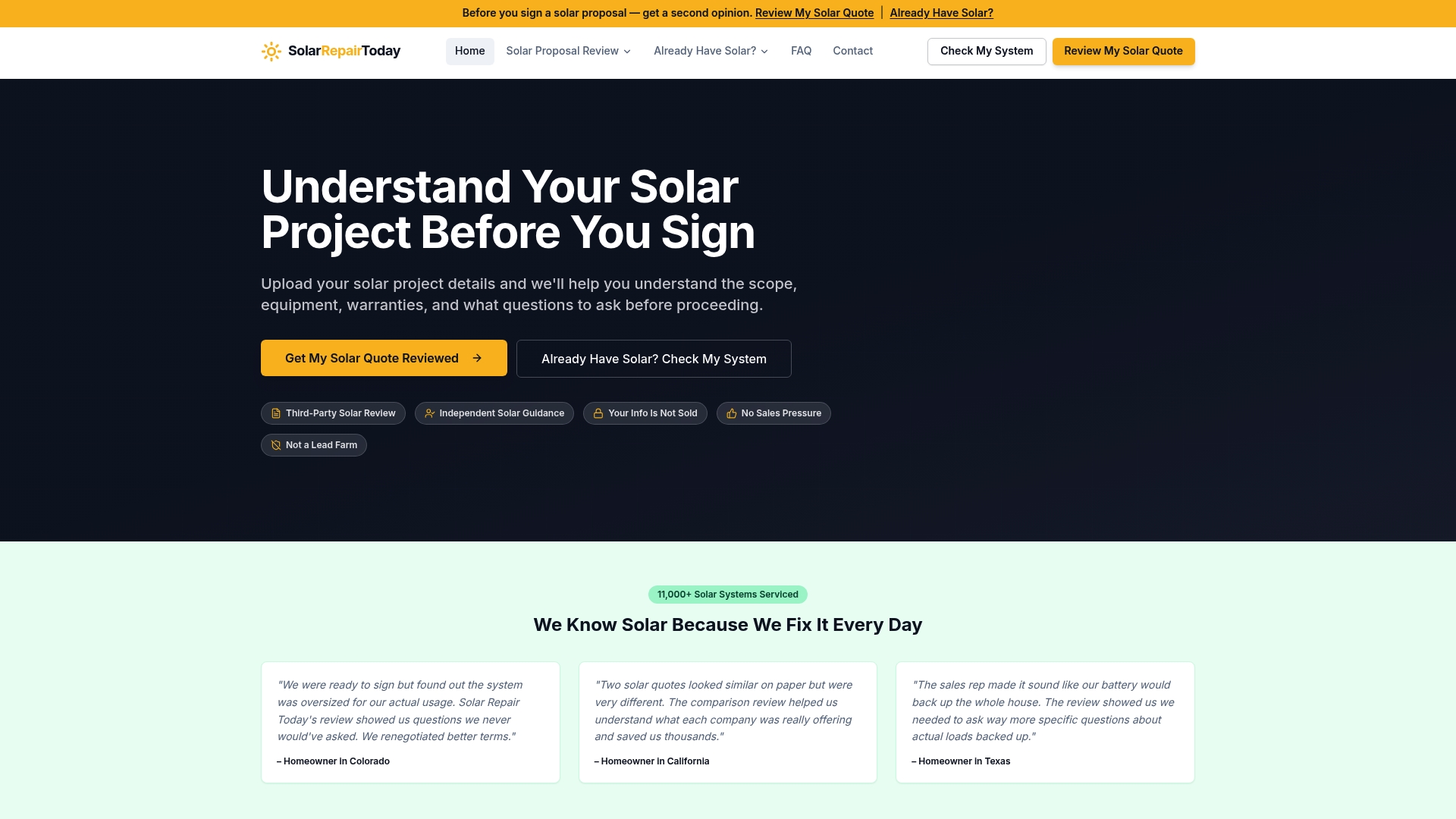
Solarrepairtoday.com built the "Before You Sign" intake program specifically for homeowners who want independent verification before committing to a solar installer. Submit your proposal, quote, or installer details for a diagnostic review covering pricing, equipment, financing terms, system sizing, and installer credential red flags. The review process checks for the exact gaps covered in this article: missing license documentation, dual-license gaps, insurance deficiencies, and permit authority issues. Get an expert solar proposal review or a full financing and contract review before you sign anything.
FAQ
Does a solar installer need a license in every state?
Yes. Every state requires some form of contractor licensing to perform residential solar installations legally. Most states require an electrical contractor license; about 12 states have dedicated solar contractor classifications.
What is the difference between a solar license and NABCEP certification?
A state license is legally required to pull permits and perform solar work. NABCEP certification is a voluntary credential that demonstrates technical expertise but carries no legal authority in most states.
How do I check if my solar installer is licensed?
Search your state's contractor licensing board database using the installer's name or license number. Confirm the license is active, covers the correct scope of work, and has no disciplinary actions on record.
What questions should I ask a solar installer about their license?
Ask for the state license number, the scope of work it covers, the municipal registration number for your jurisdiction, and separate license documentation for any subcontractors handling electrical connections. Review essential questions to ask before signing any agreement.
Is NABCEP certification required to qualify for solar rebates?
Many utility and state rebate programs require or strongly prefer NABCEP-certified installers to qualify. Check your specific program's eligibility requirements, as this varies by state and utility provider.