
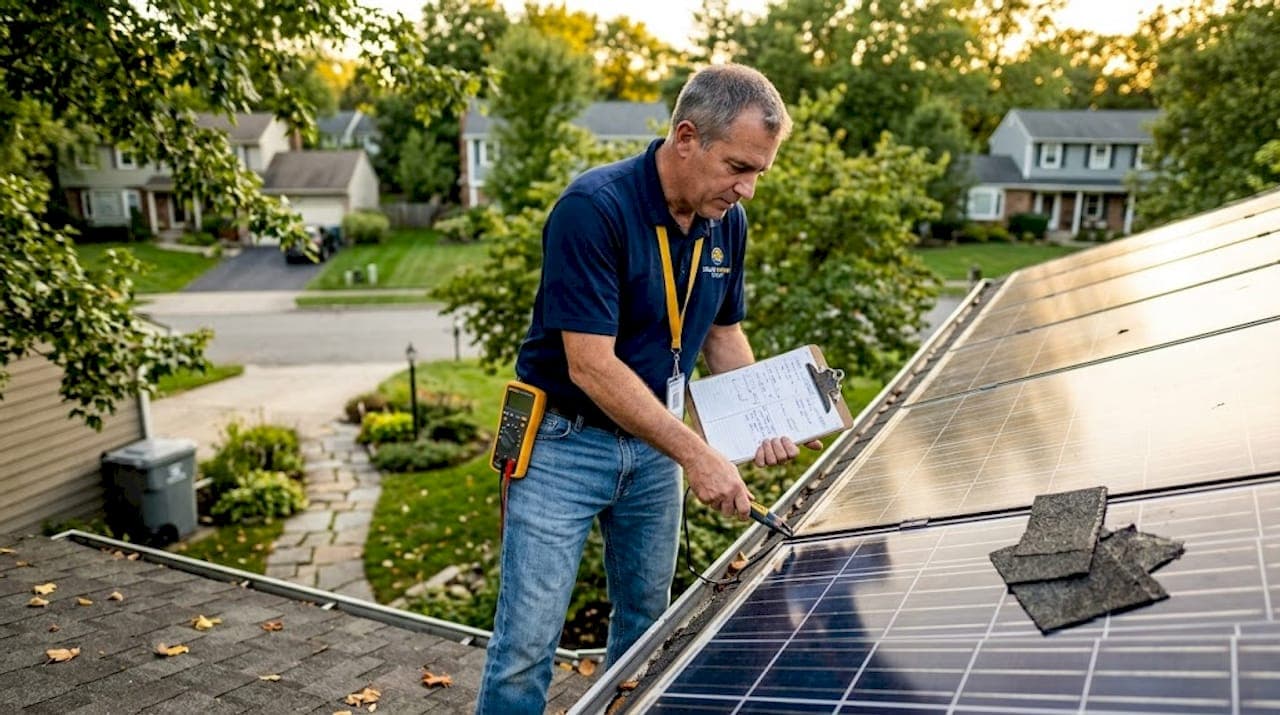
Most homeowners assume their solar panels are covered once they sign a warranty. That assumption leaves a significant gap in protection. The role of solar O&M contracts goes well beyond what any warranty offers: structured operations and maintenance agreements keep your system producing reliably, catch failures before they become expensive, and establish clear accountability for every service action. This guide breaks down what O&M contracts cover, why they matter more than reactive repairs, what different service tiers cost, and what to verify before signing anything.
Table of Contents
- What are solar operations and maintenance contracts?
- Why preventive O&M is essential for solar panel performance and safety
- What typical solar O&M contracts include: scope, service levels, and monitoring
- Solar O&M service tiers and cost expectations for homeowners
- How recurring solar O&M contracts protect your investment better than reactive repairs
- Why many homeowners overlook solar O&M contracts, and what they miss
- How Solar Repair Today helps you choose the right solar O&M contract
- Frequently asked questions
Key Takeaways
| Point | Details |
|---|---|
| O&M vs warranty | O&M contracts provide ongoing maintenance and monitoring to protect system performance beyond limited warranties. |
| Preventive care value | Regular preventive maintenance reduces safety risks and costly repairs while ensuring accurate performance. |
| Contract essentials | Key contract features include service level agreements, continuous monitoring, scheduled inspections, and clear reporting. |
| Service tiers vary | Homeowners can choose from basic to premium O&M plans depending on desired coverage and budget. |
| Recurring O&M saves money | Structured O&M contracts outperform reactive repairs by preventing energy losses and unpredictable expenses. |
What are solar operations and maintenance contracts?
Solar O&M contracts are formal service agreements between a homeowner and a provider that define how a solar system will be monitored, maintained, and repaired over time. "Operations" refers to the remote side: fault detection, automated alerts, and performance analytics. "Maintenance" covers the physical side: scheduled inspections, panel cleaning, and corrective repairs.
As one commercial solar resource notes, solar O&M covers tasks needed to keep photovoltaic assets safe, compliant, and producing at peak output, including monitoring, inspections, cleaning, repairs, and reporting. That scope applies equally to residential systems.
A typical O&M contract includes:
- Remote monitoring: Continuous tracking of production data with automated alerts for anomalies
- Scheduled inspections: Visual checks, electrical diagnostics, and thermal imaging at defined intervals
- Cleaning schedules: Panel washing at set frequencies based on location and soiling rates
- Corrective repair protocols: Defined response times for dispatching technicians after an issue is detected
- Performance reporting: Regular output summaries with benchmarks and trend data
- Warranty coordination: The O&M provider manages claims with equipment manufacturers on your behalf
This is meaningfully different from a workmanship warranty, which only covers defects in labor and materials for a limited period, usually two to ten years. Understanding solar contract financing and what each agreement actually covers is the first step before committing to any installer. Reviewing every part of your installation cost alongside the O&M terms gives you a complete financial picture before you sign.
Why preventive O&M is essential for solar panel performance and safety
Warranties do not send someone to your roof when your inverter starts tripping intermittently. O&M contracts do. That is the practical difference between passive coverage and active protection.
The U.S. Department of Energy confirms that preventive O&M is essential for PV safety and performance, including budgeting for damage repair and calibration of monitoring equipment to ensure accuracy over the system's lifetime.
Preventive maintenance catches specific, recurring failure points that warranties never address:
- Inverter faults: Intermittent tripping can reduce output by 20 to 40 percent before a homeowner notices anything on their utility bill
- Wiring degradation: Loose DC connections generate heat and create fire risks, detectable through thermal imaging during scheduled inspections
- Soiling losses: Dust, pollen, and bird droppings on panels reduce output by 5 to 25 percent annually depending on location, a problem that only cleaning resolves
- Sensor drift: If your monitoring system's sensors are not calibrated, the data you rely on for warranty claims and troubleshooting is unreliable
Reactive repairs address problems after damage occurs. Preventive O&M interrupts the failure before it progresses. For a residential system producing $1,500 to $3,000 in annual energy value, even a 10 percent undetected efficiency loss adds up to real money.
Reviewing your solar warranty details alongside an O&M contract is worth the time. What warranties exclude is often exactly what O&M agreements cover.
What typical solar O&M contracts include: scope, service levels, and monitoring
Understanding what is written into a contract, not just what a salesperson describes verbally, is how you avoid gaps in coverage. Well-structured O&M agreements specify measurable responsibilities.

According to industry standards, solar O&M contracts specify service level agreements, remote SCADA monitoring (a system that collects and analyzes real-time data from your panels), inspections and testing like IV curve tracing and thermography, and performance reporting with metrics like Performance Ratio and availability targets.
Here is what a complete contract structure typically looks like:
- Scope of work: A written list of every service included, inspection type, and system component covered
- Service level agreements (SLAs): Defined response times, such as 24-hour alert acknowledgment and 72-hour technician dispatch
- Monitoring technology: Specifies the platform used, alert thresholds, and data access for the homeowner
- Inspection schedule: Frequency of visual, electrical, and thermal inspections, typically quarterly or semi-annually for premium tiers
- Reporting cadence: Monthly or quarterly reports showing production data, Performance Ratio trends, and issue logs
- Corrective action protocols: Spare parts management, technician qualifications, and escalation procedures for major failures
- Warranty coordination: Provider handles manufacturer claims so you do not have to manage the paperwork yourself
| Contract element | What to look for | Red flag |
|---|---|---|
| SLA response time | 24 to 72 hours for dispatch | Vague language like "timely" with no hours specified |
| Monitoring platform | Named tool with homeowner dashboard access | No homeowner visibility into data |
| Inspection method | Thermal imaging and IV curve tests listed | Visual-only inspections |
| Reporting | Defined metrics like Performance Ratio | Generic summaries with no benchmarks |
| Corrective repair | Included or clearly priced | Unlimited exclusions on repair costs |
Pro Tip: Ask your O&M provider to specify which technician certifications are required for service visits. NABCEP-certified (North American Board of Certified Energy Practitioners) technicians indicate a higher standard of diagnostic competency.
Before committing to any agreement, review your solar proposal with the O&M terms side by side. The questions to ask before signing any solar contract should include every clause in the O&M scope.
Solar O&M service tiers and cost expectations for homeowners
Not every homeowner needs a premium O&M plan, but every homeowner needs some level of structured maintenance. The tier you choose determines how much protection you carry and what you pay annually.
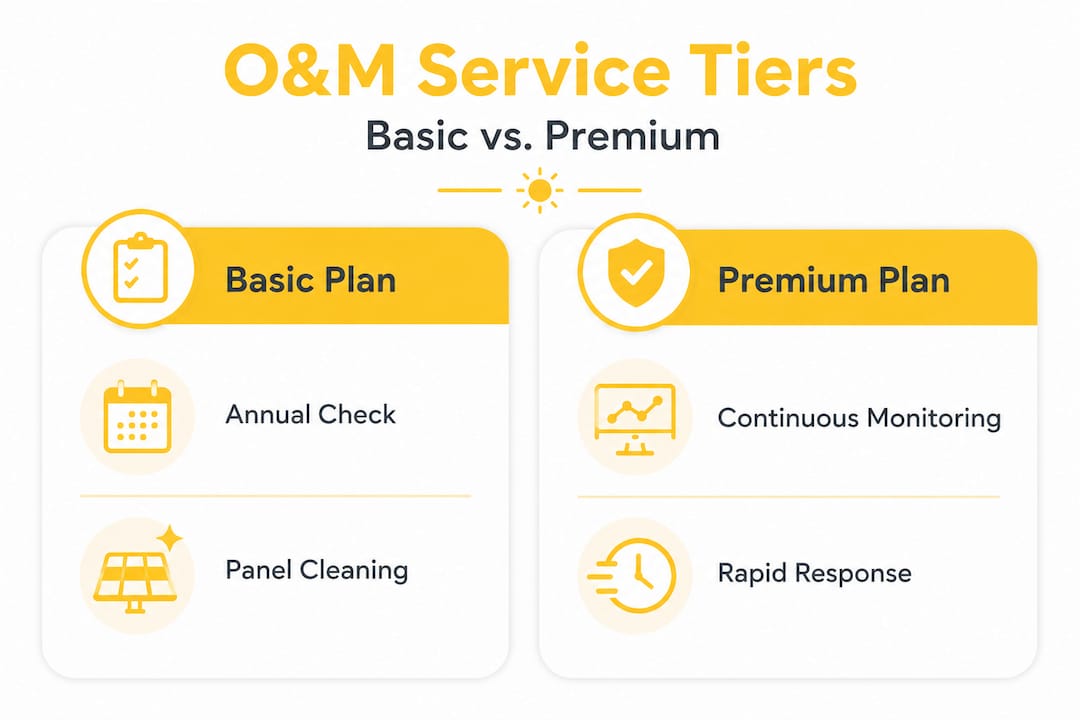
Residential O&M subscriptions typically range from $99 to $150 per year for basic plans, $250 to $400 for standard plans, and $500 to $800 for premium plans, with increasing levels of preventive services, diagnostics, cleaning, and priority response.
| Service tier | Typical annual cost | What is included |
|---|---|---|
| Basic | $99 to $150 | Annual system check, performance report, alert monitoring |
| Standard | $250 to $400 | Semi-annual inspections, inverter diagnostics, connection checks, reporting |
| Premium | $500 to $800 | Quarterly inspections, panel cleaning, thermal imaging, benchmarking, priority dispatch |
Key considerations by tier:
- Basic plans suit homeowners with newer systems under active manufacturer warranties who primarily want monitoring and documentation
- Standard plans add meaningful diagnostics and are appropriate for systems between three and eight years old
- Premium plans make the most financial sense for older systems, high-output installations, or homes in regions with extreme weather, heavy soiling, or high utility rates where lost production is most costly
Pro Tip: Calculate your annual energy production value first. If your system generates $2,400 per year in avoided utility costs, a $400 standard O&M plan costs roughly 17 percent of that value and protects the remaining 83 percent. Frame O&M cost as insurance, not overhead.
Understanding your financing options can make O&M contracts easier to budget, especially when bundling them with initial installation financing.
How recurring solar O&M contracts protect your investment better than reactive repairs
Call-when-it-breaks maintenance is the most expensive way to own a solar system. The numbers are not close.
Structured O&M keeps degradation rates near 0.5 percent annually through scheduled preventive care, versus up to 1.5 percent with neglect, and converts maintenance into predictable asset management with scheduled inspections, continuous monitoring, preventive replacements, and guaranteed response times.
That gap compounds. On a 10 kW system over 20 years, the difference between 0.5 and 1.5 percent annual degradation represents thousands of dollars in lost energy production, none of which a warranty reimburses.
Additional benefits of recurring contracts over reactive repairs:
- Predictable costs: Annual subscriptions eliminate the shock of a $1,200 inverter diagnostic call or a $600 emergency roof visit
- Faster issue resolution: Contracted providers prioritize account holders; uncontracted calls go to the end of the dispatch queue
- Warranty management: O&M providers document all service actions, creating the paper trail manufacturers require before approving warranty claims
- Continuity of care: If your original installer exits the market, a contracted O&M provider maintains system knowledge and service history
Unplanned corrective maintenance typically costs two to five times more per repair incident than the same work performed under a structured contract with pre-negotiated labor rates and parts access.
This is particularly relevant for homeowners whose installer goes out of business. Without an independent O&M contract, system history and monitoring access can disappear entirely. A solar second opinion before you sign helps verify that the O&M terms in your proposal actually deliver the protection they advertise.
Why many homeowners overlook solar O&M contracts, and what they miss
The most common pattern: a homeowner installs solar, receives a warranty document, and considers the system covered. The installer offers an O&M plan as an add-on, it reads like optional insurance, and the homeowner declines to save money.
That decision reflects a misunderstanding of how solar systems actually fail. Most performance losses are gradual and invisible. A string of panels degrading five percent faster than expected does not trigger an alarm. It shows up as a slowly rising utility bill that most homeowners attribute to rate increases, not panel underperformance.
Many homeowners mistakenly believe that installer warranties and reactive repairs are sufficient, ignoring the role of preventive O&M in managing both performance and safety risks.
What homeowners consistently miss:
The detection-to-fix chain. An O&M contract formalizes the full sequence: monitoring detects an anomaly, a technician performs diagnostics, a repair is dispatched within a defined timeframe, and the fix is documented. Without a contract, you may receive an alert from a monitoring app with no guaranteed path to resolution and no accountability if nothing gets fixed.
Data integrity. Monitoring sensors drift over time. If your performance data is inaccurate, you cannot detect real degradation, and you cannot substantiate a warranty claim. O&M contracts include sensor calibration specifically to prevent this.
Storm and environmental damage. Most O&M plans include protocols for post-storm inspections and damage documentation. Homeowners without contracts often discover damage months after an event, when documentation is harder and costs are higher.
The right O&M contract is not optional coverage. It is the accountability structure that makes your entire solar investment function as intended. Reviewing why every solar quote needs an independent check applies equally to the O&M terms embedded in that quote.
How Solar Repair Today helps you choose the right solar O&M contract
Choosing an O&M contract without a second set of eyes is a common way to end up underprotected or overpaying. Solar Repair Today's expert review service examines the full scope of your agreement before you commit.
Through the Before You Sign intake program, you can submit your O&M proposal for an independent review of service scope, SLA terms, monitoring provisions, pricing tiers, and potential red flags. Our reviewers compare what the contract promises against what providers in your market typically deliver. Need to understand financing options for bundling O&M into your installation agreement? That is part of the review too. Submit your solar proposal and get clarity before signing anything.
Frequently asked questions
What is the difference between a solar warranty and an O&M contract?
A solar warranty covers defects in labor and materials for a limited time, while an O&M contract provides ongoing maintenance and monitoring to keep your system safe and efficient over its lifespan. As one industry guide notes, a workmanship warranty covers defects for the first few years; an O&M contract fills the gap with regular inspections, monitoring, and corrective repairs.
How much do solar O&M contracts typically cost for homeowners?
Residential O&M contracts range roughly from $99 to $800 per year depending on the service tier, with higher tiers providing more preventive care and faster repair response times. Residential subscriptions are commonly tiered at approximately $99 to $150 per year for basic, $250 to $400 for standard, and $500 to $800 for premium.
Why is preventive maintenance important for my solar panels?
Preventive maintenance helps identify and fix issues early, ensuring safe operation, accurate performance data, and avoiding costly system failures. Preventive O&M is essential for long-term safety and performance, including inspections and sensor calibration across the system's full lifespan.
Can I rely on reactive repairs instead of signing an O&M contract?
Relying only on reactive repairs leads to higher costs, longer downtime, and untracked performance losses; structured O&M contracts typically save money and protect your system more effectively over time. Unplanned corrective maintenance costs more and results in lost energy production that a warranty will not reimburse.
What should I look for when reviewing a solar O&M contract?
Check for a detailed scope of work, service level agreements with defined response times, named monitoring tools, inspection schedules, reporting frequency, and warranty coordination clauses. A well-structured agreement clearly specifies responsibilities, SLAs, diagnostic methods, reporting cadence, and risk allocation terms for every service scenario.