

When you review solar production guarantees quotes, the numbers on paper rarely tell the full story. A promise of 10,000 kWh per year sounds solid until the first bill arrives and your system falls short. Many homeowners sign contracts without understanding what the guarantee actually covers, how compensation gets calculated, or what voids the whole thing. This guide breaks down every layer of a solar production guarantee so you can compare quotes with precision, spot weak contracts before signing, and protect your investment from day one.
Table of Contents
- Key Takeaways
- How to review solar production guarantees quotes
- Evaluating and comparing quotes step by step
- Homeowner obligations that keep coverage valid
- What to do when production falls short
- My take on what most guarantees actually deliver
- Protect your investment before you sign
- FAQ
Key Takeaways
| Point | Details |
|---|---|
| Guarantee vs. warranty | Production guarantees promise annual kWh output; product warranties cover panel degradation over decades. |
| P90 beats P50 | Demand P90-based estimates in quotes — P50 values underperform half the time. |
| Red flags cost money | Vague baselines, banking clauses, and monitoring gaps can eliminate your payout rights. |
| Homeowner obligations matter | Keeping monitoring online and scheduling routine maintenance are required to preserve coverage. |
| Get a second opinion | Independent proposal review catches weak guarantees and contract errors before you sign. |
How to review solar production guarantees quotes
Most homeowners assume all solar production guarantees work the same way. They do not. The term "production guarantee" refers to a contractual promise that your system will generate a specific number of kilowatt-hours over a defined period, typically one year or the full contract term. If it falls short, the installer owes you compensation. That is distinct from two other documents you will see in every solar contract.
A performance warranty (also called a panel degradation warranty) covers how much power output your panels retain over time. Solar panels degrade at 0.4% to 0.8% annually, and manufacturers typically guarantee at least 80 to 90 percent output after 25 years. This warranty does not pay you for annual shortfalls. A product warranty covers defects in materials and workmanship. Neither replaces a production guarantee.
Baseline estimates: P50 vs. P90

The number used to set your production target matters more than most sales teams admit. P50 values represent a 50/50 estimate of annual output, meaning your system will produce less than that figure half of all years. P90 values are the threshold the system will exceed 9 out of 10 years, accounting for weather variability and model uncertainty. Using a P50 estimate as a guarantee baseline is a documented industry problem, not a technicality.
Key contractual terms to understand before you compare any two quotes:
- Coverage threshold: Guarantees typically cover 84% to 95% of estimated output, depending on the installer. The closer to 100%, the stronger the protection.
- Banking clauses: Overproduction in one year can offset a shortfall in the next, reducing the chance you ever receive a payout. This is a standard feature homeowners rarely notice until they file a claim.
- Measurement source: Inverter monitoring and utility meters read production differently. Confirm which one governs your contract.
- Weather normalization: Some contracts let installers adjust production numbers for unusual weather. Broad normalization language is a major red flag.
- Exclusions: Grid outages, equipment failure outside warranty, owner modifications, and monitoring gaps may all remove compensation eligibility.
Pro Tip: Ask every installer which production model they used, P50 or P90, before comparing output numbers. A quote based on P90 is more reliable even if the headline figure looks smaller.
Evaluating and comparing quotes step by step
Comparing quotes on price per watt alone misses the most expensive variable: what happens when production falls short. Use this framework when you compare solar production quotes across installers.
-
Verify baseline inputs. Request the shading analysis, tilt angle, azimuth, and location data used to calculate estimated production. Any quote missing these details cannot be verified and should not be trusted.
-
Confirm the measurement method. Ask whether production is tracked through inverter data, a utility meter, or a third-party monitoring platform. Clarify who owns the data and how long records are retained.
-
Analyze the compensation formula. Cash payouts for triggered guarantees typically range from $0.10 to $0.20 per missing kWh. Know whether you receive cash, a bill credit, or a repair-first remedy before any payout.
-
Map the exclusions. List every scenario in which the guarantee does not apply. Common entries include monitoring outages, grid disconnections, acts of nature, and owner-initiated changes to the system.
-
Check the guarantee duration. Some guarantees cover only year one. Others span the full 20 to 25-year contract. Multi-year guarantees with banking clauses are not the same as true long-term protection.
-
Compare numeric thresholds side by side. A 90% coverage threshold from one installer and an 84% threshold from another is a significant difference at scale. On a 10,000 kWh system, that gap is 600 kWh per year, which translates to real dollars on every annual shortfall.
Use this table to structure your comparison across multiple quotes:
| Evaluation Factor | Strong Guarantee | Weak Guarantee |
|---|---|---|
| Baseline estimate | P90 | P50 |
| Coverage threshold | 90% or above | Below 85% |
| Banking clause | Absent or limited | Broad multi-year banking |
| Compensation type | Cash payout per kWh | Repair-first only |
| Monitoring requirement | Clearly defined | Vague or absent |
| Weather normalization | Narrow scope | Broad exclusion |
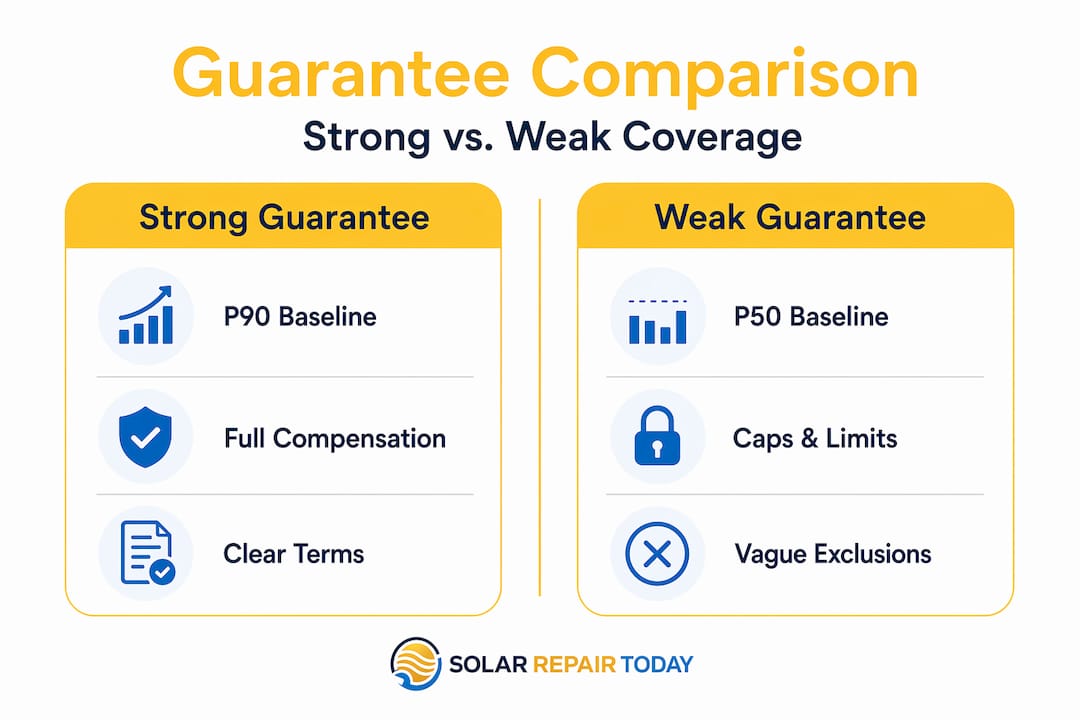
Red flags in production guarantees include vague baseline inputs, compensation caps, broad exclusions, and the absence of any written guarantee document. Any of these can result in zero payout even when underperformance is documented.
Pro Tip: Request the guarantee as a standalone written document separate from the main contract. If an installer cannot produce one, treat that as a disqualifying issue.
Homeowner obligations that keep coverage valid
Signing a contract with a strong production guarantee does not end your responsibilities. Most guarantees include conditions you must maintain throughout the coverage period. Failure to meet them can void your claim rights entirely.
- Monitoring connectivity: Continuous monitoring system connectivity is required by many guarantees. If your internet connection drops or your monitoring gateway fails and you do not report it, that period may be excluded from production calculations.
- Vegetation management: Trees or structures that create new shading after installation can give installers grounds to reduce guarantee obligations. Keep trimming schedules documented.
- Panel cleaning: Soiling reduces output. Some contracts specify cleaning intervals. Check yours for language that ties cleaning to coverage terms.
- Prompt issue reporting: Equipment faults that go unreported create liability gaps. Most contracts require you to notify the installer within a specific number of days of detecting a problem.
- No unauthorized modifications: Adding panels, changing inverter settings, or installing battery storage through a third party without notifying your original installer can trigger exclusion clauses.
Homeowners must look beyond installation warranties to cover labor and battery replacement, as these become significant cost drivers after the manufacturer warranty ends. Understanding all obligation terms before signing is how you protect your rights without surprises later.
What to do when production falls short
If your system is not hitting its guaranteed numbers, the response process matters. Acting quickly and methodically protects your claim eligibility.
-
Pull your monitoring data. Log into your inverter monitoring platform and download monthly production records. Compare them directly against the annual guaranteed figure in your contract.
-
Check for hardware issues. A single failed inverter or a shaded string of panels can reduce output significantly. Confirm that all equipment is functioning before attributing shortfalls to system design or weather.
-
Document shading changes. New construction, tree growth, or antenna installations near your property may be contributing factors. Photograph and timestamp any changes.
-
Submit a formal notice. Most contracts require written notice of a claim within a defined window, often 30 to 90 days after the end of the guarantee period. Missing this deadline forfeits your right to compensation.
-
Review the remediation process. Some installers default to a repair-first approach before issuing any cash payout. Confirm whether this is in your contract and what the timeline looks like.
-
Escalate if needed. If the installer disputes your claim or delays response past the contractual deadline, gather all documentation and consult a solar contract specialist or file a complaint with your state's contractor licensing board.
Replacement costs are not trivial. Replacing a solar panel averages $650, and inverter repair averages $483. Having a clear picture of who pays for what and when keeps those costs from landing on you unexpectedly.
My take on what most guarantees actually deliver
I've reviewed a lot of solar contracts, and the pattern is consistent. A production guarantee that sounds strong in the sales pitch almost always has at least one provision that limits its real-world value.
The P50 versus P90 issue comes up constantly. Sales teams present P50 estimates as if they are conservative projections. They are not. A P50 baseline means underperformance is expected half the time by definition. Engineering experts recommend P90 as the standard for any bankable guarantee, yet most homeowners never hear the term until after they sign.
Banking clauses are the second thing I always flag. They read like a benefit at first. Overproduction carries forward. Great. But in practice, a good year followed by two average years wipes out your payout eligibility entirely. Homeowners only notice this after years of below-expectation production with no compensation received.
What I've found actually works is insisting on written guarantees with specific numeric thresholds, P90 baselines, and cash payout formulas before any contract discussion moves to financing. If an installer will not put those terms in writing, that tells you everything. The contracts worth signing are the ones that hold up to scrutiny before you get to the signature page.
— David
Protect your investment before you sign
Before committing to any solar contract, an independent review of your proposal is one of the most direct ways to avoid a costly mistake. Solarrepairtoday's proposal review service examines production guarantees, system sizing, equipment specs, and warranty terms to identify gaps and red flags in your quote.

For homeowners navigating complex financing structures alongside guarantee terms, the contract financing review service breaks down loan terms, escalator clauses, and buyback provisions to confirm the full financial picture. Both services are built for homeowners who want a clear answer before signing, not after. Submit your proposal through the "Before You Sign" intake program and get a qualified second opinion on every term that matters.
FAQ
What is a solar production guarantee?
A solar production guarantee is a contractual promise from your installer that your system will generate a minimum number of kilowatt-hours over a defined period, typically one year. If production falls short of that threshold, the installer owes you cash, a credit, or a repair remedy.
How does a production guarantee differ from a performance warranty?
A production guarantee covers annual kWh output with compensation on shortfall, while a performance warranty covers panel degradation thresholds over 25 years without annual payouts. They are separate documents with different triggers and terms.
What does P90 mean in a solar guarantee?
P90 is a production estimate that your system will exceed 9 out of 10 years, making it a reliable baseline for guarantee contracts. P50 estimates have a 50 percent chance of underperformance and should not be used as guarantee baselines.
What voids a solar production guarantee?
Common triggers include monitoring connectivity outages, failure to report equipment issues promptly, unauthorized system modifications, and vegetation changes that create new shading. Review your exclusion clauses carefully before assuming coverage is automatic.
How much compensation can I expect if my guarantee triggers?
Cash payments for triggered guarantees typically range from $0.10 to $0.20 per missing kWh, though some contracts offer bill credits or a repair-first process instead of direct cash payout.