

Your utility bill is the single most important document you can hand to a solar company before requesting a quote. It contains the baseline energy data that determines system size, projected savings, and total cost. Without it, any solar estimate is a rough guess. When you use your utility bill to get a solar quote, you give installers the raw numbers they need to build a proposal tailored to your actual home. This guide explains exactly what data matters, how solar companies use it, and how to compare what comes back.
How to use your utility bill for a solar quote
The industry term for this process is load analysis. Solar companies pull specific data points from your bill to calculate how much electricity your home consumes and what it costs you. That analysis drives every number in your quote.
The key data points solar companies extract from your bill:
- Monthly kWh usage. This is the core metric. It tells installers how much electricity your home consumes each month. Annual consumption, the sum of 12 months, is the primary input for system sizing.
- Per-kWh electricity rate. Your rate determines how much each unit of solar production is worth in savings. A home paying $0.18/kWh saves more per panel than one paying $0.10/kWh.
- Fixed charges. Line items like grid access fees or customer service charges remain on your bill even after going solar. Fixed charges cannot be offset by solar production, and quotes that ignore them overstate your savings.
- Billing period dates. These confirm which months are included and flag any gaps in your usage history.
- Utility provider name. Net metering policies vary by utility. Knowing your provider lets installers apply the correct credit rate for excess energy your system sends to the grid.
Using 12 months of billing history captures seasonal variation and leads to more accurate solar system sizing. A single summer bill inflates your apparent usage. A single winter bill understates it. Both produce a mismatched system.
Pro Tip: Log into your utility provider's online account portal. Most utilities, including Pacific Gas & Electric, Duke Energy, and Xcel Energy, allow you to download 12 to 24 months of billing history as a PDF or CSV in under five minutes.

How solar companies turn your bill data into a custom quote
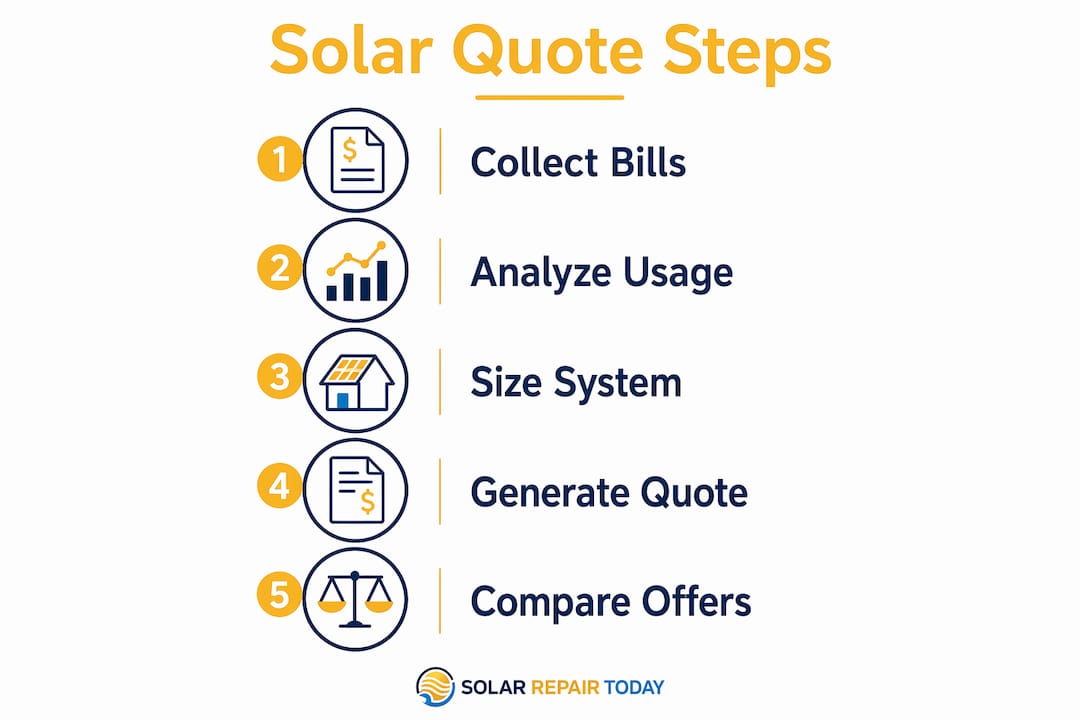
Solar installers do not simply read your kWh total and multiply by a panel count. The quoting process combines your bill data with external inputs to produce a system-specific proposal.
Here is the standard sequence most installers follow:
- Annual usage calculation. The installer totals your 12-month kWh consumption to establish your baseline load. This number anchors the entire quote.
- Rate and net metering modeling. Your per-kWh rate and your utility's net metering policy are entered into the savings model. Net metering credits you for excess electricity sent to the grid, which directly affects your projected bill reduction.
- Solar resource assessment. Tools like PVWatts or Aurora Solar overlay your location's sun hours and weather data onto your usage profile to estimate how much energy a given system size will produce annually.
- Roof analysis. Shading, orientation, pitch, and available square footage determine how many panels fit and how efficiently they will produce. This step adjusts the raw production estimate downward for real-world conditions.
- Incentive application. The federal Investment Tax Credit (ITC), state rebates, and local utility incentives are applied to the gross system cost to produce a net price.
- Quote assembly. A quality solar estimate returns recommended system size in kilowatts, projected annual energy production in kWh, estimated monthly savings, and total cost after incentives.
The output is only as accurate as the inputs. An installer working from one month of bill data, or from a verbal estimate of your usage, is building a quote on a weak foundation.
Step-by-step: preparing and submitting your bills for solar quotes
Gathering your bills correctly before contacting installers saves time and produces better proposals. Follow these steps:
- Locate 12 months of bills. Check your utility's online account portal first. Physical paper bills work too, but digital copies are faster to share. If you moved recently and lack a full year, request usage history directly from your utility's customer service line.
- Identify the key numbers. On each bill, note the billing period, total kWh used, and the total amount charged. Some bills break out the per-kWh rate separately; others require you to divide total charges by total kWh to calculate it.
- Scan or export cleanly. If submitting paper bills, scan at 300 DPI minimum. Blurry or cropped images cause delays. Digital PDF exports from your utility portal are preferable.
- Use quote aggregator platforms carefully. Platforms like EnergySage collect your address and utility bill data to provide vetted quotes via email, which reduces the volume of sales calls you receive. Submit accurate data; the quality of quotes returned depends entirely on what you enter.
- Disclose future usage changes. Mentioning future plans like adding an electric vehicle or battery storage allows installers to size your system for anticipated usage, not just current usage. A system sized only for today's load may fall short within two years.
Pro Tip: Before submitting bills to any installer, redact your account number and banking information if visible. Your kWh data and rate information are all a solar company needs. Protecting account details is a basic security practice.
Common mistakes to avoid:
- Submitting only one or two months of bills
- Using bills from a previous address or a rental property
- Failing to mention a recent major appliance addition, such as a pool pump or HVAC replacement, that changed your consumption pattern
How to compare solar quotes using your bill data as a baseline
Comparing solar quotes effectively requires understanding the assumptions behind each proposal, not just the headline price. Two quotes showing similar monthly savings can be built on entirely different models.
Use this comparison framework when evaluating proposals side by side:
| Quote element | What to check against your bill |
|---|---|
| System size (kW) | Does the proposed kW output match your annual kWh consumption divided by your location's average sun hours? |
| Annual production (kWh) | Compare to your actual annual usage. A well-sized system covers 90 to 100 percent of consumption. |
| Estimated savings ($/year) | Verify the electricity rate used. If the quote assumes $0.20/kWh but your bill shows $0.13/kWh, savings are overstated. |
| Net metering assumptions | Confirm the installer used your utility's actual credit rate, not a generic statewide average. |
| Fixed charge treatment | Check that the quote does not promise to eliminate charges solar cannot offset. |
Mismatch in electricity rates or production assumptions in solar quotes can mislead homeowners about expected savings. Ask every installer to show you the rate and production assumptions in writing. If they cannot or will not, that is a red flag. Not all solar quote prices include the same incentives or treat financing terms equally, so request itemized breakdowns before making any decision.
Common pitfalls when using your utility bill for solar quotes
Several errors consistently reduce quote accuracy or create problems after installation.
- Partial bill submissions. Submitting three or four months instead of a full year forces installers to extrapolate. Extrapolated usage estimates are frequently wrong by 15 to 25 percent, which translates directly into an undersized or oversized system.
- Ignoring usage changes. If you recently added an EV charger, replaced an old refrigerator, or changed your HVAC system, your current bills may not reflect your future consumption. Flag these changes explicitly when submitting your data.
- Misreading tiered rates. Many utilities use tiered pricing, where the rate per kWh increases after a usage threshold. If your bill shows multiple rate tiers, make sure the installer accounts for all of them in the savings model, not just the base rate.
- Accepting zero-bill promises at face value. Some installers promise a $0 electricity bill. In most utility territories, fixed grid access fees make a true zero bill impossible. A quote that promises otherwise is not accounting for your full bill structure.
- Not verifying net metering eligibility. Net metering availability and credit rates vary by state and utility. Confirm your utility's current policy before accepting savings projections that depend on full retail-rate credits. Your utility's customer service line or website will have the current policy on file.
When a bill component confuses you, call your utility directly. Most utilities have customer service representatives who can explain line items, confirm your rate schedule, and provide usage history in a format suitable for solar quoting.
Key takeaways
Accurate solar quotes depend on complete, correctly interpreted utility bill data submitted to installers before any proposal is built.
| Point | Details |
|---|---|
| Submit 12 months of bills | Seasonal variation in usage requires a full year of data for accurate system sizing. |
| Know your fixed charges | Grid access fees remain after going solar; quotes that ignore them overstate savings. |
| Verify rate assumptions | Confirm each quote uses your actual per-kWh rate, not a regional average. |
| Disclose future usage plans | Adding an EV or battery storage changes your load; tell installers before they size your system. |
| Request itemized breakdowns | Incentives and financing terms differ across quotes; line-item detail reveals hidden cost differences. |
Why utility bill literacy changes the outcome
I have reviewed hundreds of solar proposals submitted through Solarrepairtoday's "Before You Sign" intake program. The pattern is consistent: homeowners who arrive with 12 months of organized utility data receive more accurate proposals and catch more errors before signing. Homeowners who submit a single bill, or none at all, often receive quotes built on assumptions that favor the installer's preferred system size.
The most common error I see is a quote that uses a utility rate 20 to 40 percent higher than what the homeowner actually pays. That gap makes the savings projection look far better than reality. When you know your actual rate from your bill, you can spot this immediately. If an installer quotes savings based on $0.22/kWh and your bill clearly shows $0.14/kWh, the savings estimate is inflated by more than 50 percent. That is not a minor rounding error. It changes the payback period by years.
The second pattern I see regularly is homeowners accepting net metering assumptions without checking their utility's current policy. Net metering rules have changed in California, Nevada, and several other states in recent years. A quote built on an outdated credit rate produces savings projections that will never materialize. Your utility bill and a quick call to your provider confirm the current policy in minutes. That five-minute check can save you thousands of dollars in misplaced expectations.
Utility bill literacy is not a technical skill. It is a basic verification habit. Bring your bills, know your numbers, and ask installers to show their work.
— David
Get an independent review before you sign
Solarrepairtoday's "Before You Sign" intake program gives homeowners an independent review of solar proposals before any contract is signed. Submit your utility bill, solar quote, or proposal details, and the Solarrepairtoday team checks system sizing, pricing, equipment specs, financing terms, and savings assumptions against your actual usage data. The service flags red flags, identifies overstated savings claims, and confirms whether the proposed system matches your real consumption. If you have received multiple quotes and want a clear comparison grounded in your utility bill data, the solar quote comparison service provides that analysis without sales pressure. For homeowners reviewing financing options, the solar financing review service examines loan and lease terms in detail.
FAQ
What information from my utility bill do solar companies need?
Solar companies need your monthly kWh usage, billing period dates, per-kWh electricity rate, and your utility provider's name. Twelve months of bills are preferred to capture seasonal usage variation.
Why do solar quotes require 12 months of utility bills?
Energy use fluctuates seasonally, and a single bill cannot represent your full annual consumption accurately. A full year of data produces a system size matched to your actual load across all seasons.
Can solar eliminate my entire electricity bill?
Solar production offsets your variable energy charges, but fixed utility fees like grid access charges remain regardless of how much your system produces. A true zero bill is rare in most utility territories.
How do I know if a solar quote's savings estimate is accurate?
Check the electricity rate the installer used and compare it to your actual rate on your bill. Also confirm the net metering credit rate matches your utility's current policy. Discrepancies in either number will inflate projected savings.
What should I do if I receive quotes with very different savings projections?
Request the assumptions behind each quote in writing, specifically the electricity rate, annual production estimate, and net metering credit rate. Use your utility bill to verify each assumption against your actual usage and rate data before comparing final numbers.