

You installed solar panels, expected your electric bill to shrink to near zero, and then the utility statement showed up anyway. This is one of the most common points of confusion among solar homeowners, and the frustration is real. Why solar bills still arrive has everything to do with how the electrical grid works, how utilities structure their billing, and how newer policies like NEM 3.0 have changed the credit math. The answer is not a mystery. It is a billing system most installers never fully explain before you sign.
Table of Contents
- Key takeaways
- Why solar bills still arrive: the grid connection reality
- How NEM 3.0 reshaped solar credits
- Fixed fees and charges solar credits cannot touch
- The timing mismatch problem
- Practical strategies for lowering your bill
- My take on solar billing confusion in 2026
- Get clarity on your solar bills with Solarrepairtoday
- FAQ
Key takeaways
| Point | Details |
|---|---|
| Grid connection fees persist | Fixed monthly fees of $10 to $15 remain even when solar offsets all energy consumption. |
| NEM 3.0 cuts export credit value | Export credits are now 75 to 90% lower than retail rates, reducing bill offsets significantly. |
| Timing mismatches drive costs | Solar produces during the day but homes consume most electricity at night, triggering costly grid imports. |
| Non-bypassable charges cannot be offset | Certain mandated fees apply per kWh imported and cannot be cancelled by solar credits. |
| Battery storage changes the equation | Storing daytime solar for evening use reduces grid imports and lowers bills under time-of-use billing. |
Why solar bills still arrive: the grid connection reality
The most overlooked fact in solar sales is this: the majority of residential solar systems are grid-tied. They do not run independently. When your panels stop producing, at night or on cloudy days, your home draws power from the utility grid exactly like it did before installation.
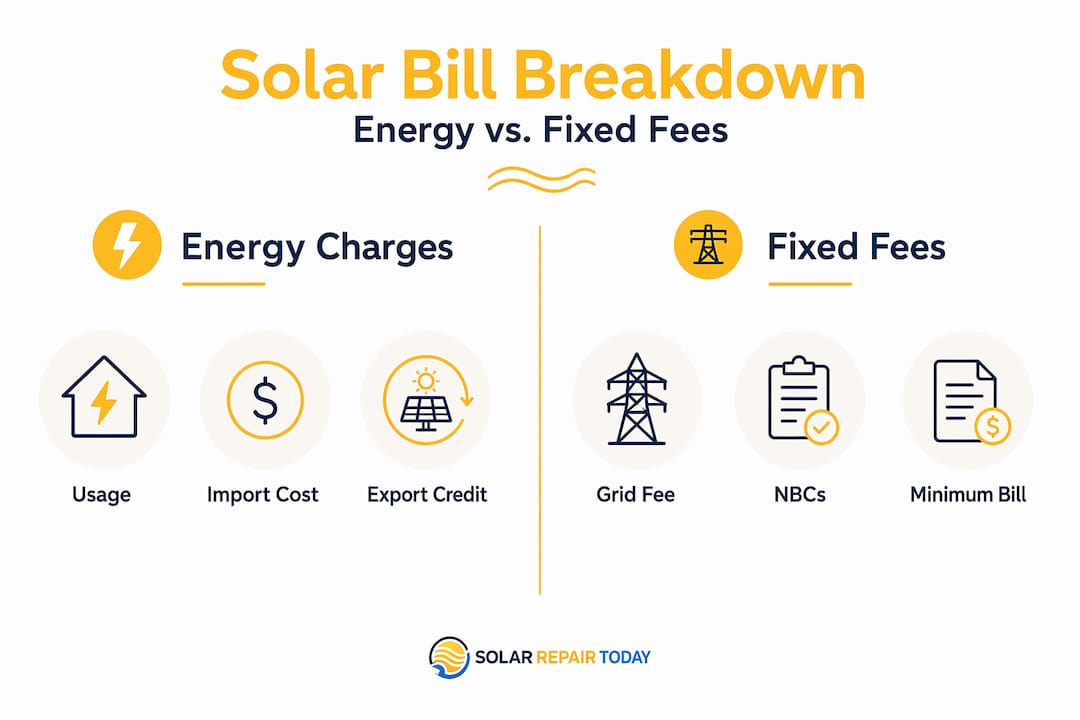
Grid access carries fixed costs regardless of how much energy you produce. These are not energy charges. They cover infrastructure: the poles, wires, meters, and transformers that keep your home connected. Utilities label them as customer service charges, meter fees, or distribution access fees.
- Fixed monthly fees typically range from $10 to $15 per month, totaling $120 to $180 per year.
- These fees appear on every bill, even in months when solar production exceeds total household consumption.
- Net metering programs allow surplus energy to flow back to the grid for credits, but those credits offset energy charges only, not fixed fees.
- Net billing programs (such as NEM 3.0) go further by reducing the value of those credits, which compounds the billing impact.
Pro Tip: Ask your utility to itemize every fixed charge on your current bill before evaluating whether solar is performing as promised. If you see line items for "meter services" or "distribution access," those will remain no matter how many panels you add.
Understanding this distinction between energy charges and infrastructure charges is the starting point for making sense of any solar bill explanation your utility provides.
How NEM 3.0 reshaped solar credits
Net metering originally gave solar homeowners a straightforward deal: export one kilowatt-hour to the grid, receive one kilowatt-hour of credit at the retail rate. That 1:1 exchange is largely gone in California and under increasing pressure in other states.
Under NEM 3.0, export credits average $0.05 to $0.08 per kWh while retail import rates can exceed $0.30 to $0.40 per kWh. That is a gap of roughly four to six times in value. You export energy cheaply and import energy expensively.
Here is how that plays out numerically:
| Scenario | Export (kWh) | Credit Rate | Import (kWh) | Import Rate | Net Bill |
|---|---|---|---|---|---|
| NEM 1.0 (retail) | 300 | $0.32/kWh | 300 | $0.32/kWh | $0.00 |
| NEM 3.0 (avoided cost) | 300 | $0.06/kWh | 300 | $0.32/kWh | $78.00 |
The same physical energy exchange produces a $78 bill under NEM 3.0 where it would have produced a zero balance under earlier net metering rules. Many homes were sold solar systems expecting 1:1 net metering, but the shift to net billing and time-of-use rates creates this export-import value mismatch.
Pro Tip: If your system was installed before NEM 3.0 took effect in your state, verify whether you are grandfathered into the older rate structure. Some utilities honor the original net metering terms for 10 to 20 years after installation date.
The financial impact of this policy shift is one of the core reasons solar billing issues persist even for homeowners with correctly sized and fully operational systems.
Fixed fees and charges solar credits cannot touch
Beyond grid connection fees, utilities layer in a category called non-bypassable charges, or NBCs. These are mandated by state regulators and fund public-purpose programs: low-income assistance, wildfire prevention, energy efficiency programs, and nuclear decommissioning costs in some states.
Non-bypassable charges typically add $0.02 to $0.03 per kWh to every unit of electricity imported from the grid. Solar production credits cannot offset these charges. They apply to every kWh drawn from the grid, period.
Several categories of fixed charges show up regularly on solar customer statements:
- Customer service charge: A flat monthly fee for account maintenance, typically $5 to $10.
- Meter charge: Covers reading and maintaining your meter, often $3 to $8 per month.
- Distribution access fee: Covers your connection to local distribution infrastructure.
- Non-bypassable charges: Applied per kWh imported, funding state-mandated programs.
- Minimum bill requirement: Some utilities set a billing floor. Even if your credits exceed your energy charges, you still owe a minimum amount, often $10 to $15.
Rising fixed charges decouple grid maintenance costs from actual consumption, which means the savings that solar generates on energy charges become less impactful as fixed costs grow. This is why understanding solar payments requires looking at the full bill structure, not just the energy portion.
If you want to understand why certain solar energy charges appear despite high production, a review of your specific billing structure can identify which charges are offsettable and which are not.
The timing mismatch problem
Solar panels peak between roughly 10 a.m. and 3 p.m. Most households hit peak consumption in the evening, after 5 p.m., when people return home, appliances run simultaneously, and panels have stopped or nearly stopped producing. This mismatch is sometimes called the "Solar Paradox."
Peak grid hours run from late afternoon to evening when solar output is low or zero. Under time-of-use billing, that is exactly when electricity costs the most. A homeowner might export surplus energy at noon for $0.06 per kWh and then import evening electricity at $0.38 per kWh.
The consequences are direct:
- Daytime exports earn low-value credits.
- Evening imports are billed at peak rates, often three to six times higher.
- Annual production totals may look impressive, but the credit-to-cost ratio is unfavorable.
- Homeowners pay retail rates for nighttime imports while receiving well below retail for daytime exports.
Battery storage addresses this directly. Battery systems help avoid the export-import loss cycle by storing midday solar energy for use during high-rate evening hours, increasing self-consumption instead of cheap exports.
Without storage, solar panel utility bills remain tied to grid rates for evening consumption. With storage, you spend more of your own solar energy and buy less from the grid at peak prices.

Practical strategies for lowering your bill
Knowing why bills persist is only half the value. Here are concrete steps to reduce costs under current billing frameworks.
-
Shift high-consumption tasks to daylight hours. Run dishwashers, washing machines, EV chargers, and pool pumps between 10 a.m. and 2 p.m. when solar production is at its peak. Every kWh you consume directly from your panels is a kWh you do not export cheaply or import expensively later.
-
Get a battery storage system reviewed before purchasing. A solar battery proposal review can confirm whether the system is sized correctly for your usage pattern and whether the economics make sense under your utility's specific rate plan.
-
Understand your utility's time-of-use rate tiers. Not all TOU plans are the same. Some utilities offer solar-friendly plans with better export rates or lower peak-hour premiums. Switching rate plans costs nothing and can noticeably reduce your bill.
-
Monitor your system's production data monthly. Do not wait for the year-end true-up bill. True-up bills can reach $1,000 to $3,000 when homeowners accumulate deficits unknowingly. Monthly tracking catches problems early.
-
Check for demand charges on your account. Demand charges are billed based on peak power draw within short intervals and are difficult to offset with solar production alone. If your utility applies them to residential accounts, battery storage combined with smart load management is the most effective response.
-
Review your solar proposal or contract for billing guarantees. Some installers include production guarantees or offset projections. If actual performance falls short, you may have recourse. An independent proposal review can clarify whether stated projections were realistic.
My take on solar billing confusion in 2026
I have reviewed hundreds of solar proposals and post-installation bills. The pattern is consistent. Homeowners were told their bill would "go to zero" or "nearly zero." That framing was never accurate, and it became actively misleading once NEM 3.0 and expanded TOU billing took hold.
The costs after installing solar do not disappear. They change form. Fixed charges remain. NBC fees remain. And for homes without battery storage, the timing mismatch creates a structural billing disadvantage that no amount of added panels will fix. More panels just means more cheap exports, not lower bills.
What I have found actually works is a combination of honest pre-installation education and proper system sizing that accounts for the homeowner's specific usage profile and utility rate structure. A 7 kW system sized for a homeowner who is home all day looks completely different from one sized for a household that consumes primarily in the evenings.
The single most common mistake I see is homeowners signing contracts based on annual kWh projections without understanding how billing timing affects the real cost. Annual production numbers look great. Monthly billing reality is a different conversation.
Every homeowner I have worked with who added battery storage and shifted loads to daylight hours saw meaningful bill reductions. Those who only added panels to a TOU-billed account often saw minimal improvement or, in some cases, higher bills.
— David
Get clarity on your solar bills with Solarrepairtoday
If you are staring at a solar bill that does not match what you were promised, Solarrepairtoday provides independent reviews designed specifically for this situation.

Through the "Before You Sign" intake program, homeowners submit their solar proposal, utility bill, or existing contract for a diagnostic review. The review covers system sizing, equipment selection, financing terms, export credit assumptions, and battery backup options. If something does not add up in your billing structure, a solar contract financing review can identify where the projections went wrong and what your actual cost exposure looks like going forward. For homeowners evaluating new proposals, the Before You Sign review provides an independent second opinion before any commitment is made. Solarrepairtoday operates with no installer affiliations, which means the analysis reflects your interests, not a sales outcome.
FAQ
Why do I still get an electric bill with solar panels?
Solar panels reduce energy consumption but do not eliminate fixed grid connection fees, which typically range from $10 to $15 per month. These charges cover metering and infrastructure access and cannot be offset by solar production credits.
What are non-bypassable charges on a solar bill?
Non-bypassable charges are state-mandated fees of roughly $0.02 to $0.03 per kWh applied to every unit of electricity imported from the grid. Solar credits cannot offset them, so they appear on every bill regardless of how much energy your system produces.
How does NEM 3.0 affect my solar bill?
Under NEM 3.0, export credits are valued at $0.05 to $0.08 per kWh while import rates often exceed $0.30 per kWh. This gap means homeowners receive far less credit for energy they send to the grid than they pay for energy they draw back.
Can a battery storage system eliminate my electric bill?
Battery storage significantly reduces grid imports by storing surplus daytime solar energy for evening use, but fixed monthly connection and service fees will still appear on your bill. It is the most effective tool for minimizing variable charges under time-of-use billing.
What is a true-up bill and why is it so high?
A true-up bill is a year-end settlement of accumulated energy credits and debits. When export credits fall short of import costs throughout the year, the balance builds quietly and can reach $1,000 to $3,000 at settlement, often catching homeowners off guard.