

Most homeowners assume their solar system is performing at full capacity as long as the inverter shows a green light. That assumption is costing them money. The role of solar string monitoring goes well beyond basic status checks. It measures what your inverter display cannot show you: which strings are underperforming, where voltage anomalies are forming, and which faults are quietly eroding your energy output before they trigger any visible alarm. This article breaks down what string monitoring does, why it matters, and how to use the data it produces.
Table of Contents
- Key takeaways
- Role of solar string monitoring: what it is and how it works
- Why string monitoring matters for homeowners
- Common faults that string monitoring catches first
- String monitoring vs. module-level monitoring
- Using monitoring data to maximize savings
- My perspective: the green light problem is real
- Get an independent review before you commit
- FAQ
Key takeaways
| Point | Details |
|---|---|
| Green light does not mean optimal | Multi-MPPT inverters can hide underperforming strings, causing silent efficiency losses. |
| String monitoring catches early faults | Issues like partial shading and panel degradation show up in string data before triggering system alarms. |
| Monitoring improves financial returns | Systems with monitoring can improve overall performance by 10-20% and reduce maintenance costs significantly. |
| String vs. module-level is a real choice | Simple, uniform arrays can rely on string monitoring; shaded or complex systems benefit from panel-level visibility. |
| Data enables proactive decisions | Monitoring trends help schedule maintenance, plan upgrades, and integrate battery storage more effectively. |
Role of solar string monitoring: what it is and how it works
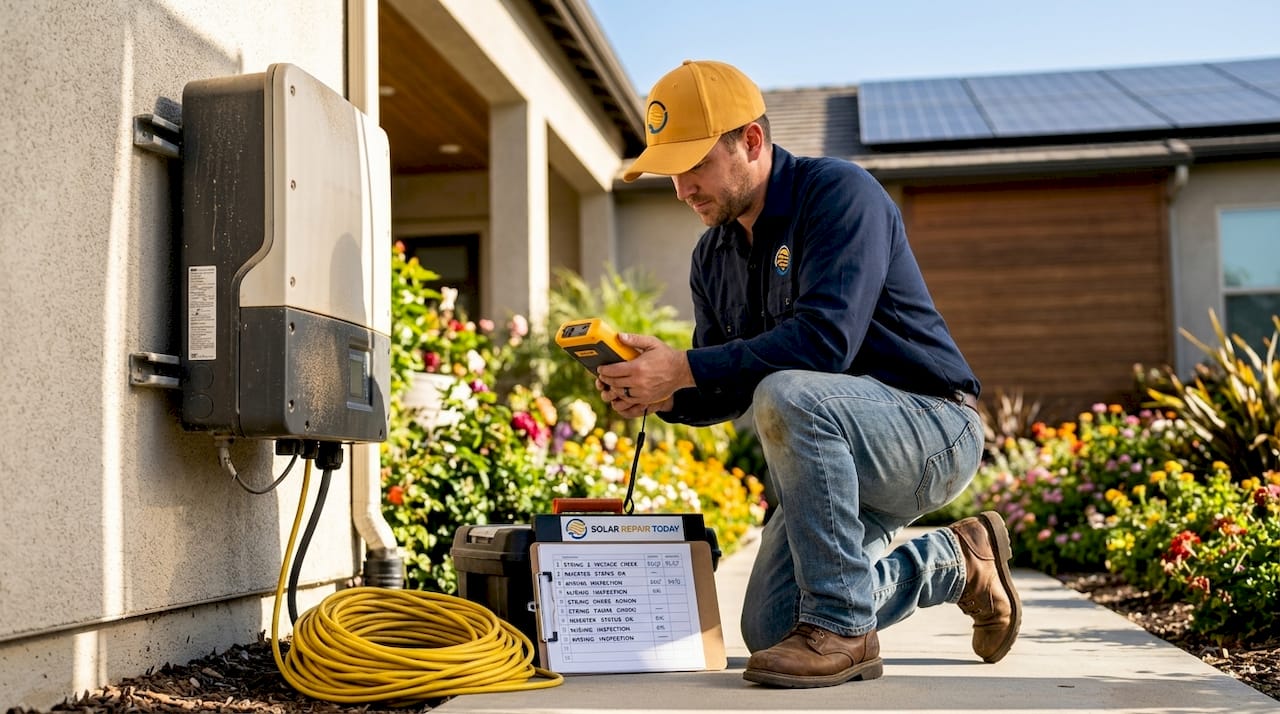
A solar string is a series of connected panels wired together to feed a single input on your inverter. Most residential systems have between one and four strings depending on roof layout and system size. String monitoring attaches hardware, typically a string monitoring unit or data logger, to each string to measure real-time current, voltage, and power output.
Here is what string monitoring tracks at the hardware level:
- Current (amperes): Detects drops that signal shading, failed cells, or loose connections
- Voltage (volts): Flags mismatches between strings that can push your inverter into a protection mode
- Surge protection device status: Confirms whether safety components are functioning or have tripped
- Circuit breaker status: Identifies disconnections at the string level before they cascade to the inverter
- Fault codes: Logs error events with timestamps for historical diagnostics
Data is collected through communication protocols like RS-485, Modbus, or wireless gateways, and then delivered to a monitoring platform accessible via desktop or mobile app. Modern AI-based monitoring systems can now classify seven distinct fault types with 93% accuracy, cutting fault identification time from days to hours.
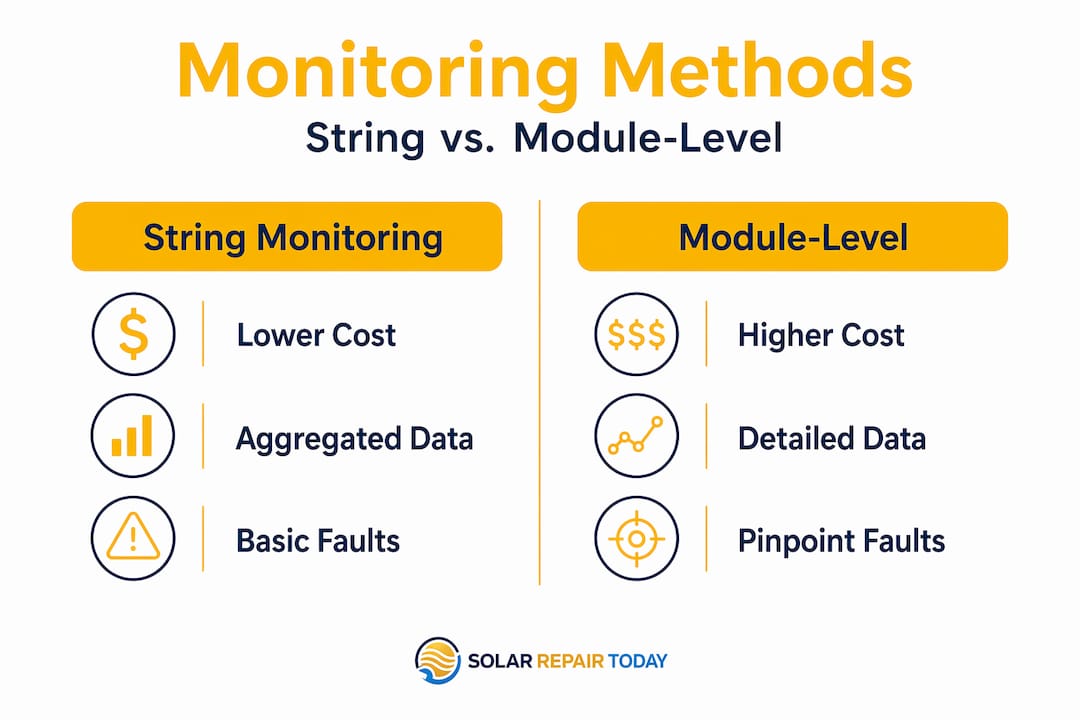
The key distinction is granularity. String monitoring gives you aggregated data per string. Panel-level monitoring, using optimizers or microinverters, gives you data per individual panel. String monitoring costs significantly less but covers less ground when faults are isolated to a single panel within a larger string.
Pro Tip: If your installer's proposal includes only a basic inverter display with no external monitoring hardware, ask specifically what string-level data you will have access to after installation. This detail often gets left out of initial quotes.
Why string monitoring matters for homeowners
The importance of solar monitoring becomes clear the moment you compare systems with and without it. Here is what monitoring delivers in practical terms:
-
Early fault detection before output losses compound. A slight deviation in string current often signals module degradation or partial shading. Without monitoring, that deviation goes unnoticed for months. Slight deviations in string current frequently precede large systemic failures that basic binary alarms miss entirely.
-
Reduced maintenance costs over time. Comprehensive solar monitoring can reduce maintenance-related costs by 30 to 50% over the life of the system by identifying faults before they require expensive repairs. Technicians who arrive on-site with string-level data spend less time diagnosing and more time fixing.
-
Better energy management decisions. Monitoring data shows when your system peaks, when it underproduces, and how seasonal shifts affect output. That information lets you time high-consumption activities, like running appliances or charging an EV, around your actual generation curve.
-
Stronger financial returns. Systems without monitoring may lose up to 20% of potential energy output due to undetected issues. A monitoring system typically pays for itself within two to four years through recovered generation and avoided repair costs.
-
Continuous performance oversight without manual checks. Automated alerts notify you when string output falls outside expected ranges. You do not need to log into a dashboard daily. The system flags anomalies for you.
The role of monitoring in solar energy is shifting from optional add-on to standard practice. The solar market is moving toward module-level monitoring as a default expectation, because waiting for faults to appear is consistently more expensive than early detection.
Common faults that string monitoring catches first
String monitoring does not just confirm your system is on. It catches the specific faults that quietly reduce your output over time.
-
Partial shading effects. A single shaded panel can drag down an entire string's output. Without string-level data, that performance loss blends into overall system output and looks normal. Monitoring isolates which string is affected and when.
-
Early panel degradation. Panels degrade at different rates. A string showing consistently lower current than its neighbors, under identical conditions, signals premature cell degradation. This is rarely visible on an inverter display. Monitoring reveals performance shifts across seasons and surfaces these issues before they become significant.
-
Inverter misreporting. Multi-MPPT inverters track each string independently but display aggregated results. Multi-MPPT inverter displays can mask underperforming strings entirely, making a system with one failed string look like it is operating at 95% when it is actually well below that.
-
Voltage mismatches between strings. When strings of different lengths or panel types are wired together, voltage imbalances develop. These mismatches push inverters into suboptimal operating modes and reduce yield across all connected strings.
-
Cascade failures. A tripped surge protector or corroded connection at the string level often escalates into full inverter shutdowns if not caught early. Many solar portfolios carry subtle underperformance that never triggers alarms but erodes output consistently over time.
Pro Tip: If your system has two strings producing measurably different outputs under the same sunlight conditions, do not assume it is normal. That gap almost always points to a real fault that warrants a diagnostic review. Check your monitoring not working guide for common diagnostic steps.
String monitoring vs. module-level monitoring
Choosing between string and panel-level monitoring depends on your system's physical setup, shading conditions, and budget. Both approaches have real trade-offs.
| Factor | String monitoring | Module-level monitoring |
|---|---|---|
| Cost | Lower upfront cost | Higher upfront cost |
| Fault resolution | String-level only | Individual panel level |
| Best for | Uniform, unshaded arrays | Complex layouts, heavy shading |
| Energy yield gain | Baseline performance tracking | 5-15% more energy in shaded installs |
| Maintenance efficiency | Good for simple systems | Reduces truck rolls by 40-60% |
| Retrofit cost | Lower | Higher labor and hardware cost |
String monitoring works well for straightforward systems: south-facing roof, no shading, uniform panel layout, and a single inverter. In those cases, string data gives you enough visibility to catch most faults and track performance reliably.
Module-level monitoring earns its higher cost when your roof has multiple orientations, obstructions like chimneys or vents create partial shading, or you have panels from different production batches performing inconsistently. In complex scenarios, retrofit installations without built-in monitoring capabilities carry high labor and diagnostic costs. Getting this decision right at the proposal stage is far more cost-effective than upgrading later.
A combined approach is also possible. Some homeowners use string monitoring on a straightforward primary array and add module-level optimizers only on the section of the roof with shading challenges. This balances cost with diagnostic coverage.
Using monitoring data to maximize savings
Having a monitoring system is one thing. Using it effectively is another. Here is how to turn raw data into real performance gains:
-
Set threshold alerts, not just alarm triggers. Most monitoring platforms allow you to configure alerts when string output drops below a set percentage of expected yield. Configure these alerts before your system goes live, not after the first fault appears.
-
Review monthly performance trends, not just daily readings. A single low-output day could be weather-related. A consistent month-over-month decline in one string points to a real hardware issue. Trend analysis is where the value is.
-
Align high-consumption activities with peak generation windows. Monitoring data shows your peak generation times by hour and season. Running your dishwasher, washing machine, or EV charger during those windows directly reduces what you pull from the grid.
-
Use string data to evaluate battery storage sizing. If monitoring shows consistent midday surplus that your home cannot absorb, that data makes the case for adding battery storage. It also calibrates how much storage you actually need versus what a sales pitch might suggest.
-
Bring monitoring reports to maintenance calls. When you schedule service, share three to six months of string performance data with the technician. Active comparison analytics identify faults before they evolve into failures, and a technician with that data can diagnose faster and fix more accurately. For broader context on how monitoring apps fit into your overall solar strategy, the role of monitoring apps resource covers platform options worth reviewing.
My perspective: the green light problem is real
I have reviewed enough solar proposals and post-installation reports to say this with confidence: the most common mistake homeowners make is trusting the inverter display as a performance report. It is not. It is a status indicator.
I have seen systems running for 18 months with one string operating at 60% of expected output. The inverter was green. The homeowner was satisfied. Nobody flagged it because there were no alarms. The lost generation over that period translated directly into higher utility bills that the homeowner attributed to seasonal changes, not a system fault.
What I have learned from working with system operators and reviewing solar O&M contracts is that monitoring is the foundation of every credible maintenance program. Without string-level data, maintenance is reactive. You fix what breaks, and you miss everything that is slowly degrading.
The homeowners who get the most from their systems treat monitoring as an active tool, not a dashboard they check when something feels wrong. They review trends quarterly, configure alerts properly, and use the data when evaluating whether to add batteries or expand their system. That approach consistently outperforms the set-it-and-forget-it mentality.
My take: if your installer's proposal does not include a monitoring setup with at least string-level visibility, ask why. The answer tells you a lot about how they expect you to manage your investment after installation day.
— David
Get an independent review before you commit
If your solar proposal includes a monitoring setup and you are not sure whether it delivers the right level of visibility for your system, Solarrepairtoday can help. Through the "Before You Sign" intake program, you can submit your proposal for a detailed review of monitoring specifications, equipment choices, system sizing, and financing terms.
The review covers whether your proposed monitoring solution matches your roof layout and shading conditions, flags mismatches in string configuration, and evaluates whether a solar battery proposal is sized correctly relative to your actual generation data. For a full equipment and pricing check, the solar proposal review service gives you a clear, independent assessment before you sign anything.
FAQ
What is the role of solar string monitoring?
Solar string monitoring tracks the current, voltage, and output of each string of panels in your system. It detects faults, degradation, and underperformance that standard inverter displays do not report.
How does string monitoring work?
A monitoring unit or data logger connects to each string and measures electrical parameters in real time. That data is transmitted to a platform where you can review performance trends, receive alerts, and identify faults by string.
Why monitor solar strings if the inverter shows no errors?
Multi-MPPT inverters can mask underperforming strings within an aggregate output reading. A string operating at 60% capacity may not trigger any inverter alarm, but string-level monitoring will flag the deviation immediately.
What is the difference between string and module-level monitoring?
String monitoring reports data per group of panels. Module-level monitoring reports data per individual panel. Module-level monitoring costs more but provides precise fault isolation, which delivers 5-15% more energy recovery in shaded or complex systems.
How soon does solar monitoring pay for itself?
Systems with active monitoring typically recover the investment within two to four years through improved energy yield and reduced maintenance costs. Systems without monitoring risk losing up to 20% of potential output due to undetected faults.