

Signing a solar power purchase agreement (PPA) locks your household into an energy pricing structure for 20 to 25 years. That's a long time to live with terms you didn't fully understand or negotiate. Many homeowners focus on the first-year savings pitch from the installer and miss the compounding effects of escalation clauses, transfer restrictions, and developer risk buried deeper in the contract. This guide walks through every stage of PPA negotiation, from understanding the contract structure to running final due diligence checks, so you can secure terms that actually work in your favor over the full contract period.
Table of Contents
- Understand what a solar PPA really means
- Preparation: What to clarify and demand before negotiating
- Step-by-step: How to negotiate the strongest PPA terms
- Before you sign: Hidden pitfalls and verifying your agreement
- What most homeowners get wrong about negotiating solar PPAs
- Get professional help to negotiate your solar PPA
- Frequently asked questions
Key Takeaways
| Point | Details |
|---|---|
| Understand escalation clauses | Escalation clauses can increase the cost of your solar PPA over time, so review them carefully. |
| Request a flat-rate option | Always ask for a 0% escalator or flat-rate proposal to lock in predictable electricity pricing. |
| Model total contract costs | Calculate and compare total contract costs with different escalation rates, not just year-one savings. |
| Review transfer and buyout rules | Check how transfer or buyout clauses may affect you if you sell your home before the PPA expires. |
| Get expert review | Having a professional review your PPA can reveal hidden risks and help you negotiate better terms. |
Understand what a solar PPA really means
Before you negotiate anything, you need a clear picture of what a solar PPA is and how it differs from other solar financing options. Skipping this step is one of the most common and costly mistakes homeowners make.
A solar PPA is a financing arrangement where a third-party developer installs solar panels on your roof at no upfront cost. As the SEIA residential guide explains, a residential solar PPA means you pay the provider only for the electricity their system generates, but they own the panels. You're essentially buying power, not equipment.
This is a critical distinction. With a solar lease, you pay a fixed monthly amount regardless of how much electricity the system produces. With a PPA, your bill is tied to actual output. With full ownership, either through a cash purchase or a solar loan, you own the system outright and keep all the benefits, including tax credits. Understanding solar contract financing basics helps clarify which structure fits your situation before you commit to any one path.
Key PPA contract elements you must understand:
- Rate per kilowatt-hour (kWh): The price you pay for each unit of electricity the system generates
- Contract length: Typically 20 to 25 years
- Escalation clause: An annual rate increase built into the contract, often 2% to 4% per year
- Transfer provisions: Rules governing what happens if you sell your home
- Buyout options: Whether you can purchase the system partway through the contract and at what price
- Performance guarantees: Whether the developer guarantees a minimum output level
| Feature | PPA | Solar lease | Ownership |
|---|---|---|---|
| Upfront cost | $0 | $0 | $15,000 to $30,000+ |
| Who owns panels | Developer | Developer | Homeowner |
| Payment structure | Per kWh generated | Fixed monthly | One-time or loan payment |
| Tax credit eligibility | Developer keeps it | Developer keeps it | Homeowner keeps it |
| Escalation risk | Yes, if clause included | Often fixed | None |
| Transfer complexity | High | High | Low |
The table above shows why ownership is financially superior in most cases, but PPAs remain popular because of the zero upfront cost. If a PPA is your chosen path, the terms you negotiate will determine whether it saves you money or costs you more than your current utility bill over time.
Preparation: What to clarify and demand before negotiating
Once you know what you're truly signing up for, gather your information and clarify your must-haves before negotiation begins.
The single most important item to clarify before you sit down with any installer is the escalation clause. This clause defines how much your per-kWh rate increases each year. A 3% annual escalator sounds small, but over a 20-year contract it means your rate in year 20 is roughly 80% higher than your starting rate. That's a substantial compounding effect that can eliminate your savings entirely if utility rates don't rise at the same pace.
Industry guidance recommends always requesting a 0% escalator (flat rate) PPA proposal to avoid long-term compounding increases. Not every developer will offer this, but many will if you ask directly. If a developer refuses to even model a flat-rate option, treat that as a red flag about their willingness to negotiate fairly.
You also need to read escalation clauses carefully to avoid unwanted cost increases over the contract term. Some contracts use indexed escalators tied to utility rate changes rather than a fixed percentage. Indexed escalators can work in your favor or against you depending on market conditions, so always ask for a fixed percentage alternative for comparison.
Escalation clause comparison over 20 years (starting rate: $0.12/kWh):
| Escalator type | Year 1 rate | Year 10 rate | Year 20 rate | Total cost (est.) |
|---|---|---|---|---|
| 0% (flat rate) | $0.12 | $0.12 | $0.12 | Lowest |
| 2% annual | $0.12 | $0.145 | $0.177 | Moderate |
| 4% annual | $0.12 | $0.177 | $0.263 | Highest |
The numbers above assume consistent energy production. The difference between a 0% and a 4% escalator over 20 years can easily reach $5,000 to $10,000 or more depending on system size and local electricity consumption.
Preparation checklist before negotiating:
- Pull 12 months of utility bills to establish your actual average monthly kWh usage
- Request a solar proposal review to verify system sizing against your real consumption
- Ask every installer for both a flat-rate (0% escalator) and a 2% escalator proposal so you can compare total costs
- Request a full 20-year cost model, not just first-year savings
- Ask for transfer fee disclosures in writing before you negotiate
- Confirm the developer's buyout pricing schedule at years 5, 10, and 15
- Check the before you sign checklist to ensure nothing is missed
Pro Tip: Run the total 20-year cost of each proposal side by side against your projected utility costs. Installers often show you year-one savings only. The real question is whether you save money in year 15 or year 20, when escalated PPA rates may exceed what the utility would have charged.
Step-by-step: How to negotiate the strongest PPA terms
You've clarified what you want. Now let's walk through exactly how to negotiate each term for best results.
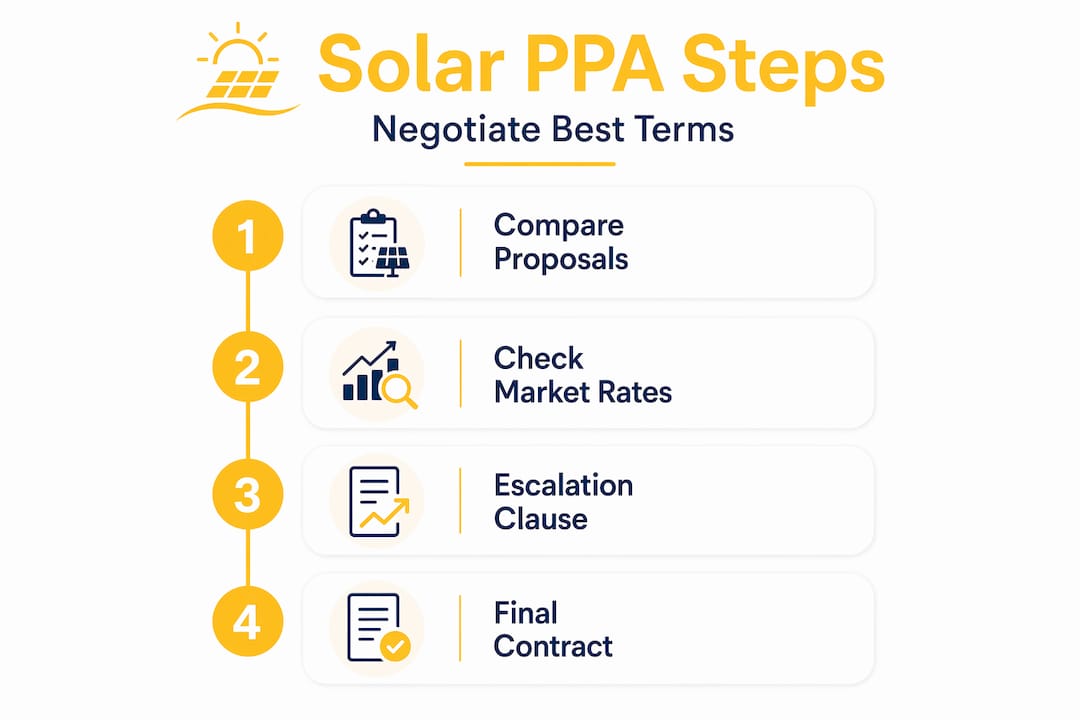
Step 1: Get at least three competing proposals. Never negotiate from a single quote. Request proposals from at least three installers and make sure each one includes the same system size, equipment tier, and escalation options. Variation in pricing will be significant, and having competing offers gives you direct leverage.
Step 2: Use market data to anchor your rate expectations. PPA prices fluctuate with market trends, and average North American prices increased by 4.7% in Q1 2026. That data point matters in negotiation. If you know market rates are rising, you can frame your request for a lower starting rate as time-sensitive for the developer too, since locking in a customer now at a competitive rate benefits both sides.
Step 3: Negotiate the escalation clause first, not the starting rate. Most homeowners fixate on the opening per-kWh rate. That's a mistake. A slightly higher starting rate with a 0% escalator will almost always outperform a lower starting rate with a 3% or 4% escalator over the full contract term. Model all costs with escalators to avoid surprises. Insist on seeing the full cost curve before agreeing to any rate structure.

Step 4: Request a performance guarantee. Ask the developer to include a guaranteed minimum annual production figure in kilowatt-hours. If the system underperforms, the developer should credit you for the shortfall. Not all developers offer this, but it's a legitimate and negotiable term.
Step 5: Clarify the buyout schedule in writing. Ask for a written buyout price schedule at each five-year interval. Some contracts include a fair market value buyout option, which sounds reasonable but can be difficult to enforce if the developer controls the appraisal process. Push for a fixed-price buyout schedule instead.
"Treat the PPA as a long-term pricing product. Model all costs with escalators to avoid surprises." This framing, from consumer guidance at Utilities For My Home, is exactly the mindset you need going into negotiation.
Red flags to watch for during negotiation:
- Refusal to provide a flat-rate proposal
- No written buyout schedule
- Vague transfer language such as "subject to developer approval"
- No performance guarantee or production estimate in writing
- Pressure to sign quickly without time to review
Use the option to compare solar PPA quotes to benchmark what you're being offered against current market rates. If a quote looks out of line, it probably is. And if you're unsure whether the terms you've negotiated are fair, get a second opinion from an independent reviewer before you sign.
Pro Tip: If market PPA rates are rising, as they were in early 2026, use that data point to justify locking in a flat-rate contract now. Frame it as mutual benefit: you get price certainty, and the developer locks in a long-term customer before rates climb further.
Before you sign: Hidden pitfalls and verifying your agreement
Even after a promising negotiation, don't sign until you run a final due-diligence check. These are make-or-break details too many homeowners miss.
The most frequently overlooked risk in a PPA is what happens when you sell your home. A PPA can complicate home sales due to transfer, buyout, or qualification clauses. Buyers must qualify to assume the PPA, and many won't. If the buyer doesn't qualify or doesn't want to assume the agreement, you may be forced to buy out the contract at a price that wipes out any savings you accumulated.
Developer reliability is a second major risk that homeowners rarely investigate. PPAs depend on developer reliability, and due diligence is essential to avoid project non-completion risk. Research the developer's track record, check for complaints with your state's contractor licensing board, and confirm they carry adequate insurance.
"A PPA can complicate home sales due to transfer, buyout, or qualification clauses. Ask about these upfront." This warning from real estate professionals reflects a recurring issue that surfaces only when homeowners try to sell, often years after signing.
Final pre-signing checklist:
- Confirm the transfer process in writing, including buyer qualification requirements and any transfer fees
- Verify the buyout price schedule is fixed, not "fair market value"
- Check the developer's license, insurance, and Better Business Bureau record
- Confirm the solar warranty transfer terms for equipment if you sell the home
- Verify that performance guarantees are legally binding and enforceable
- Ensure there is no automatic renewal clause that extends the contract without your explicit consent
- Confirm the process for dispute resolution, including whether arbitration is mandatory
If any of these items are unclear or missing from the contract, do not sign. Request written clarification. If the developer resists providing clear answers, that resistance itself is a red flag. Consider a professional agreement review before committing to any contract that contains ambiguous language.
What most homeowners get wrong about negotiating solar PPAs
The most common mistake in PPA negotiation is treating it like a utility bill comparison. Homeowners see a lower per-kWh rate than their current utility and assume the deal is good. It may not be.
The real analysis requires modeling the full 20-year cost curve, not just year-one savings. A PPA with a 3% annual escalator may save you money for the first eight to ten years, then begin costing more than your utility would have charged, especially if utility rates stabilize or fall. Locking into a PPA protects you from market swings, but you may end up paying more if utility rates fall. Always weigh contract terms against projected long-term electricity prices.
Developers benefit from this confusion. A complex contract with a favorable-sounding opening rate is easier to sell than a transparent 20-year cost model. Asking for that model, and insisting on it before signing, is the single most powerful thing you can do in any PPA negotiation.
Many homeowners also fail to demand a flat-rate option. They accept the escalator as a given because the salesperson presents it as standard. It isn't. Flat-rate PPAs exist and are available in most markets. The risks of overpaying with a PPA are real and quantifiable. Knowing what to ask for, and having the data to back it up, changes the negotiation entirely.
The uncomfortable truth is that a well-negotiated PPA can be a reasonable financial product. A poorly negotiated one can cost you thousands of dollars more than staying on the grid. The difference comes down entirely to preparation, comparison, and willingness to push back.
Get professional help to negotiate your solar PPA
Navigating PPA terms on your own is possible, but it's easy to miss details that have significant financial consequences over a 20-year contract.
SolarRepairToday.com offers independent solar proposal review services designed specifically for homeowners at this stage. Through the Before You Sign intake program, you can submit your proposed PPA, utility bills, and project details for a professional review covering pricing, escalation structure, equipment, system sizing, and contract red flags. If you're unsure whether the terms you've negotiated are fair, a solar second opinion from an independent expert can confirm your position or identify issues before you're locked in for two decades. The cost of a review is a fraction of what a poorly structured PPA can cost over its full term.
Frequently asked questions
What is the most important term to negotiate in a solar PPA?
The escalation clause is most crucial. Request a 0% escalator option to avoid compounding cost increases that can eliminate your savings over the contract term.
Can I get out of a solar PPA if I sell my home?
PPAs include specific transfer, buyout, or qualification provisions that must be reviewed before signing. Transfers and buyouts are often subject to provider approval and should be confirmed in writing before you commit.
What risks should I watch out for with PPAs?
Developer reliability and escalation clause structure are the two primary risks. Developer background and escalation structure can materially affect PPA value over the full contract period.
How do market prices impact my PPA negotiation leverage?
Rising market prices reduce your leverage on the starting rate but still leave room to negotiate escalator terms. Average North American solar PPA prices rose 4.7% in early 2026, making flat-rate contracts more valuable than ever.