
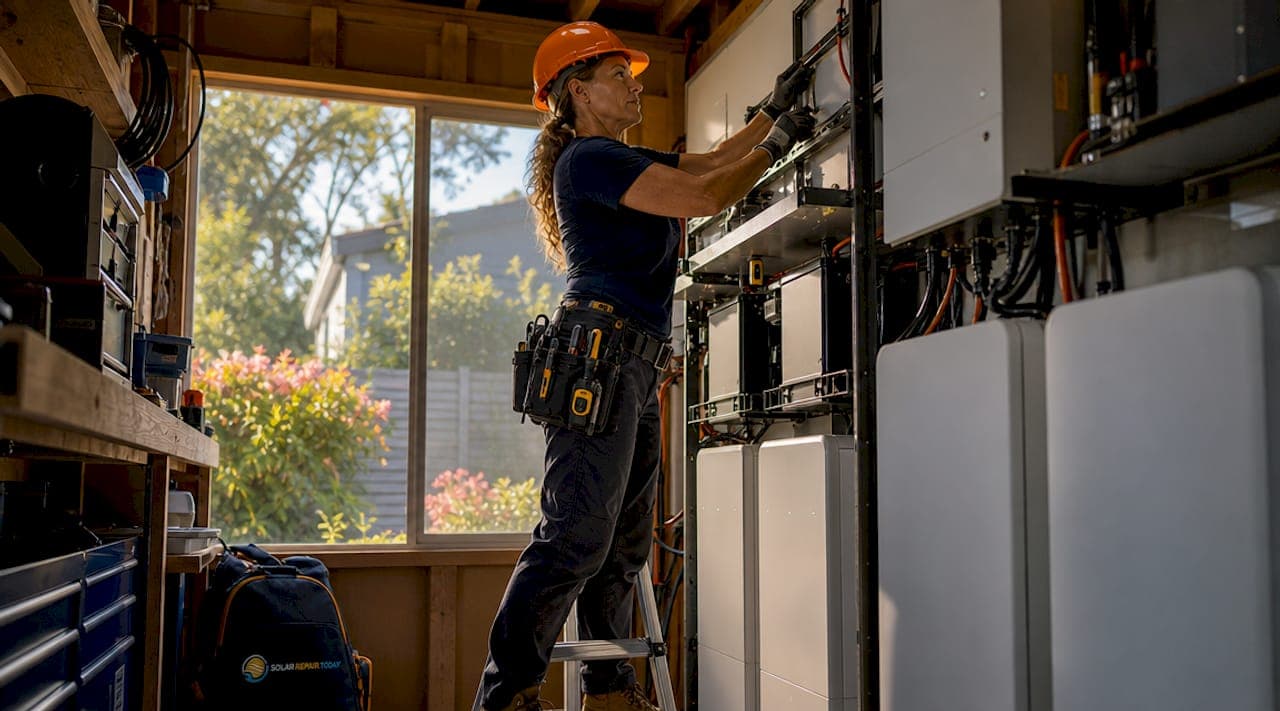
The price of a solar battery backup add-on for an existing residential solar system ranges from $12,000 to $18,000 installed in 2026, depending on system compatibility, battery size, and available incentives. The industry term for this process is a battery storage retrofit, and it carries a cost premium over integrating storage during initial solar installation. Retrofit costs run 10% to 15% higher than new-build battery integration because of the additional wiring, electrical work, and permitting required. The federal Residential Clean Energy Credit reduces that net cost by 30%, and state programs like California's SGIP can cut it further. Understanding what drives the price solar battery backup add-on projects carry is the first step toward budgeting accurately.
What does the price of a solar battery backup add-on include?
The final installed price of a battery storage retrofit is not just the battery unit itself. Hardware, labor, permitting, and potential electrical upgrades all combine to produce the number on your quote. Knowing each component prevents sticker shock after you sign.
Battery hardware is the largest single cost driver. Capacity is measured in kilowatt-hours (kWh), and the price per usable kWh for AC-coupled retrofits runs approximately $1,000 to $1,500. Popular residential units like the Tesla Powerwall 3, Enphase IQ Battery 5P, and Franklin Electric apower each carry different price points based on usable capacity and integrated features.
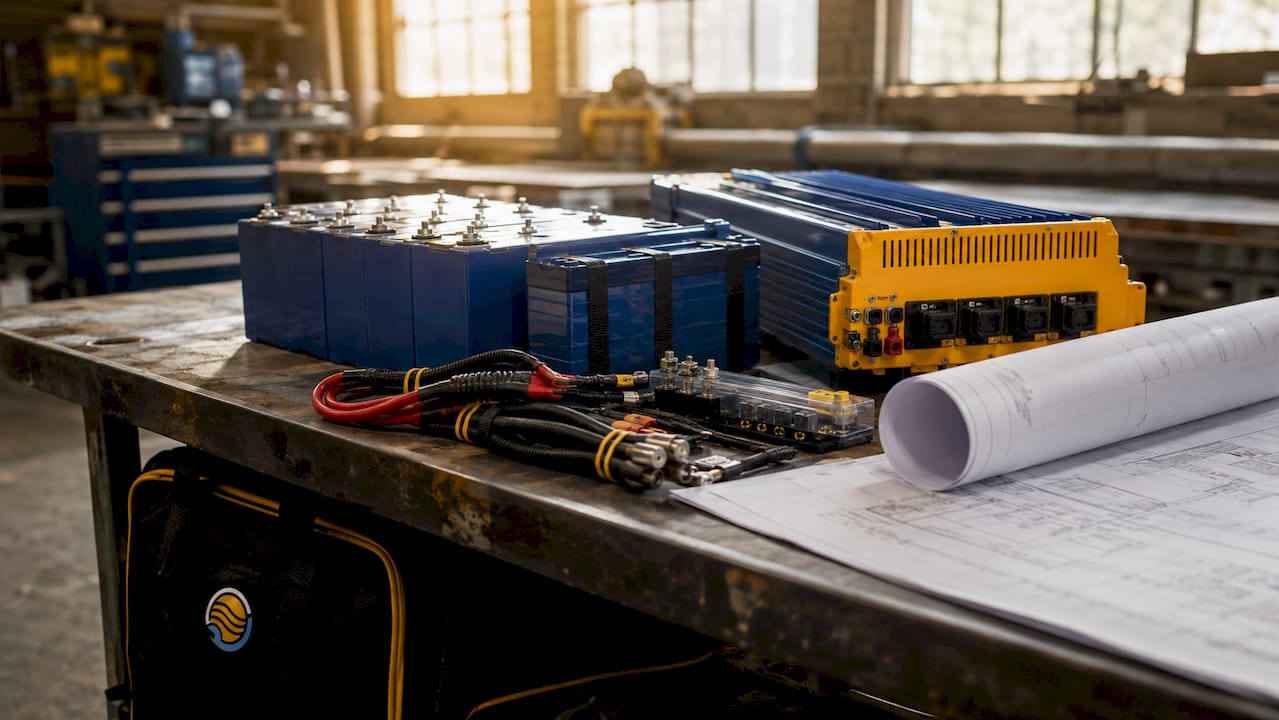
Installation labor and permitting add a meaningful layer to solar battery backup cost. Retrofit projects require a licensed electrician, a permit application, and often a utility interconnection amendment. Labor alone can range from $1,500 to $3,000 depending on your region and the complexity of the existing system.
Electrical panel and inverter upgrades are the most common surprise costs in a retrofit. If your main service panel is undersized or your existing solar inverter is incompatible with battery storage, those upgrades add $1,500 to $4,000 before the battery is even installed. A detailed battery quote should specify usable capacity, backup design, panel upgrade requirements, inverter type, and warranty terms as separate line items.
Key cost components to verify in any retrofit quote:
- Usable battery capacity in kWh (not just nameplate capacity)
- Battery inverter or gateway hardware
- Labor and permitting fees
- Main panel upgrade, if required
- Inverter replacement or compatibility work
- Utility interconnection amendment fees
- Warranty terms and monitoring equipment
Pro Tip: Ask your installer to separate hardware costs from labor and permitting in the quote. A bundled "all-in" price makes it impossible to compare bids accurately or identify where costs are inflated.
How do AC-coupled and DC-coupled systems affect retrofit cost?
The two main technical approaches to adding battery storage to an existing solar system are AC coupling and DC coupling. The choice between them has a direct impact on retrofit cost, installation complexity, and backup performance.
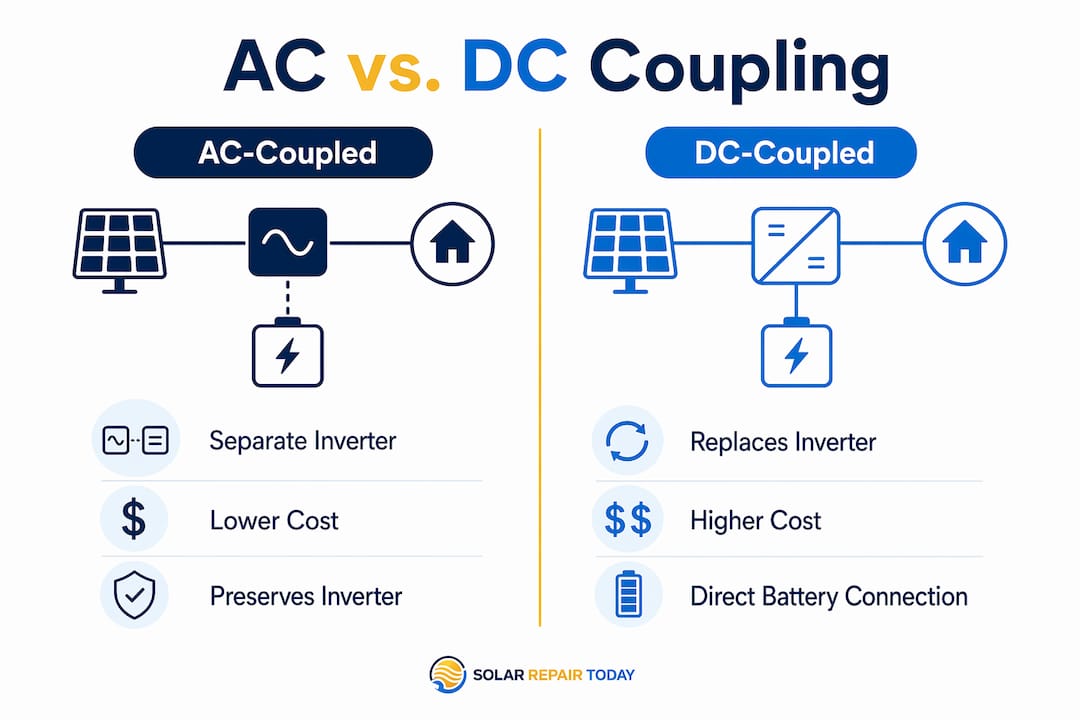
AC-coupled systems add a separate battery inverter that operates independently from your existing solar inverter. Your solar panels continue to feed your existing inverter, and the battery system charges from AC power on the home circuit. This approach preserves your existing inverter and avoids the cost and disruption of replacing it. Permitting is generally simpler because the solar portion of the system remains unchanged.
DC-coupled systems connect the battery directly to the solar array on the DC side, before the inverter. This requires either a hybrid inverter that handles both solar and battery, or a DC-coupled charge controller. For a retrofit, that typically means replacing your existing solar inverter entirely, rewiring DC circuits, and re-permitting the solar portion of the system. The result is a more integrated system with slightly higher round-trip efficiency, but the upfront cost is meaningfully higher.
| Factor | AC-coupled retrofit | DC-coupled retrofit |
|---|---|---|
| Existing inverter | Preserved | Usually replaced |
| Installation complexity | Lower | Higher |
| Permitting scope | Battery only | Solar + battery |
| Typical cost difference | Lower by ~$1,900 | Higher by ~$1,900 |
| Round-trip efficiency | Slightly lower | Slightly higher |
| Best for | Most existing systems | New installs or inverter replacements |
AC-coupled retrofits cost about $1,900 less than DC-coupled retrofits because the electrical work is less invasive. That gap widens further if your existing inverter is a high-quality unit with years of life remaining. For most homeowners adding battery backup to a functioning solar system, AC coupling is the practical and cost-effective path.
Pro Tip: If your solar inverter is already approaching end of life or showing faults, a DC-coupled hybrid inverter replacement may actually cost less over the full project than an AC-coupled add-on. Check your inverter's fault history before committing to either approach.
What incentives reduce the cost of adding solar battery backup in 2026?
Federal and state incentive programs significantly reduce the net solar battery backup cost for qualifying homeowners. The programs available in 2026 are the most favorable in U.S. history for residential battery storage, but eligibility requirements and budget caps apply.
Federal Residential Clean Energy Credit: The 30% federal tax credit applies to qualifying battery storage add-ons with a minimum capacity of 3 kWh. The credit covers equipment, installation labor, electrical upgrades directly related to the battery, and permitting costs. It runs through 2032. On an $15,000 retrofit, that credit returns $4,500 directly against your federal tax liability. The credit is non-refundable, meaning it reduces what you owe rather than generating a refund, so your tax liability must be sufficient to absorb it.
California SGIP: California's Self-Generation Incentive Program offers tiered rebates from $250 to over $1,000 per kWh for qualifying battery storage. Equity and resiliency tiers provide the highest rebates for income-qualified customers and those in high fire-risk zones. Budget caps and reservation slots limit availability, and the program operates on a first-come basis within each utility territory.
Key points on incentive eligibility:
- The federal credit applies to standalone battery purchases meeting the 3 kWh minimum, even without simultaneous solar installation
- State and utility rebates vary by location and change annually as budgets are allocated
- SGIP reservation slots close quickly when new budget cycles open
- Some utilities offer time-of-use rate incentives that improve payback independent of rebates
Careful verification of state and utility rebate programs is critical, as availability fluctuates and reservation slots close quickly. Assuming a rebate is available without confirming your reservation status is a common and costly mistake. Contact your utility directly or use a licensed installer familiar with your territory's current program status before finalizing your budget.
Battery storage retrofits make the strongest financial case when your utility's export compensation rate is low and your import electricity price is high. Payback periods without the federal credit run approximately 6 to 13 years in 2026, depending on your tariff structure and evening energy consumption. The 30% credit shortens that range considerably.
How to prepare for hidden costs when adding battery backup
The most common source of budget overruns in a battery storage retrofit is not the battery itself. It is the costs that appear after the initial quote is accepted. Preparing for these in advance keeps your project on schedule and on budget.
Follow this sequence before signing any battery backup contract:
- Request an itemized quote. Every cost category should appear as a separate line item. Hardware, labor, permitting, panel upgrades, and inverter work must each be listed individually. A quote that bundles everything into one number is a red flag.
- Clarify backup scope upfront. Backup systems are typically designed for critical loads unless you explicitly pay for whole-home backup. Critical loads coverage protects your refrigerator, lighting, and a few outlets. Whole-home backup requires a larger battery bank and a transfer switch, adding cost. Confirm which design your quote covers before signing.
- Assess your main service panel. A 100-amp panel may need upgrading to 200 amps to support battery storage, particularly for whole-home backup designs. This upgrade can cost $1,500 to $3,000 and is frequently omitted from initial quotes.
- Confirm permitting scope. Some jurisdictions require a new interconnection agreement with the utility when battery storage is added. That process can add weeks to the timeline and fees to the budget.
- Verify warranty terms. Battery warranties typically cover a specified number of cycles or years, with a guaranteed end-of-warranty capacity. Confirm the warranted usable capacity at end of term, not just the initial nameplate figure.
Pro Tip: Size your battery based on your actual evening and overnight energy consumption, not your solar array's total output. Sizing to actual demand maximizes cost-effectiveness and avoids paying for storage capacity you will never use.
Key takeaways
Adding battery storage to an existing solar system costs $12,000 to $18,000 installed in 2026, with AC-coupled retrofits offering the most cost-effective path and the 30% federal tax credit providing the single largest reduction in net cost.
| Point | Details |
|---|---|
| Baseline retrofit cost | Installed price ranges from $12,000 to $18,000, running 10%–15% above new-build integration. |
| AC coupling advantage | AC-coupled retrofits cost approximately $1,900 less than DC-coupled and preserve your existing inverter. |
| Federal tax credit | The 30% Residential Clean Energy Credit applies through 2032 and covers equipment, labor, and permitting. |
| Hidden cost risk | Panel upgrades, backup scope, and permitting fees are frequently omitted from initial quotes. |
| Sizing strategy | Match battery capacity to evening and overnight consumption, not total solar array output. |
What I've learned about budgeting for battery storage retrofits
Most homeowners I speak with come in anchored to a number they saw in an ad or a neighbor's quote. That number is almost always for a new solar-plus-storage system, not a retrofit. The retrofit premium is real, and it catches people off guard when they get their first actual proposal.
The single most useful shift in thinking is this: treat the inverter situation as the first decision, not the battery brand. If your existing inverter is a Enphase IQ7 or a SolarEdge HD-Wave with five or more years of life left, an AC-coupled system like the Enphase IQ Battery or a Franklin Electric unit is the right call. You preserve the inverter, simplify permitting, and keep costs down. If the inverter is aging or already faulting, the math changes. A hybrid inverter replacement that enables DC coupling may cost less over the full project than stacking an AC-coupled battery on top of a failing inverter you will replace in two years anyway.
The second thing I consistently see underestimated is backup scope. Homeowners assume "battery backup" means the whole house stays on during an outage. Most standard installs cover critical loads only. That distinction is worth thousands of dollars in equipment and wiring. Get it in writing before you sign anything.
Battery prices are declining year over year. The 30% federal credit runs through 2032. If your current system is functioning well and your evening consumption is modest, there is no urgency to rush. A well-timed, well-scoped retrofit will outperform a rushed one every time.
— David
Get an independent review before you commit
Before you sign a battery backup contract, submit your proposal to Solarrepairtoday for an independent review. The "Before You Sign" intake program covers pricing, equipment compatibility, backup scope, financing terms, and potential red flags in your quote.

Solarrepairtoday's battery proposal review service examines every line item in your quote, confirms whether the backup design matches what you were told, and flags any missing costs before you commit. If financing is part of your plan, the solar contract financing review evaluates loan terms, interest rates, and total cost of ownership so you know exactly what you are agreeing to. Homeowners who use an independent review before signing consistently avoid the most expensive retrofit surprises.
FAQ
How much does it cost to add battery backup to existing solar?
Adding battery backup to an existing solar system costs $12,000 to $18,000 installed in 2026, or roughly $1,000 to $1,500 per usable kWh for AC-coupled retrofits. The federal 30% tax credit reduces that net cost significantly for qualifying installations.
What is the difference between AC-coupled and DC-coupled battery retrofits?
AC-coupled systems add a separate battery inverter without replacing your existing solar inverter, making them simpler and less expensive for most retrofits. DC-coupled systems connect the battery directly to the solar array and typically require inverter replacement, adding cost and permitting complexity.
Does the federal tax credit apply to battery-only add-ons?
Yes. The 30% Residential Clean Energy Credit applies to standalone battery storage purchases with a minimum capacity of 3 kWh, including installation and related electrical work, through 2032. The battery does not need to be installed simultaneously with solar panels to qualify.
What hidden costs should I watch for in a battery backup quote?
The most common omissions are main service panel upgrades, utility interconnection amendment fees, and inverter compatibility work. Backup scope is also frequently misrepresented. Confirm whether your quote covers critical loads only or whole-home backup before signing.
How long does it take to pay back a solar battery retrofit?
Without the federal tax credit, payback periods run approximately 6 to 13 years depending on your utility's import and export rates and your evening energy consumption. The 30% credit and applicable state rebates like California's SGIP can shorten that range meaningfully.